
Pharmaceutical Cold Chain Couriers GDP Audit Checklist: Specialty vs Integrator QTA, Customs Cold Rooms, and Excursion SLAs
Audit pharmaceutical couriers and temperature-controlled shipping companies across EU GDP QTA clauses, customs cold rooms, ULD charging, and excursion SLAs.

Qualifying pharmaceutical couriers requires auditing physical airport and depot infrastructure rather than accepting a carrier brochure at face value. A passive phase-change shipper qualified for 96 hours in an environmental chamber will still suffer a temperature excursion, batch rejection, and product loss if a courier leaves it on a +55°C airport tarmac for two hours or holds it inside an unconditioned customs cage over a three-day weekend. When pharmaceutical quality and procurement teams evaluate temperature-controlled shipping companies, they must verify three physical gates before tendering the first shipment: how the carrier shields cargo on airside aprons, whether customs inspections happen inside temperature-mapped bonded cold rooms, and which transit depots can physically plug in active ULDs or replenish dry ice and liquid nitrogen.
This guide establishes a Good Distribution Practice (GDP) audit framework and a Quality Technical Agreement (QTA) clause matrix for biopharma sponsors, clinical supply managers, and logistics buyers. It connects carrier qualification to the wider Procurement & Evidence section, the cold chain packaging supplier evaluation guide, and the shipping lane qualification evidence plan.
Specialty couriers vs commercial healthcare integrators vs regional GDP fleets
Not all pharmaceutical couriers operate the same network topology. Marketing Authorization Holders (MAHs) and clinical trial sponsors divide temperature-controlled shipping companies into three structural tiers based on routing architecture, physical replenishment capability, and custody handoffs:
- Tier 1: White-Glove Specialty Biopharma Couriers (exemplified by World Courier, Marken, QuickSTAT, and Cryoport Systems) operate point-to-point bespoke routing rather than fixed conveyor hubs. Shipments move via Next-Flight-Out (NFO) commercial belly cargo or dedicated vehicles through a global network of company-owned, GxP-compliant depots. Trained technicians at origin, transit, and destination depots can open outer cartons under controlled SOPs to top up solid carbon dioxide (dry ice), swap pre-conditioned phase-change material (PCM) coolants, recharge vapor-phase liquid nitrogen (LN2) dewars, and pre-clear customs before aircraft wheels-up.
- Tier 2: Commercial Healthcare Integrator Premier Tiers (such as UPS Premier Silver/Gold/Platinum, DHL Medical Express (WMX) and Life Sciences Air GxP, and FedEx Priority Alert Plus / Custom Critical) overlay active RFID, Bluetooth Low Energy (BLE), GPS, and cellular mesh telemetry onto a global hub-and-spoke sortation network (Memphis, Louisville, Leipzig, Cincinnati). Sensor flags route healthcare packages down priority sortation chutes and alert 24/7 hub rescue desks that can move delayed parcels into a +2°C to +8°C vault or re-ice them at major gateway hubs, though spoke stations rarely stock conditioned PCM or LN2. Standard non-intervened express parcels are covered separately in our parcel carrier cold shipping checks.
- Tier 3: Regional GDP Refrigerated LTL/FTL Fleets operate dedicated Full-Truckload (FTL) or consolidated Less-Than-Truckload (LTL) temperature-controlled box vans and 53 ft highway reefer trailers (+2°C to +8°C, +15°C to +25°C, or -20°C) with dual-evaporator redundancy, satellite door-switch telematics, and three-phase (400 V / 480 V AC) shore power at GDP cross-docks. For container and trailer aerodynamics, see reefer container temperature and T-floor airflow loading rules.
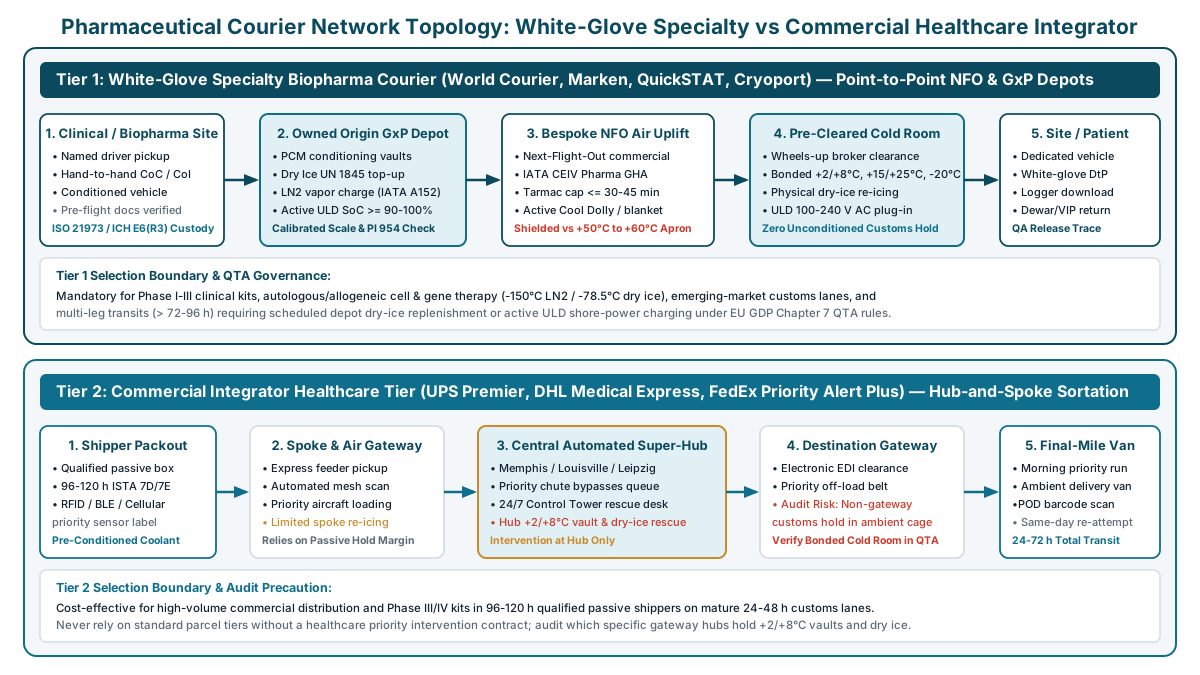
Table: scroll horizontally if needed to see every column.
| Evaluation dimension | Tier 1: White-glove specialty couriers (e.g., World Courier, Marken, QuickSTAT, Cryoport) | Tier 2: Commercial integrator healthcare tiers (e.g., UPS Premier, DHL Medical Express, FedEx Priority Alert Plus) | Tier 3: Regional GDP refrigerated LTL/FTL carriers | Sponsor selection rule |
|---|---|---|---|---|
| Core network topology & routing | Point-to-point Next-Flight-Out (NFO) commercial airlines, charters, and dedicated GxP depot vehicles | Automated hub-and-spoke sortation hubs with RFID/BLE/cellular priority chutes and dedicated rescue desks | Over-the-road (OTR) temperature-mapped box trucks and 53 ft highway reefer trailers | Use Tier 1 when lane duration or customs uncertainty exceeds passive shipper hold time |
| In-transit refrigerant & power replenishment | Full GxP depot intervention: dry-ice top-up (UN 1845), pre-conditioned PCM swaps, LN2 vapor charging (IATA A152), and ULD AC plug-in | Intervention restricted to major air hubs and Life Sciences Competence Centers (+2°C to +8°C vault storage and hub dry-ice top-up) | Continuous diesel/electric TRU cooling with 400 V / 480 V AC shore power at cross-docks; no parcel dry-ice or LN2 top-up | Audit the exact station list before relying on Tier 2 hub re-icing on multi-leg international lanes |
| Customs brokerage & inspection handling | Dedicated life-sciences brokers execute “wheels-up” pre-clearance and escort held cargo into bonded cold rooms | High-speed electronic customs clearance at integrator gateways; non-gateway holds require explicit priority cold-room routing | Cross-border road freight stays inside the running refrigerated trailer during border clearance | Mandate 24-hour pre-pickup document review and named bonded cold rooms at every port of entry |
| Chain of Custody (CoC) & Chain of Identity (CoI) | Hand-to-hand wet or electronic signature at every physical transfer node (complies with ISO 21973 for cell and gene therapy) | Automated conveyor barcode/RFID/cellular scans with manual signature at pickup and final delivery | High-security bolt seal (ISO 17712) with continuous GPS/telematics and dock Bill of Lading sign-off | Require Tier 1 named custodian handoffs for autologous cell therapies and blinded clinical kits |
| Primary biopharma use cases | Phase I–III clinical trial kits, cell & gene therapies (-150°C LN2 / -78.5°C dry ice), emerging-market lanes, direct-to-patient (DtP) | Commercial biologics and Phase III/IV supplies in 96–120 h passive shippers on mature 24–48 h customs lanes | Commercial palletized distribution between manufacturing plants, 3PL hubs, and hospital wholesalers | Match carrier tier to total landed risk in the cold chain packout cost worksheet |
Structuring the Quality Technical Agreement (QTA) under EU GDP and USP <1079>
A commercial Service Level Agreement (SLA) negotiated by purchasing covers freight rates, transit time KPIs, and financial liability caps, but it does not satisfy pharmaceutical regulatory inspections. Under WHO Technical Report Series No. 961, Annex 9, Technical Supplement 16 and WHO TRS 1025, Annex 7, the Contract Giver (sponsor or MAH) must execute a legally binding Quality Technical Agreement (QTA) with the Contract Acceptor (courier) before shipping regulated medicinal products.
Subcontracting prohibition without prior written approval (EU GDP Chapter 7)
Under the European Commission Guidelines on Good Distribution Practice of Medicinal Products for Human Use (2013/C 343/01), Chapter 7 (Outsourced Activities, Clauses 7.1–7.3), the Contract Giver must audit the courier’s premises, equipment, and Quality Management System (QMS) before operations begin. Crucially, Clause 7.2 stipulates that the Contract Acceptor must not pass to a third party any of the work entrusted to it under the contract without the Contract Giver’s prior evaluation and written approval of the arrangements.
In international cold-chain logistics, unapproved subcontracting is the single most common root cause of excursions: a global courier accepts a clinical shipment to an emerging market or secondary city and quietly hands the final-mile leg to an unvetted local cartage agent operating an unrefrigerated van. The QTA must include an Approved Subcontractor and Ground Handling Agent (GHA) Register per shipping lane, backed by a mandatory 30-day advance change-control notice before any local agent, customs broker, or airline GHA is substituted.
Why couriers must never self-evaluate Mean Kinetic Temperature (USP <1079.2>)
Under USP <1079> (Risks and Mitigation Strategies for the Storage and Transportation of Finished Drug Products) and USP <1079.2> (Mean Kinetic Temperature in the Evaluation of Temperature Excursions During Storage and Transportation of Drug Products), Mean Kinetic Temperature (MKT) is a non-linear Arrhenius-weighted calculation reserved strictly for evaluating short, transient thermal spikes by the product owner’s Quality Unit:
- For Controlled Room Temperature (
CRT,+20°C to +25°C) products,MKTmust remain<= +25.0°C, transient excursions are bounded between+15.0°C and +40.0°C, and cumulative spike duration must not exceed 24 hours. - For Controlled Cold (
+2.0°C to +8.0°C) refrigerated biologics and vaccines, USP<1079.2>restrictsMKTstrictly:MKTmay be calculated for a brief excursion only if the temperature never exceeds+15.0°Cand never drops below+0.0°C. Any sub-zero freeze event (< 0.0°C) causes irreversible protein denaturation or adjuvant agglomeration thatMKTmath masks completely.
The QTA must explicitly prohibit courier personnel from calculating MKT to classify a shipment as “acceptable” or clearing an excursion on the airwaybill. Courier depots must place the affected consignment into quarantine at its labeled storage temperature and transmit the raw, unaltered temperature log file to the sponsor’s Quality Unit within 24 hours.
Table: scroll horizontally if needed to see every column.
| Regulatory standard & section | Core GxP mandate for outsourced transport | Mandatory QTA clause & audit evidence artifact |
|---|---|---|
| EU GDP (2013/C 343/01), Chapter 7 (Clauses 7.1–7.3) | Written contract defining duties; pre-contract competency audit; zero third-party subcontracting without prior audit and written approval | Approved Subcontractor & GHA Register naming every regional delivery agent and airline GHA per lane, plus right-to-audit and 30-day change control |
| EU GDP (2013/C 343/01), Chapter 9 (Clauses 9.1–9.4) | Risk-assessed transport routes; calibrated temperature monitoring; equipment maintenance; minimum dwell duration in temporary transit storage | Lane Risk Assessment (per WHO Supplement 14) and hard transit-hub dwell cap (<= 4 to 6 hours before mandatory transfer into a mapped cold room) |
| WHO TRS 961 Annex 9, Supplement 16 & WHO TRS 1025 Annex 7 | Separation of commercial SLA from GxP QTA; 3-season thermal mapping of transit hubs/vehicles; emergency cooling and dry-ice replenishment SOPs | Signed Bifurcated QTA + SLA, summer/winter OQ/PQ thermal mapping reports for transit depots, and annual mock recovery drill logs |
USP <1079> & USP <1079.2> (Mean Kinetic Temperature) |
Restricts MKT excursion evaluation (CRT +15°C to +40°C <= 24 h; Chilled +2°C to +8°C strictly 0.0°C to +15.0°C max); zero-tolerance freeze prohibition |
Unilateral Disposition Prohibition Clause barring courier staff from applying MKT to clear deviations; raw telemetry sent to Sponsor QA within <= 24 h |
| IATA CEIV Pharma & TCR Chapter 17 | Standardized airside pharma handling, Time and Temperature Sensitive labeling, active/passive ULD checklists, and trained GHA personnel | Current IATA CEIV Pharma Certificates for origin, transit, and destination airport stations and Ground Handling Agents |
Gate 1: Auditing airport tarmac exposure windows and customs-bonded cold rooms
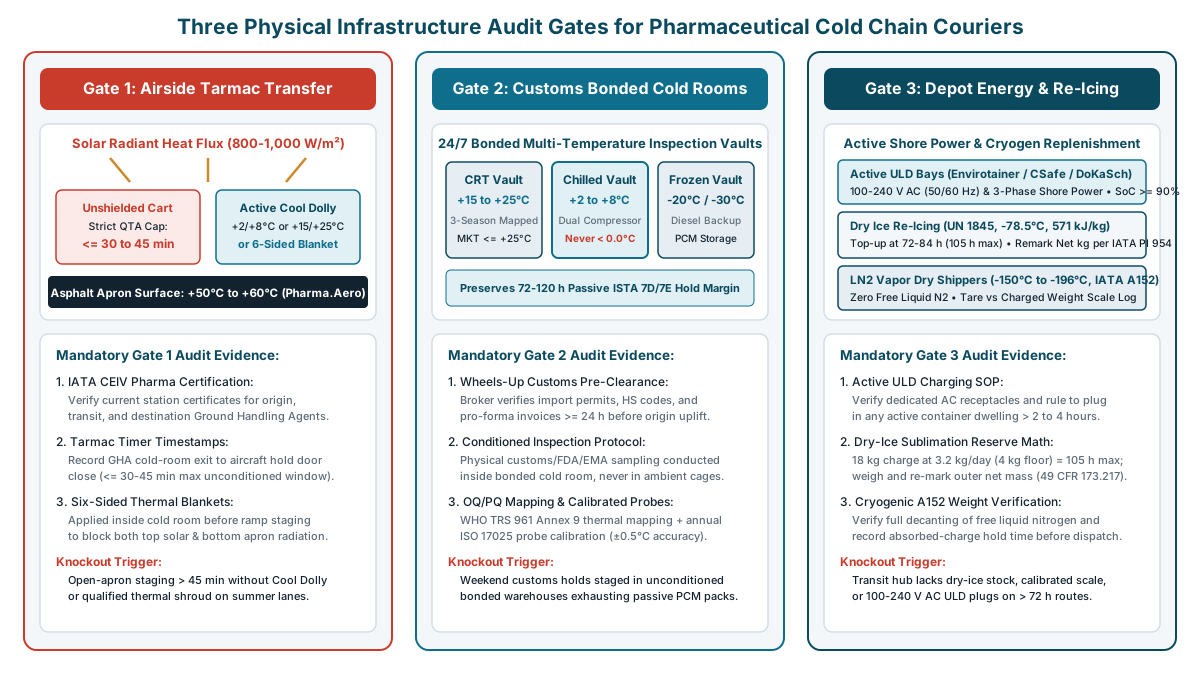
In international airfreight, the highest thermal heat flux occurs not inside the aircraft cargo hold, but on the airport apron and in destination customs warehouses. When building a route profile under our shipping lane qualification plan and WHO Technical Supplement 14, auditors must verify two airside infrastructure controls: tarmac transfer timers and customs-bonded cold rooms.
1. Airside tarmac radiant heat and the 30-to-45-minute exposure cap
According to Pharma.Aero’s Airside Transportation Survey White Paper, dark asphalt and concrete airport aprons absorb direct solar radiation (800 to 1,000 W/m²), driving tarmac surface temperatures to +50°C to +60°C (+122°F to +140°F) when shade air is +32°C to +38°C. A passive parcel or pallet staged on an open baggage cart absorbs radiant heat from both overhead sun and the superheated asphalt underneath.
To prevent rapid phase-change melt-out or active ULD battery drain, the QTA must enforce:
- A hard maximum unconditioned tarmac exposure window of
<= 30 to 45 minutesmeasured by scanned timestamps from Ground Handling Agent (GHA) cold-room exit to aircraft cargo door closure at uplift, and from aircraft door opening to GHA cold-room entry at arrival. - Mandatory deployment of active refrigerated apron “Cool Dollies” (mobile diesel/electric temperature-controlled airside transfer chambers set to
+2°C to +8°Cor+15°C to +25°C) or six-sided reflective/PCM thermal blankets (installed inside the cold room before exiting onto the ramp) whenever tarmac staging or aircraft tail-to-tail transfers can exceed 30 minutes.
2. Customs-bonded multi-temperature inspection cold rooms
Passive vacuum-insulated panel (VIP) and PCM shippers qualified under ISTA 7D or 7E typically provide 72, 96, or 120 hours of thermal hold time (see reviewing thermal packaging qualification reports). If destination customs authorities flag a consignment for documentary review or physical agricultural/FDA/EMA sampling over a 48- to 72-hour weekend inside an unconditioned +30°C bonded warehouse, the passive PCM reserve is exhausted before the package ever clears the airport.
Auditors must verify that the courier’s designated port of entry maintains 24/7 access to customs-bonded, three-season temperature-mapped cold rooms across all required storage bands (+15°C to +25°C CRT, +2°C to +8°C Chilled, and -20°C Frozen), and that customs officers perform physical package inspections inside or immediately adjacent to the conditioned chamber followed by GxP re-sealing.
Table: scroll horizontally if needed to see every column.
| Shipment thermal regime | Airside tarmac transfer limit & shield requirement | Required customs-bonded cold room setpoint | Customs inspection & hold protocol |
|---|---|---|---|
Controlled Room Temperature (+15°C to +25°C CRT) |
<= 45 min unshielded apron cap; six-sided thermal blanket or +15°C to +25°C Cool Dolly in summer (> +30°C) or sub-zero winter |
Mapped +15°C to +25°C bonded chamber with continuous monitoring (±0.5°C) |
Wheels-up pre-clearance >= 24 h prior to origin uplift; transfer to CRT bonded vault if hold exceeds 4 hours |
Refrigerated / Chilled (+2°C to +8°C) |
<= 30 min unshielded apron cap; mandatory +2°C to +8°C active Cool Dolly at high-ambient hubs |
Mapped +2°C to +8°C bonded vault with dual refrigeration and never-freeze (> +0.0°C) cutout |
Physical customs opening permitted only inside conditioned inspection room with trained courier technician present to close VIP lid |
Frozen (-15°C to -25°C) & Ultra-Cold Dry Ice (-60°C to -80°C) |
<= 30 to 45 min apron transfer; shield from direct solar radiation to limit CO2 sublimation spike |
-20°C to -30°C bonded freezer plus access to UN 1845 dry-ice replenishment bunker |
Verify remaining dry-ice mass on calibrated scale if customs hold exceeds 24 hours; top up per IATA PI 954 |
Cryogenic Vapor LN2 (-150°C to -196°C) |
Upright mechanical handling only; zero horizontal tipping on belt loaders (< 30° tilt threshold) |
Ventilated bonded security cage with O2-depletion alarm and bulk LN2 recharge backup | X-ray clearance exemption or supervised vertical inspection; never invert or lay dewar flat during security screening |
Gate 2: Active ULD shore-power bays, dry-ice re-icing math, and LN2 dry-shipper stations
When a shipment’s door-to-door transit plus customs buffer approaches the autonomy limit of its container—a decision framed in our active versus passive packaging comparison and pharmaceutical shipping packout guide—the courier’s transit depots must replenish energy in transit. A GDP audit must verify the physical engineering specifications of those replenishment bays.
1. Active ULD shore-power charging infrastructure (Envirotainer, CSafe, DoKaSch)
Active air cargo Unit Load Devices (ULDs)—such as the Envirotainer RAP e2, RKN e1, and Releye series, CSafe RKN and RAP, and DoKaSch Opticooler RAP and RKN—maintain +2°C to +8°C or +15°C to +25°C using mechanical vapor-compression cooling and electric heating. In flight, these containers run on internal rechargeable battery banks (typically 30 to 100+ hours of autonomy depending on container model and ambient delta); on the ground, they rely on facility AC shore power.
When auditing a courier’s airport gateway or GHA station for active ULD lanes, verify:
- Dedicated AC Shore-Power Receptacles: Sheltered indoor charging bays equipped with standard single-phase
100–240 V AC(50/60 Hz,10–16 A) circuits for Envirotainer and CSafe e-technology units, plus three-phase400 V / 480 V ACindustrial receptacles where required by high-rate Opticooler chargers or intermodal refrigerated units. - Dispatch & Transit State-of-Charge (
SoC) Rules: A written SOP requiring batterySoC >= 90% to 100%before origin dispatch and mandatory connection to AC shore power whenever ground dwell at a transit hub or customs warehouse exceeds2 to 4 hours.
2. Worked dry-ice sublimation and depot re-icing calculation (49 CFR § 173.217 / IATA PI 954)
Solid carbon dioxide (CO2(s), UN 1845) sublimates directly from solid to gas at -78.5°C (-109.3°F) with a latent heat of sublimation of 571 kJ/kg (245.5 BTU/lb). Depending on vacuum-insulated panel (VIP) or polyurethane foam geometry and ambient exposure, a clinical dry-ice shipper loses 2.0 to 5.0 kg of dry ice per 24 hours.
To set the contractual re-icing trigger in a QTA, calculate the safe operating window using stated illustrative inputs:
t_max = (M_initial − M_floor) ÷ R_sub
Assume a deep-frozen clinical trial shipper is packed with an initial net dry-ice charge M_initial = 18.0 kg, exhibits an average lane sublimation rate R_sub = 3.2 kg/day, and requires a minimum residual dry-ice mass M_floor = 4.0 kg around the payload chamber to prevent internal temperatures from rising above -60.0°C:
- Consumable dry-ice mass before thermal rise:
18.0 kg − 4.0 kg = 14.0 kg. - Maximum time to reach the
4.0 kgsafety floor:t_max = 14.0 kg ÷ 3.2 kg/day = 4.375 days(105.0 hours). - Contractual QTA Re-Icing Trigger: Applying a 20% to 30% safety margin against flight delays, the courier’s transit depot must execute a scheduled physical dry-ice top-up at
72 to 84 hourselapsed transit time (when roughly5.4 to 8.4 kgof dry ice remains).
Under 49 CFR § 173.217 and IATA Dangerous Goods Regulations Packing Instruction 954 (PI 954)—detailed in our dry ice shipping regulations guide for IATA PI 954 and DOT—every courier depot performing in-transit re-icing must:
- Open the outer vented carton under a GxP work instruction without disturbing the inner primary payload container or temperature probe.
- Fill the refrigerant bunker with food/pharma-grade dry-ice pellets or slices, weigh the restored package on a calibrated platform scale, and verify that total net dry ice does not exceed the
200 kgper-package air transport limit (or aircraft holdCO2ventilation limits). - Strike through or replace the old net-mass entry and re-mark the updated net dry-ice mass (in
kg) on the outer package alongside the UN 1845 Class 9 label, logging the re-icing timestamp and operator signature in the shipment record.
3. Cryogenic vapor-phase LN2 dry-shipper charging (IATA Special Provision A152)
Autologous and allogeneic cell and gene therapies (-150°C to -196°C) ship in vapor-phase liquid nitrogen (LN2) dry shippers (such as MVE Chart Biomedical or Cryoport Express dewars) lined with a hydrophobic porous calcium-silicate or fibrous absorbent core. Under IATA Dangerous Goods Regulations Special Provision A152, an LN2 dry shipper is classified as non-restricted (exempt from Class 2.2 UN 1977 refrigerated liquid dangerous-goods bans on passenger and cargo aircraft) only if all free liquid nitrogen has been completely poured off after saturating the absorbent matrix, so that no free liquid can escape regardless of package orientation.
During a depot audit of specialty pharmaceutical couriers, verify that the facility maintains bulk LN2 storage tanks, oxygen-depletion room alarms (< 19.5% O2), cryogenic PPE, and calibrated scales to record the exact Saturated Charged Weight versus Empty Tare Weight before dispatch—confirming that absorbed LN2 mass meets the required 10- to 14-day static hold time (typical evaporation rate 0.4 to 0.8 kg/day) and that shock/tilt telemetry monitors against dewar tipping (> 30° from vertical).
Table: scroll horizontally if needed to see every column.
| Replenishment system & thermal band | Governing regulatory & technical standard | Depot equipment to verify during physical audit | Mandatory QTA operational & documentation rule |
|---|---|---|---|
Active Air Cargo ULDs (+2°C to +8°C / +15°C to +25°C) |
Envirotainer / CSafe / DoKaSch Opticooler manuals; IATA TCR Ch. 17 | Sheltered 100–240 V AC (50/60 Hz) single-phase and 400 V / 480 V 3-phase shore-power bays; backup generator |
Dispatch battery SoC >= 90%; mandatory AC plug-in whenever hub or customs dwell exceeds 2 to 4 hours |
Passive Phase-Change Material (PCM) Shippers (+2°C to +8°C / +15°C to +25°C / -20°C) |
WHO TRS 961 Annex 9 (Supplements 13 & 16); ISTA 7D / 7E | Dedicated temperature-mapped conditioning freezers/coolers (±1.0°C uniformity) holding model-specific PCM bricks |
Maintain 24-hour minimum PCM conditioning logs; prohibit swapping unconditioned or mismatched phase-point bricks |
Dry Ice (CO2(s), UN 1845, -78.5°C, 571 kJ/kg latent heat) |
49 CFR § 173.217 & IATA DGR Packing Instruction 954 (<= 200 kg/pkg) |
Pelletizer or insulated dry-ice chests, CO2 ventilation monitors (5,000 ppm TWA limit), and calibrated platform scales |
Trigger re-icing at 72–84 h (on 105 h max window); weigh added dry ice and update outer net-mass kg marking per PI 954 |
Vapor-Phase LN2 Dry Shippers (-150°C to -196°C) |
IATA DGR Special Provision A152 & ISO 21973 (Cell & Gene Therapy transport) | Bulk LN2 manifold, decanting funnel, O2-depletion alarm, calibrated scale, and vertical tilt/shock beacon |
Pour off 100% of free liquid N2; verify Charged Weight − Empty Tare Weight >= Min Required LN2 Mass before tender |
Gate 3: 24/7 control tower telemetry and excursion intervention SLAs
Real-time GPS and cellular visibility has zero protective value if no technician acts when an alarm fires at 02:00 UTC on a Sunday. When auditing temperature-controlled shipping companies, separate passive “track-and-trace portals” from a contracted 24/7 Control Tower with physical depot intervention SLAs.
Telemetry calibration and flight-mode standards
In-transit temperature probes—whether provided by the sponsor or integrated into the courier’s smart package service (as detailed in our guide to selecting USB versus real-time cellular temperature data loggers)—must meet three technical baselines under WHO TRS 961 Annex 9 and EU GDP Chapter 9:
- NIST-Traceable / ISO/IEC 17025 3-Point Calibration: Every probe must carry an active calibration certificate spanning the operating range (for example,
-20°C, +5°C, +25°Cfor chilled/frozen or-80°C / -196°Cfor ultra-cold/cryo) with verified accuracy of<= ±0.5°Cacross-30°C to +50°C(<= ±1.0°Cbelow-30°C) and a 5- to 15-minute logging interval. - RTCA DO-160G Flight-Mode Radio Suppression: Real-time cellular/BLE loggers flown on commercial aircraft must sit on the operator’s approved electronic device list and use dual-independent triggers (such as barometric pressure plus accelerometer or optical sensors) to suppress RF transmission automatically during takeoff and flight.
- 21 CFR Part 11 / EU Annex 11 Cloud Audit Trail: Every alert acknowledgment, threshold setting, and custody comment must be recorded in an immutable, time-synced electronic audit trail.
The four-stage contractual QTA intervention clock
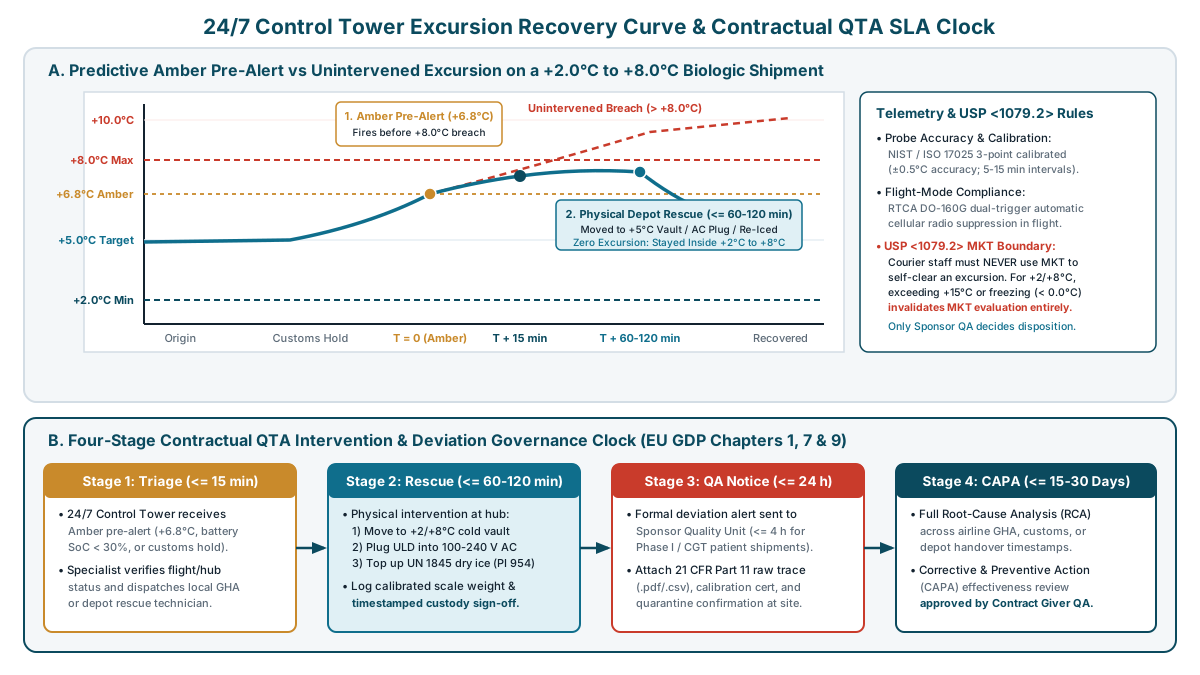
To prevent excursions rather than merely reporting them after product loss, structure the QTA around two-tier telemetry thresholds—an Amber Pre-Alert (set inside the specification band, such as +6.8°C or +2.8°C on a +2.0°C to +8.0°C biologic, ULD battery SoC < 30%, or customs dwell > 12 hours) and a Red Excursion Alarm at the statutory limit (< +2.0°C or > +8.0°C)—governed by four binding SLA clocks:
- Stage 1 — Control Tower Human Triage (
<= 15 minutes): Within 15 minutes of an Amber pre-alert or flight/customs delay trigger, a named Control Tower specialist must review the live telemetry trace, verify aircraft or hub custody status, and dispatch the local station or GHA intervention technician. - Stage 2 — Physical Depot or Hub Intervention (
<= 60 to 120 minutes): Within 60 to 120 minutes of triage on the ground, local staff must execute physical recovery—moving the shipper into a mapped+2°C to +8°Ccold room, plugging an active ULD into100–240 V ACshore power, or performing an IATA PI 954 dry-ice top-up—and upload a timestamped scale or plug-in verification record. - Stage 3 — Sponsor Quality Deviation Notification (
<= 24 hours/<= 4 hoursfor Phase I or CGT): If internal payload temperature crosses the Red statutory boundary, the courier must notify the sponsor’s Quality Unit in writing within 24 hours (or within 4 hours for patient-critical autologous cell therapies and Phase I clinical kits), attaching the raw.pdfand.csvtemperature files, probe calibration certificate, and receiving-site quarantine confirmation. - Stage 4 — Formal Root-Cause Investigation and CAPA Report (
<= 15 to 30 business days): The courier’s Quality Unit must deliver a complete Root-Cause Analysis (5-Why or Fishbone covering GHA tarmac timestamps, customs hold logs, and container conditioning records) and a Corrective and Preventive Action (CAPA) effectiveness plan within 15 to 30 business days for approval by the Contract Giver’s Quality Unit under EU GDP Chapter 1 and Chapter 7.
Copyable 100-point pharmaceutical courier GDP audit checklist and QTA scorecard
Use this 100-point weighted evaluation table during Request for Quotation (RFQ) screening and on-site or virtual GDP vendor qualification audits. While point weights help compare candidates across lanes, any single Auto-Fail Knockout Trigger places the courier on immediate quality hold until closed by verified corrective evidence.
Table: scroll horizontally if needed to see every column.
| Audit domain & regulatory reference | Max weight | Evidence to inspect & verify | Auto-fail knockout trigger (immediate hold) | Candidate score & evidence ID |
|---|---|---|---|---|
| 1. Quality Management System (QMS), EU GDP Ch. 7 QTA & Subcontractor Control | 20 pts | Signed bifurcated QTA prior to first dispatch; lane-specific Approved Subcontractor & GHA Register; >= 30-day change-control clause; staff GxP training logs; USP <1079.2> ban on unilateral courier MKT release |
Courier refuses to disclose or pre-approve local last-mile subcontractors or airline GHAs on the contracted lane | ___ / 20 pts (Ref: ______) |
| 2. Airside Tarmac Exposure Cap & Customs-Bonded Cold Rooms (Gate 1 & Gate 2) | 25 pts | Current IATA CEIV Pharma station certificates; <= 30–45 min unshielded tarmac cap; active Cool Dolly or 6-sided thermal blanket SOP; 24/7 mapped customs-bonded cold rooms (+2/+8°C, +15/+25°C, -20°C); wheels-up pre-clearance |
Destination port of entry lacks a customs-bonded cold room for passive shippers with < 96 h residual hold margin |
___ / 25 pts (Ref: ______) |
| 3. Active ULD Shore Power & Passive Replenishment Depots (Gate 3) | 25 pts | Indoor 100–240 V AC & 3-phase ULD charging bays (SoC >= 90% at tender; plug in if dwell > 2–4 h); calibrated dry-ice scales & IATA PI 954 net-mass remarking SOP; conditioned PCM vaults; IATA A152 LN2 dry-shipper tare/charge weight logs |
Transit or customs hub cannot re-ice dry-ice shippers or plug in active ULDs on multi-leg routes exceeding 72 hours | ___ / 25 pts (Ref: ______) |
| 4. 24/7 Control Tower Telemetry, Calibration & Intervention SLA Clock | 20 pts | NIST / ISO 17025 3-point calibrated probes (±0.5°C); RTCA DO-160G airline approval; 21 CFR Part 11 portal; predictive Amber pre-alerts; <= 15 min triage SLA, <= 60–120 min physical rescue SLA, <= 24 h QA notice, and annual mock recovery drill records |
“Track-and-trace only” visibility portal with zero contracted human physical intervention capability at transit hubs | ___ / 20 pts (Ref: ______) |
| 5. Lane Qualification Evidence (WHO Supplement 14) & Commercial Transparency | 10 pts | Historical lane excursion rate (< 0.1% specialty / < 0.5% integrator premier); summer/winter ambient route profiling records; transparent tariff schedule for emergency re-icing, customs cold storage, and VIP/dewar reverse logistics |
Courier provides no route profiling data, GHA handover timestamps, or OQ/PQ lane evidence for the proposed corridor | ___ / 10 pts (Ref: ______) |
| Total Qualification Score & Disposition | 100 pts | >= 85 pts ( zero knockouts): Qualified for clinical/biologics • 70–84 pts: Conditional (close CAPAs prior to dispatch) • < 70 pts or any knockout: Disqualified | Any single knockout trigger active at time of audit | ___ / 100 pts |
Pre-contract GDP auditor field verification checklist
- Bifurcated QTA and SLA drafted: Quality Technical Agreement separated from commercial tariff contract per WHO Technical Supplement 16 and signed by both Quality Units before first shipment.
- Approved Subcontractor Register locked: Every origin pickup agent, airline GHA, customs broker, and final-mile delivery partner named by legal entity and station code per EU GDP Chapter 7 (Clause 7.2).
- Tarmac transfer protection verified: Maximum unconditioned apron window capped at 30 to 45 minutes, with active Cool Dollies or six-sided thermal blankets contracted for summer (above +30°C) and winter (below 0°C) lanes.
- Customs-bonded cold rooms inspected: 3-season thermal mapping reports, dual-compressor/generator backup logs, and ISO 17025 calibration certificates verified for destination customs cold vaults (+2°C to +8°C, +15°C to +25°C, and -20°C).
- Active ULD charging bays confirmed: 100–240 V AC (50/60 Hz) and 3-phase shore-power receptacles verified at origin, transit, and destination stations, with dispatch battery SoC >= 90% rule in the station SOP.
- Dry-ice and LN2 replenishment math documented: Sublimation safety floor calculated (72 to 84 h re-icing trigger on a 105 h hold window), calibrated scales verified, and IATA PI 954 net-mass remarking / IATA A152 absorbed-vapor weight checks audited.
- Control Tower mock intervention drill reviewed: Documentary proof of a recent shipment or mock drill showing <= 15 minute Amber pre-alert triage and <= 60 to 120 minute physical hub cold-room or re-icing intervention.
- USP <1079.2> excursion governance enforced: Written prohibition preventing courier staff from applying Mean Kinetic Temperature (MKT) to self-clear deviations, with <= 24 hour raw data delivery and <= 15 to 30 business day CAPA closure.
Frequently asked questions
What is the operational difference between specialty pharmaceutical couriers like World Courier and commercial healthcare integrators like UPS Premier?
Specialty pharmaceutical couriers (such as World Courier, Marken, QuickSTAT, and Cryoport) move clinical trial kits, cell and gene therapies, and high-value biologics point-to-point using Next-Flight-Out commercial airlines and a network of company-owned GxP depots where technicians physically replenish dry ice, swap pre-conditioned PCM bricks, recharge LN2 dry shippers, and pre-clear customs into bonded cold rooms. Commercial integrator healthcare tiers (such as UPS Premier, DHL Medical Express, and FedEx Priority Alert Plus) move sensor-tagged parcels through automated hub-and-spoke sortation networks with priority chutes and gateway hub cold-room rescue, making them well suited for 96-to-120-hour qualified passive shippers on mature 24-to-48-hour customs lanes.
Why must a Quality Technical Agreement prohibit unapproved third-party subcontracting under EU GDP Chapter 7?
Under EU GDP Guidelines (2013/C 343/01) Chapter 7, Clause 7.2, the Contract Acceptor (courier) is prohibited from subcontracting any outsourced transport activity to a third party without the Contract Giver’s prior evaluation and written approval. Without a locked Approved Subcontractor Register in the QTA, an international courier may hand final-mile delivery in secondary markets to an unvetted local cartage company using unconditioned vehicles and non-GxP drivers, breaking both temperature control and chain of custody.
How do you calculate when a pharmaceutical courier depot must replenish dry ice in transit?
Subtract the minimum residual dry-ice safety floor required to hold payload temperature from the initial packed dry-ice mass, then divide by the daily sublimation rate. For an illustrative clinical shipper packed with 18.0 kg of dry ice losing 3.2 kg/day and requiring a 4.0 kg minimum safety floor, the maximum hold window is (18.0 kg minus 4.0 kg) divided by 3.2 kg/day, which equals 4.375 days (105 hours). Applying a safety buffer against flight or customs delays, the QTA should mandate physical depot re-icing at 72 to 84 hours, followed by calibrated scale weighing and updating the outer package net dry-ice mass marking under 49 CFR 173.217 and IATA Packing Instruction 954.
Can a pharmaceutical courier use Mean Kinetic Temperature (MKT) to clear a +2°C to +8°C temperature excursion?
No. Under USP <1079.2> and EU GDP Chapter 9, a logistics provider must never calculate Mean Kinetic Temperature to unilaterally approve or release a temperature-deviated shipment. For +2°C to +8°C refrigerated pharmaceuticals, USP <1079.2> restricts MKT evaluation strictly to transient spikes that never exceed +15.0°C and never drop below 0.0°C, because sub-zero freezing destroys biologics regardless of the average kinetic temperature. The courier must quarantine the shipment at labeled storage conditions and transmit the raw temperature trace to the sponsor’s Quality Unit within 24 hours for formal disposition.
Method and sources
This guide synthesizes GxP regulatory standards, airside thermal physics studies, dangerous-goods transport rules, and carrier/container engineering documentation accessed on 25 October 2026:
- Outsourced transport governance, subcontractor approval mandates, and QTA versus SLA separation come from the European Commission Guidelines on Good Distribution Practice of Medicinal Products for Human Use (2013/C 343/01), Chapters 7 and 9, WHO Technical Report Series No. 961, Annex 9 (Model Guidance), WHO Technical Supplement 14 (Transport Route Profiling Qualification), WHO Technical Supplement 16 (Quality and Service Level Agreements), WHO TRS 1025, Annex 7, and USP
<1079>/ USP<1079.2>. - Airside tarmac asphalt temperatures (
+50°C to +60°C), unconditioned apron exposure caps (<= 30 to 45 minutes), Cool Dolly transfers, six-sided thermal blanket rules, and station certification baselines come from the Pharma.Aero Airside Transportation Survey White Paper and the IATA CEIV Pharma and Temperature Control Regulations (TCR) framework. - Specialty courier depot architecture and commercial integrator priority lane designs are grounded in published service specifications from World Courier (Cencora), UPS Healthcare (UPS Premier), and DHL Life Sciences & Healthcare.
- Active ULD shore-power charging requirements (
100–240 V AC,50/60 Hzsingle-phase and three-phase receptacles) and dangerous-goods refrigerant rules come from Envirotainer (RAP e2 / RKN e1 / Releye), DoKaSch Temperature Solutions (Opticooler), and 49 CFR § 173.217 alongside IATA Dangerous Goods Regulations Packing Instruction 954 and Special Provision A152.
The dry-ice sublimation reserve calculation (18.0 kg initial charge, 3.2 kg/day loss rate, 4.0 kg safety floor, and 105 hour maximum window) and the 100-point audit scorecard weights use stated illustrative inputs to demonstrate QTA trigger design; establish shipment-specific re-icing intervals and acceptance limits from your container OQ/PQ qualification reports and product stability files.
Prepared by Cold Chain Practice Editorial Desk.
Related guides
Shipping Lane Qualification: Build a Route Evidence Plan
Prepare a shipping lane qualification study with a route-node matrix, protocol inputs, logger retrieval records and a change-review checklist.
Read guide
How to Evaluate Cold Chain Packaging Suppliers
Compare supplier scope, qualification evidence and regional support before selecting a cold chain packaging manufacturer or provider.
Read guide Planning a Clinical-Trial Kit Shipping Workflow
Map kit components, labeling, handovers and temperature evidence for clinical trial kit shipping, with clear owners and an escalation path for excursions.
Read guide
Reefer Container Temperature and Airflow Loading Rules: Bottom-Air T-Floors, Red Load Lines, and Pre-Cooling Limits
Specify reefer container temperature control (Chilled SAT vs Frozen RAT), T-bar floor airflow, red load lines, pre-cooling rules, and insulated pallet covers.
Read guide