
Active vs Passive Cold Chain Packaging: A Buyer's Comparison
Compare active and passive cold chain packaging by system boundary, route constraints and operating conditions, without a universal winner.
The question this comparison answers
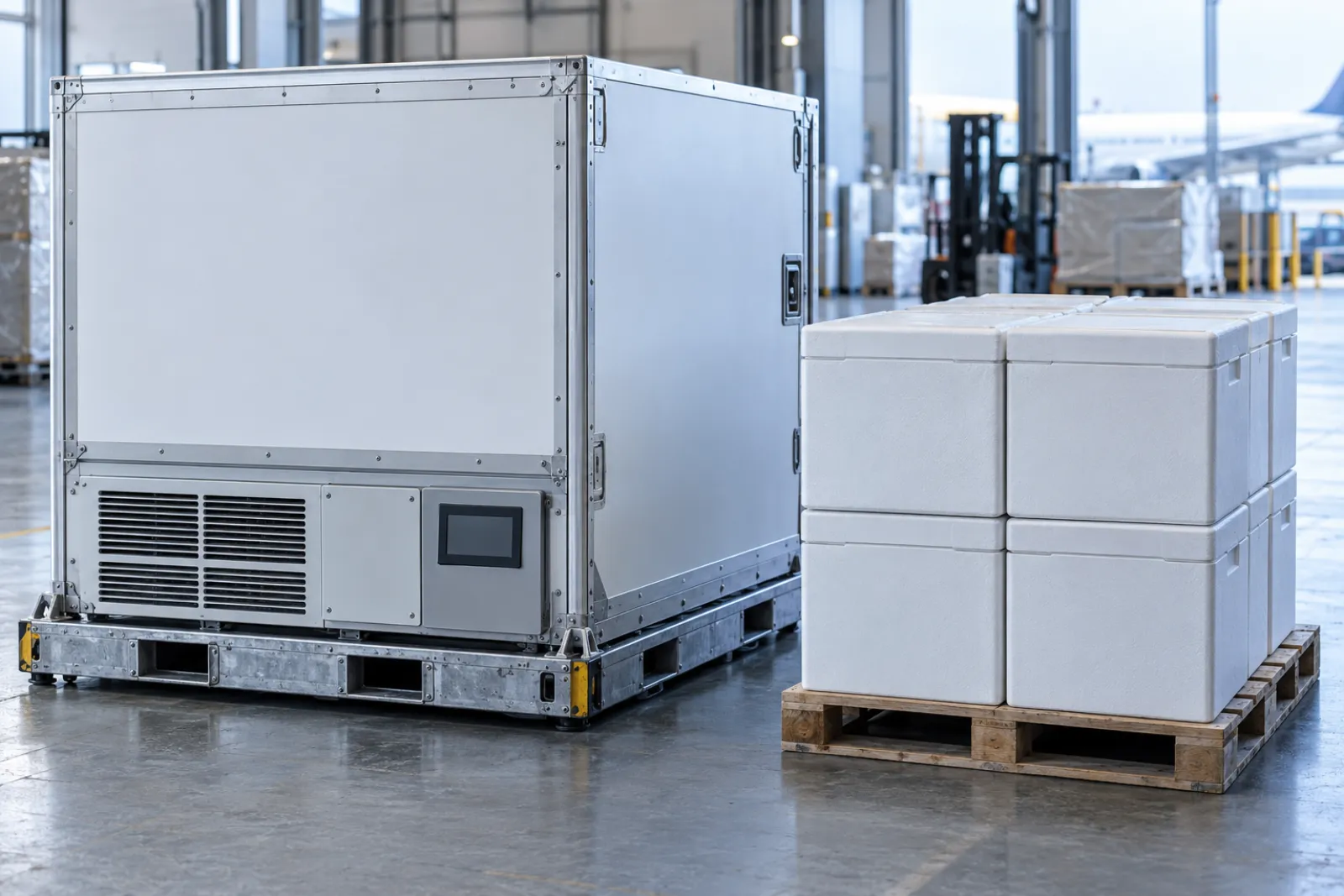
Buyers often ask whether active or passive packaging is “better”. There is no general answer. The two draw their system boundaries in different places, and the right choice depends on what your lane, volume and handling model can support. This article compares them on those boundaries and does not rank them. Other guides in the packaging section cover the individual components in more depth.
In this guide, passive means a thermally insulated container that relies on a conditioned refrigerant and the thermal mass of the payload to hold a temperature range for a limited time. No energy source is needed during transit. Active means a system with a temperature control unit, usually powered from a mains supply, a vehicle or a battery, that adds or removes heat while it runs. Some products sit between the two, such as a shipper with a small battery-driven fan or a passive box inside a refrigerated vehicle. Treat the definitions as a spectrum, and describe your own configuration precisely when you talk to suppliers.
Scope note: This guide compares system types for buyers. It does not state which product range a given medicine or food may be held in. That comes from product documentation and your quality system.
Common premises before you compare
Write down the same inputs for both sides before comparing anything.
- Product temperature range and time limit, taken from the product documentation (including any excursion allowance) and never from a packaging brochure.
- Payload size and thermal mass: volume, weight, units per shipment, and whether the load is a single item or a mixed pallet.
- Lane profile: origin, destination, modes (road, air, sea, parcel), transfer points, expected dwell times and the worst credible delay.
- External conditions: the seasonal ambient range at origin, in transit and at destination, including tarmac and unheated hubs.
- Shipment frequency. A steady weekly pallet and an irregular one-off clinical shipment pull the decision in different directions.
- Who touches the shipment: trained staff, a courier, a customer or a retail receiver.
How each type works, and where its boundary sits
The diagram below shows what each system includes and which inputs sit outside it.
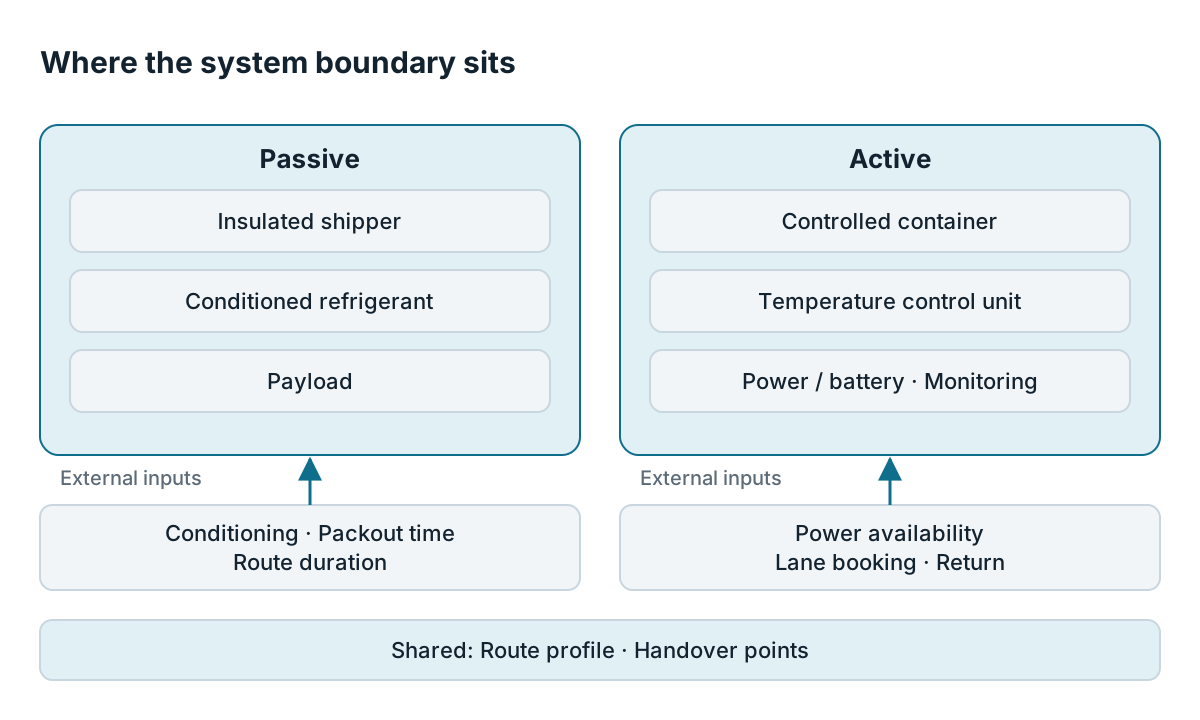
A passive system has a small, physical boundary. Performance is fixed when the box is packed, and the shipper cannot respond to a delay afterwards. So the inputs you control are upstream: whether the refrigerant was conditioned for the specified time, how long packout took, and whether the box was packed to the tested configuration. The performance claim is a duration under a stated ambient profile.
An active system has a larger boundary. It includes a power source and a control unit that can fail, run out of energy or be switched off, and it works only if the unit stays powered and is accepted at every transfer point. Here the inputs you control are operational: charging or power connection, lane booking, availability of units at the origin, and return of the unit afterwards. The performance claim is a controlled range for as long as the supply holds.
Conditional analysis by route and operating condition
- If the lane is short and predictable, with few handovers and a known delivery window, then a passive shipper sized to the lane is often enough, and the extra operational layer of an active unit may not earn its place.
- If the lane includes long dwell at transfer hubs or an uncertain schedule, then a fixed passive duration becomes the limiting factor. Consider a longer-duration passive design with a margin, or an active system if the carrier can support power.
- If a power source cannot be guaranteed at every point, such as parcel networks, hand carry or hold space on some aircraft, then an active system carries a failure mode that a passive one does not. Check the carrier’s rules on batteries and powered equipment before you plan around it. For air freight, refer to the current IATA temperature control and dangerous goods rules.
- If the payload is large, such as full pallets, then the cost and handling of many passive shippers may shift the comparison toward pallet-scale active or insulated options. Confirm whether the cost model includes labor, conditioning space and waste.
- If shipments are frequent and returnable, then the logistics of getting units back matters more than the unit itself. See the guidance on reusable thermal shippers when that applies. That is a separate decision from this one, since reusable designs exist in both categories.
- If the product has a very narrow range, then ask whether the design controls both the upper and lower limits. A passive pack that protects against heat can still cause freezing if refrigerant is badly conditioned.
Comparison table
| Criterion | Passive thermal packaging | Active cold chain packaging |
|---|---|---|
| Energy dependence | None in transit; depends on refrigerant conditioning beforehand | Needs mains, vehicle or battery supply |
| Performance claim | Time held within a range under a stated ambient profile | Controlled range while powered and functioning |
| Response to delay | Cannot adapt once packed | Can adapt within its capacity, subject to power |
| Typical operating burden | Conditioning, packout discipline, packout time | Power connection, maintenance, availability, return of units |
| Failure modes | Mis-conditioned refrigerant, wrong packout, delay beyond design | Power loss, device fault, unit not accepted by carrier, set-point error |
| Qualification focus | Packout configuration and thermal duration under tested profiles | System operation, alarms, power autonomy, maintenance records |
| Handover points | Packing line, carrier, receiver unpack | Charging or booking, carrier acceptance, receiver return |
| Monitoring need | Usually a logger inside the load | Often built-in; may be supplemented by a separate logger |
Many shippers weigh one row far more than the others, so a total score would mislead. Use the table to generate questions.
Interfaces and operations you will inherit
With passive packaging the interface is the packing line. Define the conditioning area, the time window between removing refrigerant from conditioning and closing the box, and a pack diagram that staff follow. Equipment that fills, seals and assembles packouts affects repeatability, which is why packout cost should include labor and conditioning space and not just the unit price of the box.
With active packaging it is the carrier and the asset. Ask who owns the unit, who prepares it, who checks the set point, who is called if an alarm triggers, and who is responsible for it between delivery and return. Maintenance and calibration records for the sensors and control components belong in the supplier file.
In both cases, decide how you will know what happened in transit. The real-time versus offline monitoring decision interacts with this choice. An active system with remote alerting gives a chance to intervene, while a passive box with an offline logger gives a record after the fact. Either way you still need a response plan.
Evidence to request from suppliers
- The tested configuration, including payload mass, refrigerant quantity, conditioning method and duration, and the ambient profiles used.
- For passive packaging, the test method or protocol used, for example one of the ISTA thermal transport procedures, and the full report rather than a summary. Check the current version of any named standard.
- For active systems, qualification documentation for the controlled system, covering installation, operation and performance checks. PDA Technical Report No. 64 is a commonly cited reference for this kind of qualification.
- Battery or power autonomy under the conditions you expect, and what happens at low charge.
- Alarm behavior and who receives it.
- Cleaning, maintenance and calibration requirements for reusable parts.
- Conditions the supplier did not test, stated plainly.
The way to read this evidence is covered in the guide to reviewing qualification reports. When a report covers a different lane or season from yours, treat it as supporting information rather than proof.
Selecting a size and duration
After choosing a system type you need a specification. For passive shippers, the practical inputs are in insulated shipper selection. Refrigerant is a major performance variable of its own, so read the notes on comparing gel packs and other PCM refrigerants before you accept a default.
Buyer checklist
- Product temperature range and time limit taken from product documentation
- Payload mass, volume and configuration defined
- Lane mapped with modes, transfer points, dwell times and worst credible delay
- Seasonal ambient range defined for each lane segment
- Carrier rules for batteries, powered units or dry ice confirmed in writing
- Power or conditioning responsibilities assigned to named roles
- Return process for reusable units defined, or disposal route confirmed
- Monitoring approach and response plan agreed for excursions
- Supplier test report reviewed against your lane and season
- Qualification scope and requalification triggers recorded
Limitations of this guide
This guide compares categories, not products. Real products differ widely within each category, and the line between categories is not sharp. It contains no performance data, so any duration or temperature behavior must come from the supplier’s documentation and your own qualification. It does not interpret regulations for your jurisdiction, and standards named here should be checked in their current versions. Cold Chain Practice has not tested any packaging. Decisions about product suitability remain with your quality function.
Related guides
Selecting Insulated Shippers: Payload, Transit Time and Handling Constraints
Turn payload, transit time, ambient conditions, dimensions and handling into clear purchasing inputs for insulated shipper selection and supplier quotes.
Read guide
Comparing Water-Based Gel Packs and Other PCM Refrigerants
Compare cold chain refrigerants by formulation, phase-change range, conditioning and encapsulation instead of relying on a simple gel versus PCM label.
Read guide
Real-Time Tracking or Downloadable Loggers: Which Workflow Fits?
Compare real-time and downloadable temperature monitoring by when data arrives, alarm response, network dependence and cost structure, lane by lane.
Read guide
Thermal Packaging Qualification Reports: Reading Conditions and Limitations
How to read a thermal packaging qualification report: check the test object, payload, temperature profile, duration, acceptance criteria and stated limits.
Read guide