
Comparing Water-Based Gel Packs and Other PCM Refrigerants
Compare cold chain refrigerants by formulation, phase-change range, conditioning and encapsulation instead of relying on a simple gel versus PCM label.

Why the usual gel versus PCM split is not enough
Buying conversations about refrigerants often start with “gel packs or PCM?” The question mixes labels with properties. A water-based gel pack is a phase change material in a practical sense, because it absorbs and releases heat as the water-based fill changes between solid and liquid. Products differ in formulation, the temperature at which the phase change happens, how they must be conditioned, and how they are encapsulated.
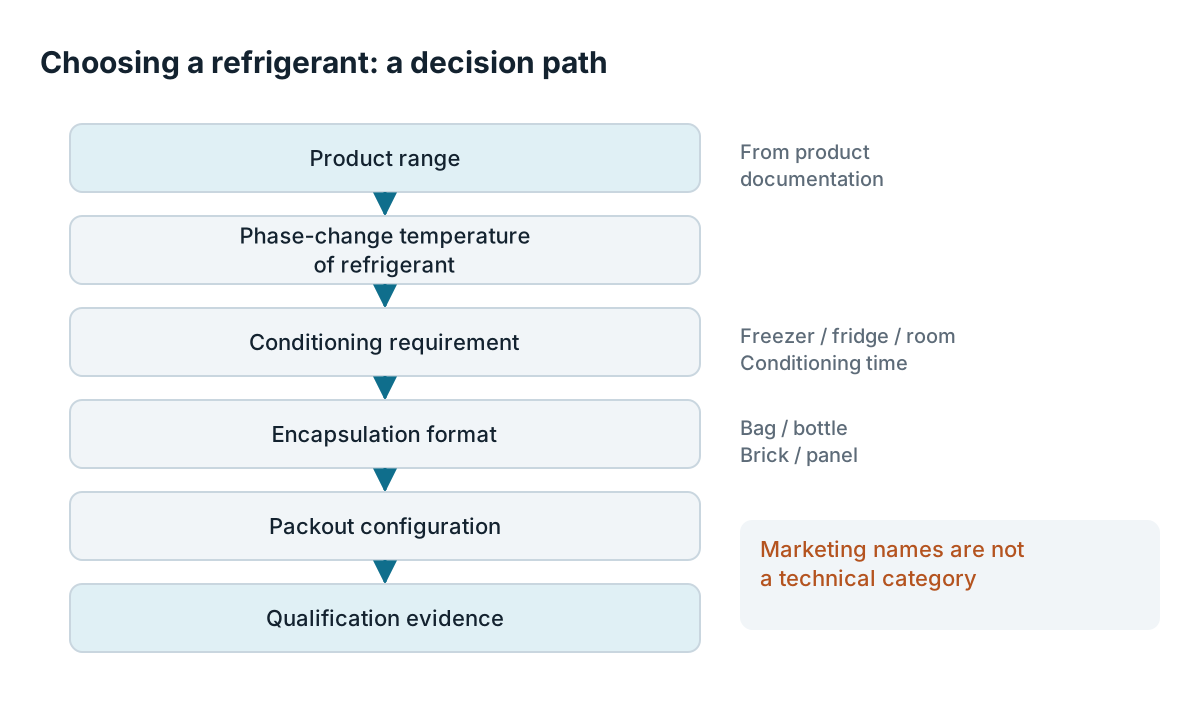
Naming also varies by supplier. Cold Chain Technologies, for example, describes some of its refrigerant products as non-water-based phase change materials (see its refrigerant PCM page, listed in the sources). That tells you the formulation differs from water-based gel. It says nothing about the melting range, energy capacity or behavior in a packout. A marketing name is not a technical category, so compare the datasheet properties. For the wider set of packaging topics, see the packaging section.
Scope note: This guide compares ways of describing and selecting refrigerants. It gives no product temperature ranges or performance figures. Those come from supplier documentation and from your own qualification.
The four properties to compare
The diagram shows a selection path that starts from the product.
1. Formulation
Formulation is what is inside: water with a thickener, water with salts to shift the freezing point, an organic compound such as a paraffin or fatty-acid blend, or another mixture. It sets the phase-change temperature, the energy absorbed per unit of mass or volume, density, flammability or toxicity classification, and compatibility with packaging materials. Ask for the safety data sheet, and for food contact information where the refrigerant may touch food or food packaging. For food, requirements such as the EU framework on food contact materials may apply, so check current rules for your market.
2. Phase-change range
The phase-change range is the temperature band where the refrigerant absorbs or releases most of its heat while staying near a constant temperature. It is the most important property for matching a refrigerant to the product’s range. Ask for the range as a stated band, the method used to measure it, and the freezing and melting behavior, since these can differ. If the supplier gives one number, ask what it represents.
Three design questions follow from this.
- If the product must not freeze, match the phase-change range to a conditioning method and packout layout that keep product surfaces above the lower limit. A refrigerant that changes phase near the bottom of the range and sits against the product is a freezing risk.
- If the lane is hot and long, energy capacity and the position of refrigerant relative to the payload matter at least as much as the range itself.
- If the product is frozen, the aim is to stay below an upper limit. The choice is then among refrigerants that change phase at frozen temperatures, or other cooling agents with their own transport rules.
3. Conditioning
Conditioning brings the refrigerant to the starting state it needs before packout, usually by holding it in a freezer, a refrigerator or a controlled room for a defined time. Ask the supplier for the conditioning temperature and minimum time for each format. These questions decide whether a refrigerant works in your plant:
- Do you have enough conditioning capacity at peak, including space that can be mapped and monitored?
- Is the conditioned state easy to verify, or does it rely on elapsed time alone?
- Does the refrigerant need a staged process, such as freezing then tempering, and how is that tracked?
- What happens if a batch is under-conditioned or left in too long?
Conditioning mistakes are a typical cause of shipper failures that look like packaging problems, and a well-chosen refrigerant that is poorly conditioned can fail a lane. One that is simple to condition and check may be more practical than one with a marginally better thermal profile on paper.
4. Encapsulation
Encapsulation is the container around the refrigerant: a film pouch, a rigid bottle, a brick or a panel. It affects durability, leakage risk, fit in the shipper, handling, cleaning and automation. Pouches can be cheaper and flexible but may puncture. Rigid formats tend to hold shape and resist damage but take up fixed space. If the packs will be reused, ask how many cycles the supplier supports and how wear is assessed. If you plan to fill and seal packs in-house, see the notes on gel pack filling and sealing equipment for line interfaces, seal integrity and traceability.
Comparison table
The table compares refrigerant types by property. Ranges and energy values must come from each supplier’s data.
| Property | Water-based gel packs | Other PCM refrigerants (organic, salt-hydrate or blended) | What to verify |
|---|---|---|---|
| Formulation | Water with thickener; may include additives | Varied formulations, sometimes non-water-based | Safety data sheet and composition class |
| Phase-change range | Often tied to water’s freezing behavior unless modified | Can be designed for different bands | Stated band, measurement method, freeze and melt behavior |
| Conditioning | Commonly freezer or fridge based | Depends on band; may include fridge, room or freezer | Temperature, minimum time, verification method |
| Encapsulation | Often pouches, also rigid formats | Pouches, bottles, bricks, panels | Durability, leak risk, shape, reuse cycles |
| Handling | Usually familiar to staff | May need new procedures | Training, labeling, disposal |
| Qualification | Required for each packout | Required for each packout | Report covering your payload and profile |
Both columns are broad, and individual products overlap. Use the table to organize questions, and pick the refrigerant from your own data.
Application context
For medicines, product documentation and your quality system set the range, and packout steps must be controlled and recorded; see the guide to pharmaceutical packout. For perishable food, ranges are broader and food safety rules and food contact concerns carry more weight, as discussed in the guide to chilled and frozen food.
Fit with the insulated shipper
Quantity, position and format of the refrigerant interact with the wall type, cavity size and payload, so it cannot be judged on its own. Before you finalize a choice, read the inputs described in insulated shipper selection, then ask the supplier which refrigerant format and conditioning were used in the test, and which alternatives they have data for. Changing refrigerant after qualification is a change to the tested configuration, so plan for requalification or documented risk assessment.
Questions for suppliers
- What is the exact formulation class, and where is the safety data sheet?
- What is the phase-change range, and how was it measured?
- What are the conditioning temperature, minimum time and maximum hold time?
- What formats exist, and which was used in the test report?
- How many reuse cycles are supported, and how is wear assessed?
- What is the leakage or puncture history, and how does the supplier handle complaints?
- What are the disposal and transport classifications?
- How are changes to formulation or supply notified?
Selection checklist
- Product temperature range and excursion allowance taken from product documentation
- Risk of freezing assessed as well as risk of heat
- Phase-change range, measurement method and behavior on freezing and melting obtained
- Conditioning requirements and capacity confirmed for peak volumes
- Method to verify conditioning decided
- Encapsulation format checked for durability, fit and automation
- Safety data sheet reviewed, and food contact documents requested where relevant
- Refrigerant used in the test report matches the intended packout
- Requalification trigger set for any refrigerant change
Limitations of this guide
This guide compares refrigerants on properties that matter in practice. It gives no thermal performance numbers, ranks no products and does not say which refrigerant suits a given medicine or food. Supplier statements about formulations, including the Cold Chain Technologies description cited here, are the supplier’s own and should be checked against current datasheets. Standards and regulations are named for context only, so confirm current versions and local rules. Cold Chain Practice has not tested any refrigerant.
Related guides
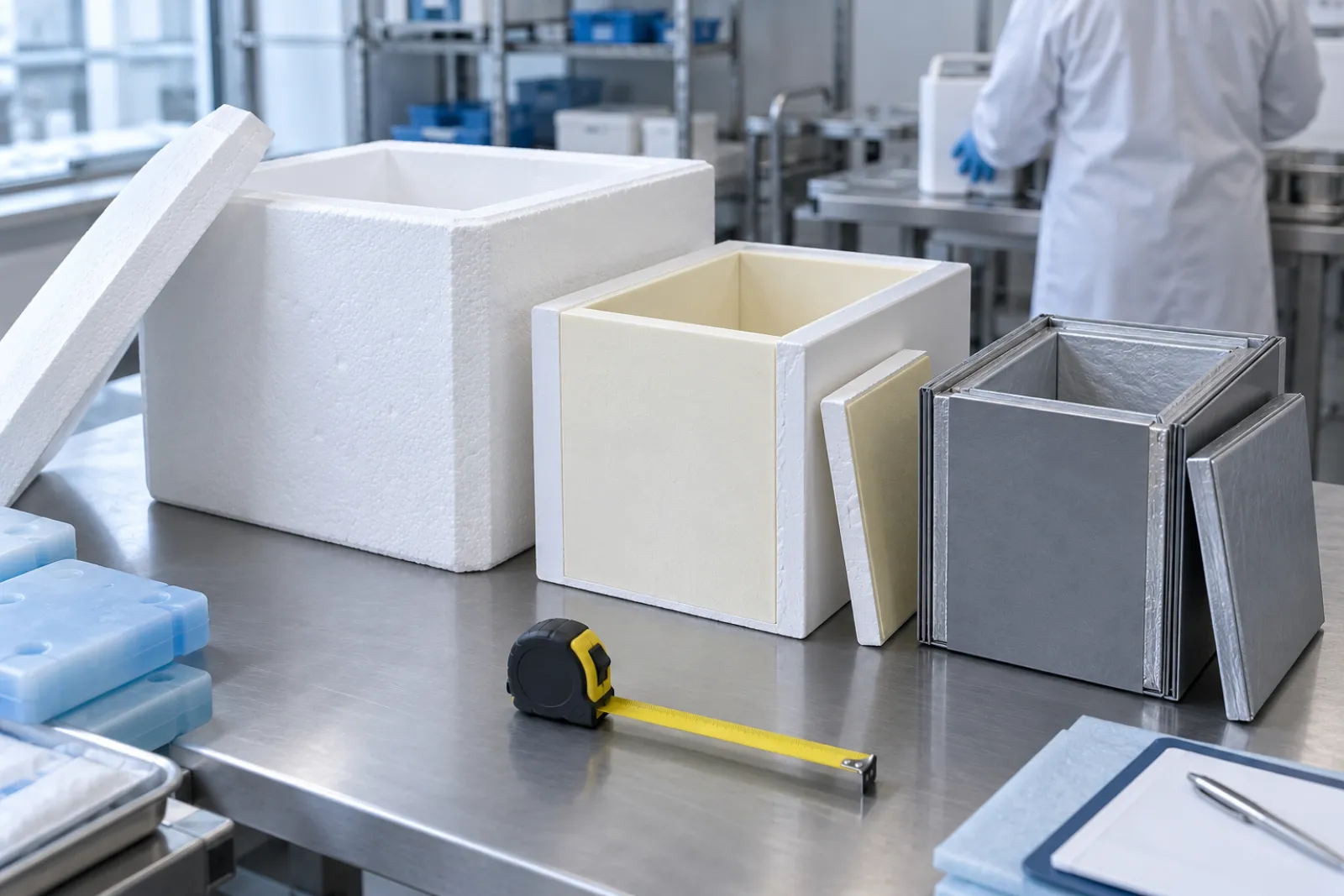
Selecting Insulated Shippers: Payload, Transit Time and Handling Constraints
Turn payload, transit time, ambient conditions, dimensions and handling into clear purchasing inputs for insulated shipper selection and supplier quotes.
Read guide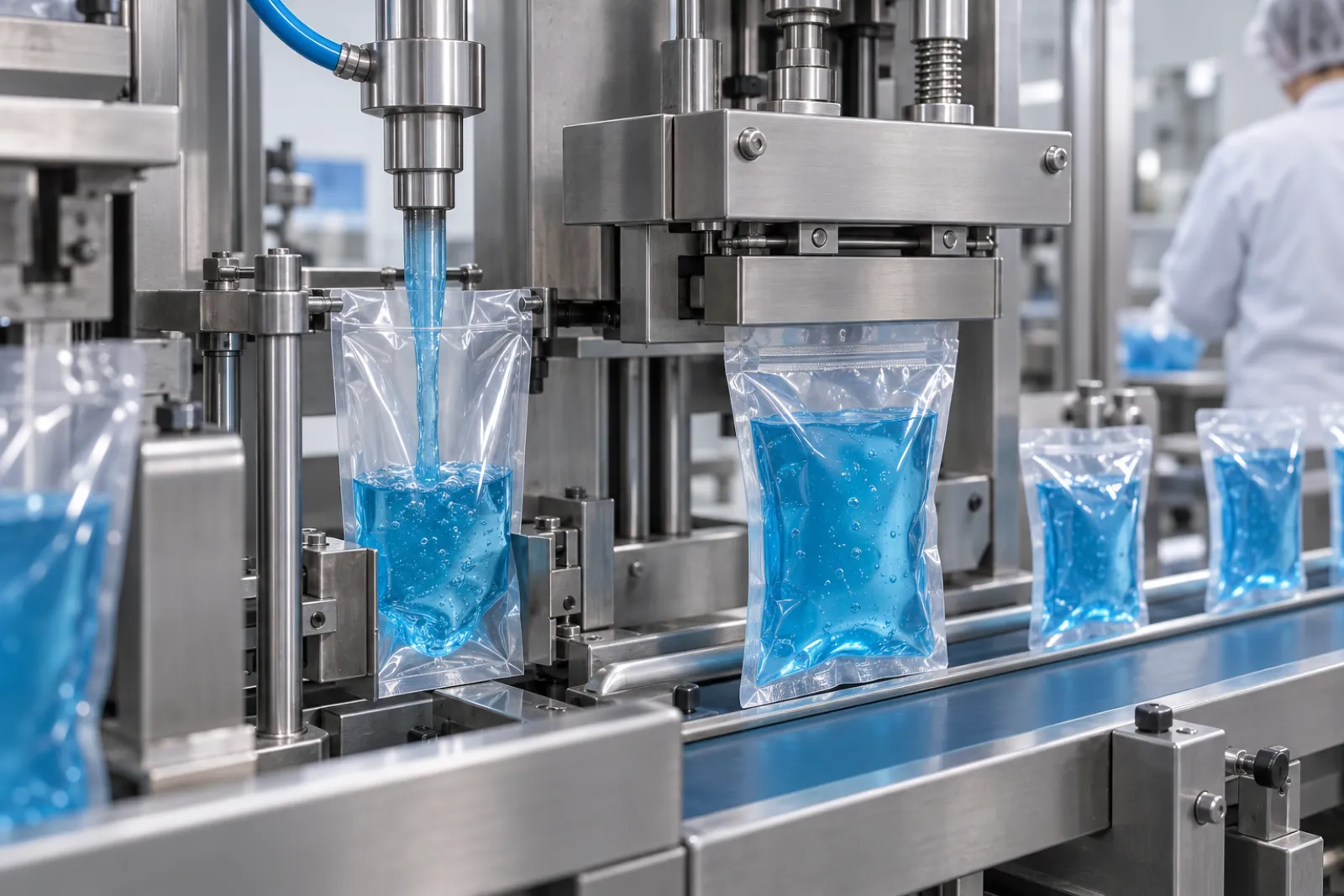
How to Specify a Gel-Pack Filling and Sealing Process
How to define refrigerant, film, fill quantity, sealing and cleaning requirements before you ask suppliers about gel-pack filling and sealing equipment.
Read guide
Pharmaceutical Shipping Packout: What Buyers Must Define Before Equipment Selection
Build packout requirements from product documentation, lane assessment and quality input before you shortlist equipment. Owners, interfaces and records.
Read guide
Chilled and Frozen Food Packaging: Product Packing vs Thermal Shipping
Separate primary food packaging from thermal shipping packaging, and see where the equipment boundary sits between product packing and cold chain packout.
Read guide