
Phase Change Material Conditioning: Freezer Setpoints, Supercooling Delta and Brick Checks
Check PCM freezer settings, nucleation, staging and brick readiness before packout, with product-specific instruction examples and a release checklist.
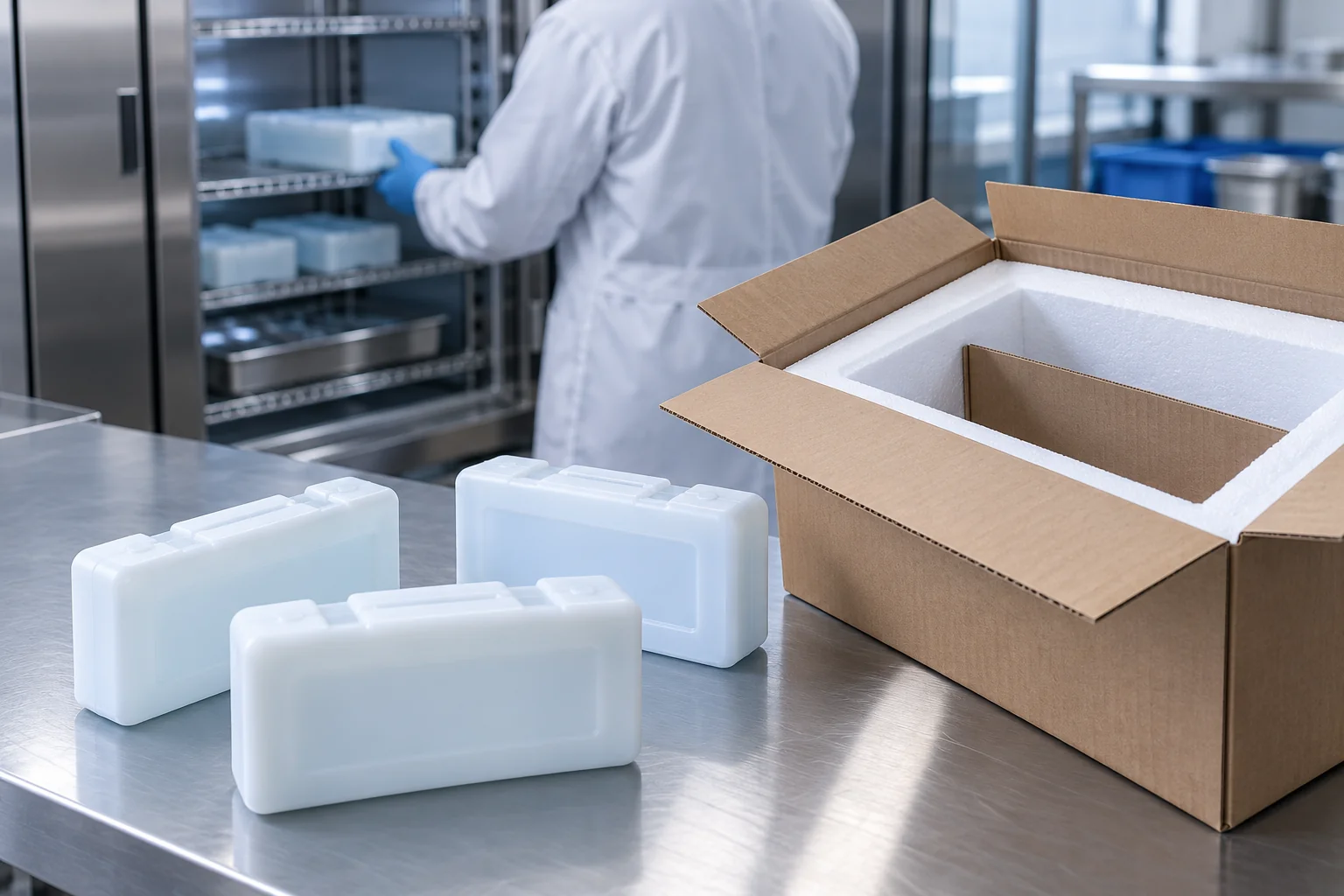
Condition phase change material (PCM) packs to the starting phase and packout temperature specified for the shipper configuration. A freezer setpoint, a cold surface or a hard exterior alone cannot establish that a brick is ready. For cold-chain packout, separate three questions: has crystallization started, has the required phase change finished, and is the pack at its release temperature?
For a configuration requiring solid PCM, complete the prescribed freezing cycle and phase check, then perform any required staging before loading the shipper. Keep the loading arrangement, cycle history and release checks together. Manufacturer instructions can differ substantially: Peli BioThermal’s Crēdo Cube Series 4 Rev F guide specifies freezing followed by staging for its standard cooling configuration, while Thermco’s −21°C panel instructions call for immediate packout after conditioning. Choose the procedure by pack identity and lane configuration, then use the checks below to verify readiness.
- Match the pack and conditioning procedure to the qualified configuration.
- Verify the required phase using the prescribed method.
- Check the packout temperature after any staging step.
- Keep damaged, unconditioned and released packs segregated.
For the wider relationship between refrigerants, insulation and payload layout, start with the cold-chain packaging guides.
What does a fully conditioned PCM pack look like?
A fully conditioned pack has reached its specified phase and temperature; appearance is only one part of the check. In a cooling packout that starts with solid PCM, melting absorbs heat near the material’s transition range. Freezing releases heat during recharge. A liquid pack that has not crystallized can still exchange sensible heat, but it has not acquired the intended solid-to-liquid latent cooling capacity.
Table: scroll horizontally if needed to see every column.
| State encountered | What it means for a solid-start configuration | Next check or action |
|---|---|---|
| Liquid below its reference freezing temperature | Crystallization may be delayed by supercooling | Hold from release; examine the conditioning history and the approved phase test |
| Frozen exterior with an unfinished core | The brick has only partly completed recharge | Check the qualified cycle and the slowest-cooling locations in the load |
| Fully solid, colder than its permitted packout temperature | Recharge is complete but the brick can overcool the payload initially | Apply the configuration’s staging procedure and release-temperature check |
| Required solid phase and release temperature achieved | The thermal starting conditions are satisfied | Complete identity, integrity and configuration checks before packout |
The MHRA’s Use of Freezers describes the partially frozen core problem and warns that some fully conditioned gel formulations remain soft. Peli’s Series 4 guide also includes a separate extreme-cold configuration requiring liquid TIC panels. The intended phase therefore belongs on the work instruction.
Gel pack vs PCM conditioning: what changes?
Water-based gel packs also use phase change. “Gel” describes a formulation or consistency, while a rigid brick describes a container format. Neither name specifies the required conditioning endpoint. Use the exact formulation, encapsulation and starting-state instruction to decide which physical checks are meaningful. Compare the broader material choices in water-based gel packs and other PCM refrigerants.
How far below the phase-change temperature should the freezer be?
Use the conditioning temperature specified for the particular pack and configuration. The nominal transition label describes the refrigerant; the freezer setting describes the cooling environment. Heat still has to leave the pack, crystallization has to occur, and the required phase change has to finish throughout the intended load.
Two temperature differences answer different questions:
- Supercooling delta: ΔTsc = Teq − Tnuc. Teq is the documented equilibrium or reference phase-change temperature; Tnuc is the observed onset of crystallization during cooling. Retain the supplier’s measurement definition when its data use a calorimetry onset or peak.
- Conditioning offset: ΔTset = Tref − Tair,set. This compares the stated reference temperature with the chamber air setpoint. It describes the chosen conditioning environment, not the measured nucleation event.
Temperature differences have the same numerical magnitude in kelvins and degrees Celsius. Keep the reference temperature, measurement location and method beside either delta. A chamber setpoint is not a pack-core measurement.
Nucleation is the start of crystal formation. It can be followed by recalescence, a temperature rise as crystallization releases heat. The first such event does not prove that the full brick has solidified. Lilley and colleagues’ work on size and thermal gradients explains why cooling conditions and scale affect supercooling; Rakkappan and colleagues’ water/ice experiments demonstrate nucleation delay and repeated-trial variability in spherical storage enclosures. For transport bricks, characterize the actual formulation, pack geometry and loading process.
In a conditioning study, record the pack’s initial state, chamber air behavior, load position, timing and approved pack-temperature or phase measurements across repeated cycles. Follow the trace through the phase-change interval to the specified endpoint. A single minimum temperature cannot supply all of that evidence.
What do manufacturer conditioning instructions actually specify?
Keep freezing and staging instructions attached to the named product and document revision. These examples show the decisions a controlled procedure must resolve. Match the current applicable manual to the installed system before applying its settings.
Table: scroll horizontally if needed to see every column.
| Product and instruction | Freezing or phase requirement | Staging and packout requirement |
|---|---|---|
| Peli BioThermal Crēdo Cube Series 4 TIC, Option 1 — UG-001-EN-E Rev F, ©2021, p. 3 | Lay flat at −18°C or below for a minimum of 24 hours; use the manual’s check for absence of audible liquid | Stage at room temperature. Its optional IR check reads +3°C to +4.5°C at the edge of the center stand-off. The time chart assumes a −18°C freezer, +22°C room, unstacked panels and ample airflow |
| Thermco PerformaTherm 5°C panels, ACCPT3L/5L/10L — 5°C PCM Conditioning Instructions, v2, p. 1 | Freeze for 24 hours or until clearly frozen solid, as worded in the sheet; use the system’s controlled freezer instruction | Place flat at +21°C ±5°C for 20 minutes; keep panels unstacked and separated |
| Thermco PerformaTherm −21°C panels, ACCPTFRZ/ACCPTFRZ10 — −21°C PCM Conditioning Instructions, v2, R1-5/5/2026, p. 1 | Condition at −30°C ±3°C for 24 hours or until clearly frozen solid, as worded in the sheet | Immediately proceed to packout for the specified −25°C to −15°C transport configuration |
For the Thermco −21°C example, the nominal reference-to-setpoint offset is 9 K. Measuring supercooling would additionally require observing crystallization onset in the PCM. Keep those quantities separate when discussing a freezer margin.
The Thermco time-or-state wording must be implemented through the applicable controlled procedure. Peli’s minimum-time wording and its panel-specific checks belong to the Series 4 system; transferring only a temperature from one row into another system loses the rest of the instruction.
How should a loaded freezer be checked?
Verify conditioning with the loading arrangement that operators will actually use. Pack thickness, initial temperature, the number of units, airflow and equipment performance all affect the time needed to reach the required state. Peli’s Series 4 guide explicitly ties freezing time to the load and equipment, and its staging chart assumes separated panels with airflow around them.
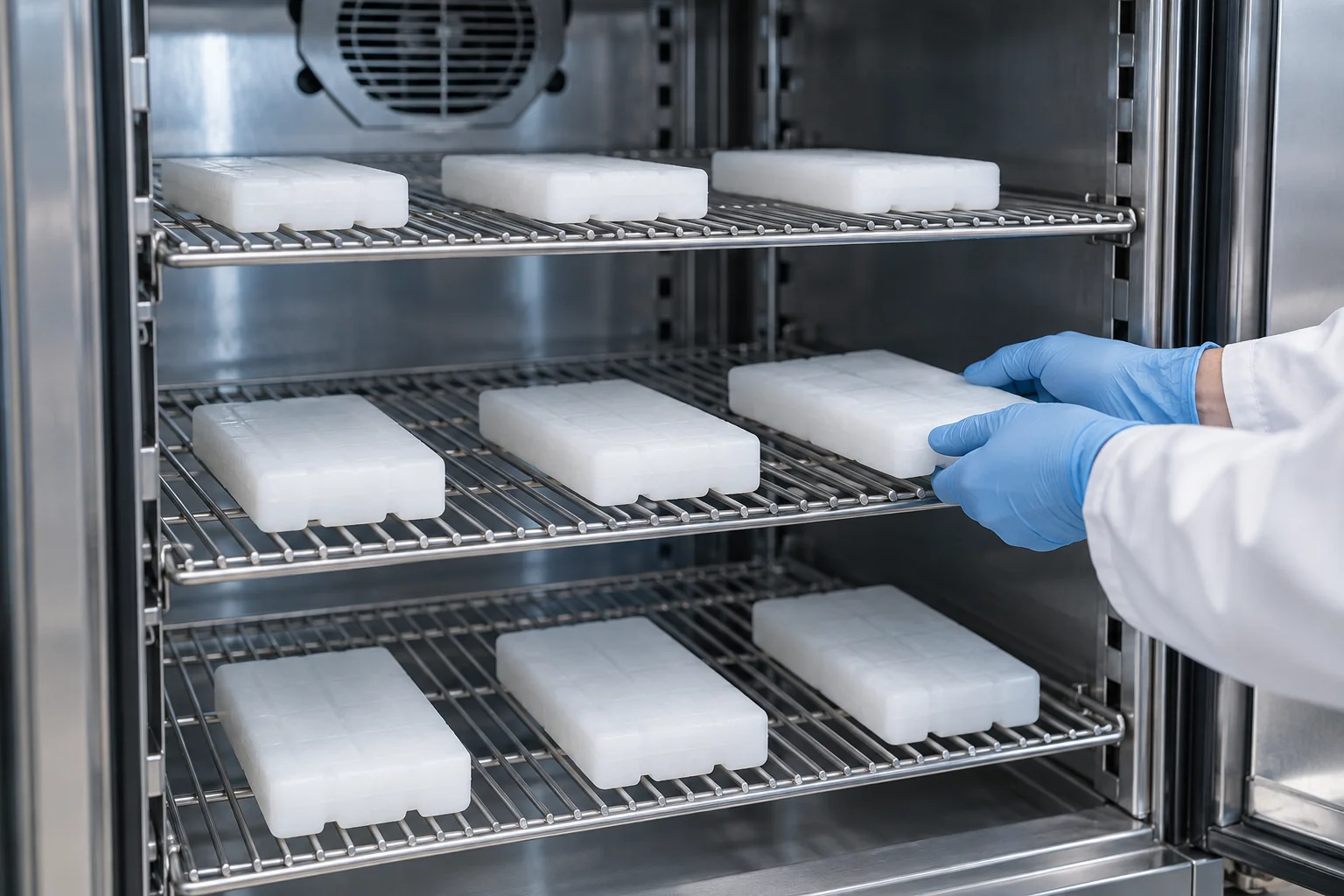
Build the loading instruction around reproducible conditions:
- Identify the permitted shelf layout, pack orientation, separation and maximum qualified load.
- Use representative starting states and the actual operating sequence, including routine loading and door access.
- Examine suspected slow-cooling positions. If stacks or pallets are part of the intended process, include their interior positions in the study.
- Correlate the approved phase checks with the conditioning record, then preserve that arrangement during routine use.
Record a changed loading pattern as a process change for assessment. A cycle established for separated panels cannot simply be carried over to a tightly stacked load. Document the qualified spacing in the site procedure rather than choosing a gap by appearance.
Conditioning capacity also belongs in insulated shipper selection: the selected system needs a preparation process the site can reproduce at dispatch volume.
When should frozen PCM be staged before packout?
Stage an overcold solid pack when the configuration requires it, and verify both its temperature and retained phase afterward. Continued cooling after solidification can take a brick well below its nominal transition temperature. The payload initially encounters that colder pack, so the prescribed staging step is part of preparation for a chilled shipment.
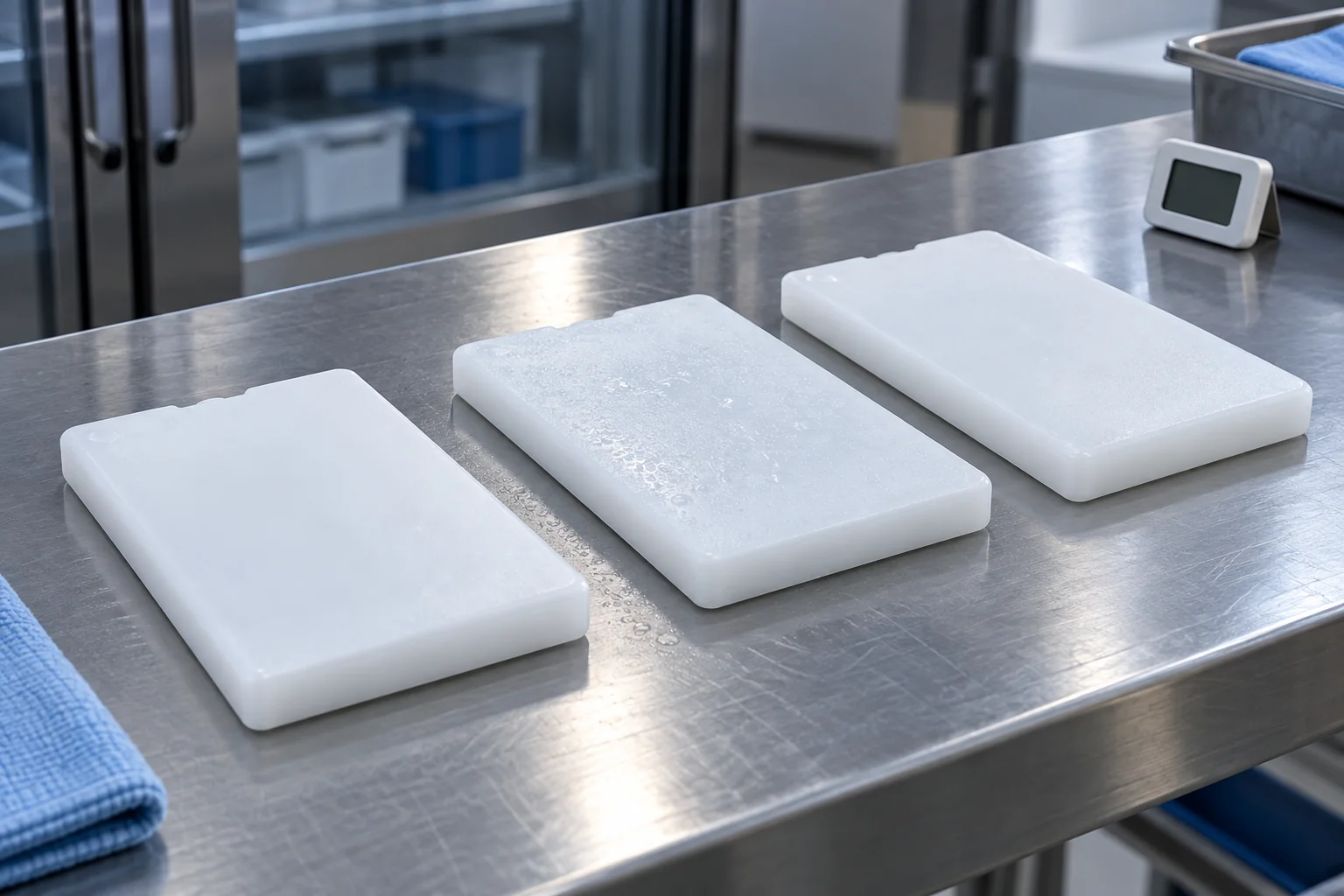
Peli’s Series 4 Rev F guide provides two approaches after freezing: room-temperature staging, or Option 2 rotational conditioning in a +2°C to +8°C refrigerator until the TIC system reaches a minimum usable temperature of +2°C. Under Option 2, panels that begin to melt return to the freezer for reconditioning. Track the transition between these steps so the packout team can distinguish frozen stock from staged, ready stock.
The MHRA article uses “supercooling” for continued cooling of an already solid pack. For troubleshooting, distinguish this overcold solid from supercooled liquid awaiting nucleation. The former calls for the prescribed equilibration; the latter calls for investigation of crystallization and recharge.
Keep coolant placement consistent with the configuration. For EU medicinal distribution, the European Commission’s GDP guidelines, section 9.4 state that medicines should not directly contact cool packs and address staff training and controlled reuse. The pharmaceutical packout guide connects product requirements to that packing workflow.
Which brick checks belong on the release record?
Release a pack only when its identity, cycle, phase, temperature and integrity meet the applicable instruction. Make each result traceable to the batch or pack and the shipper configuration. This keeps a surface observation from becoming a substitute for the full readiness decision.
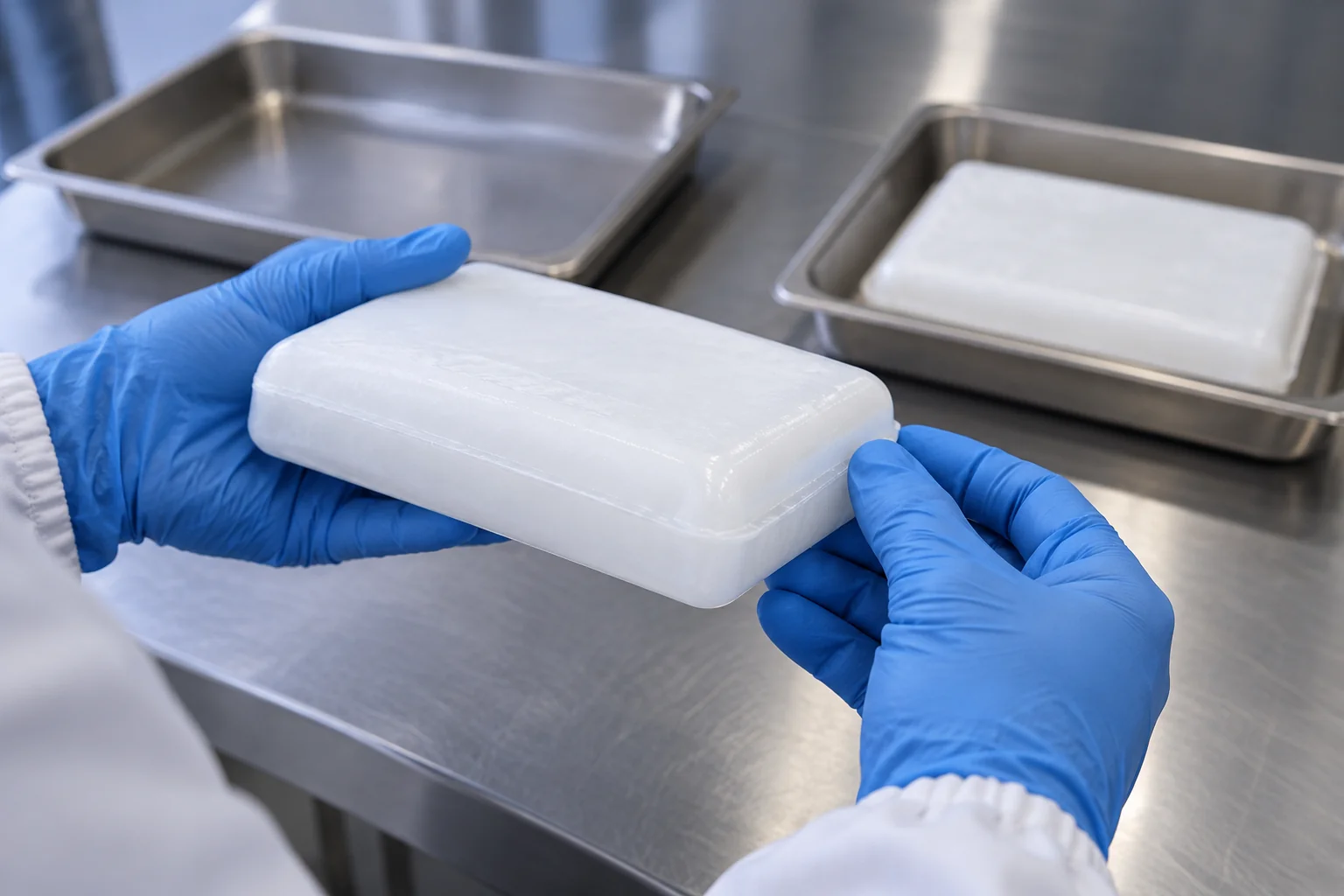
Table: scroll horizontally if needed to see every column.
| Check | What to retain | Hold from release when… |
|---|---|---|
| Identity and configuration | Pack or panel ID, batch, shipper configuration and instruction revision | Identity is uncertain or the pack does not match the configuration |
| Conditioning history | Equipment ID, loading arrangement, start/end times and cycle record | Required history is missing or the load departed from the approved process |
| Required phase | Specified state, inspection method and result | The prescribed phase criterion is not met |
| Staging and temperature | Staging conditions, times, measurement location/device and endpoint | Staging is incomplete or the pack is outside its release limits |
| Integrity and reuse | Seal, shell and leak inspection; reuse disposition | Damage or leakage is found |
| Handoff | Ready-stock location, release decision, operator and packout time | Status is ambiguous or ready packs have become mixed with other stock |
Download the PCM conditioning and brick-check record (CSV). It includes fields for the reference temperature, approved chamber setpoint, qualified flat-layout spacing, phase checks and staging. Enter acceptance criteria from the controlled procedure before recording results.
At the packout station, keep ready stock physically distinct and its release status visible. When an endpoint fails, segregate the affected packs and follow the approved reconditioning or disposition procedure. If shipment temperatures are inconsistent, take the conditioning and staging records into the packout failure investigation alongside the payload layout and logger trace.
Questions that often delay PCM release
Does “sweating” mean a pack is ready?
Condensation describes the interaction between the pack surface and surrounding air. Use the documented staging conditions and endpoint to decide readiness. Thermco’s 5°C instruction combines its sweating illustration with a specified temperature, duration and separated-panel arrangement.
Is an infrared surface reading enough?
Use IR only where the applicable procedure defines its role, measurement location and acceptance range. Peli’s Series 4 Option 1 supplies a particular surface-check location. A surface reading alone does not establish that an opaque brick’s core has completed its phase change.
What if liquid packs repeatedly fail to crystallize?
Hold the affected packs, preserve the cycle records and compare initial state, load position and chamber behavior. Escalate recurrent failure to the pack supplier and the process owner for formulation and conditioning assessment. Nucleation behavior belongs in that assessment; keep sealed packs intact and use only the approved handling procedure.
Related guides
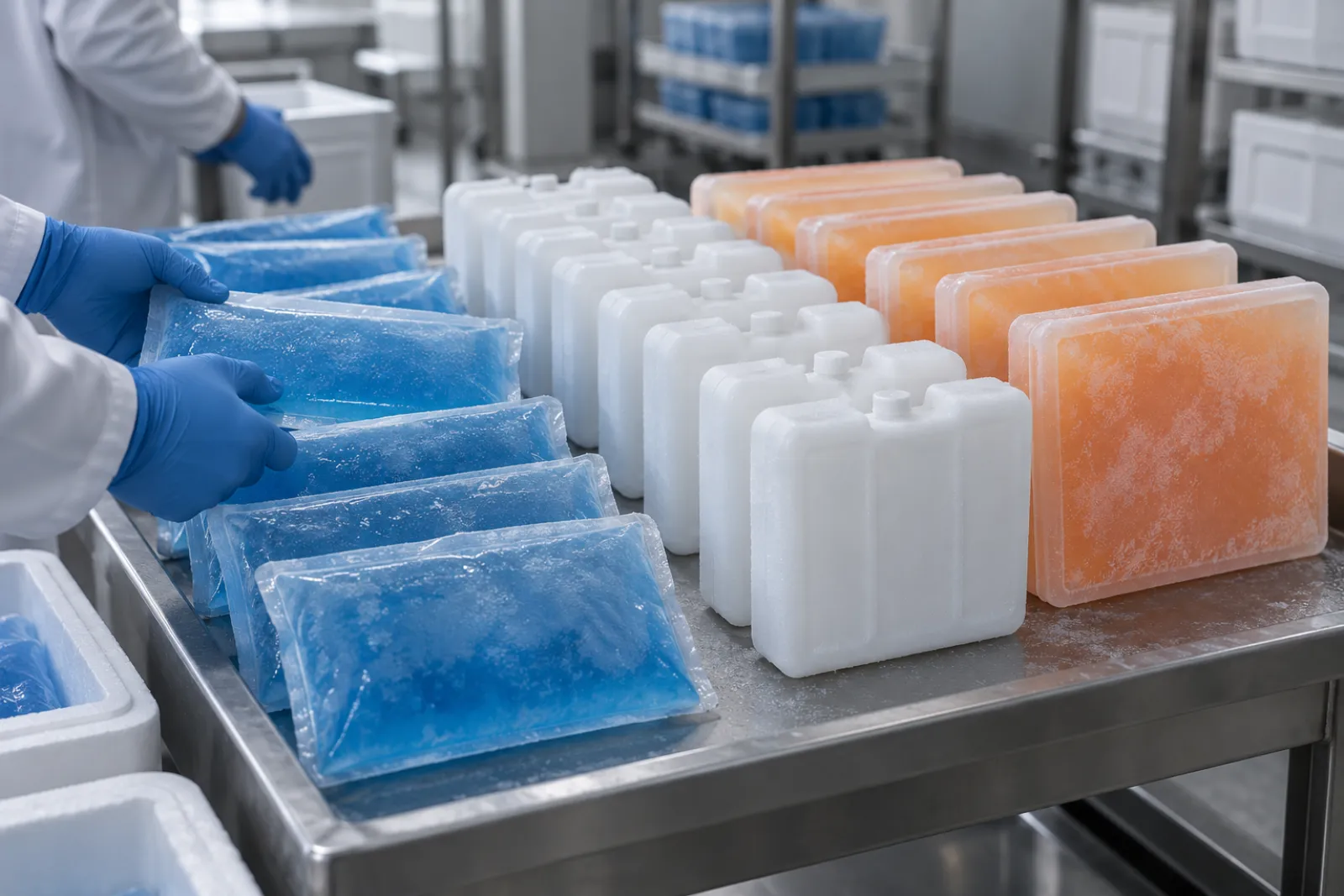
Comparing Water-Based Gel Packs and Other PCM Refrigerants
Compare cold chain refrigerants by formulation, phase-change range, conditioning and encapsulation instead of relying on a simple gel versus PCM label.
Read guide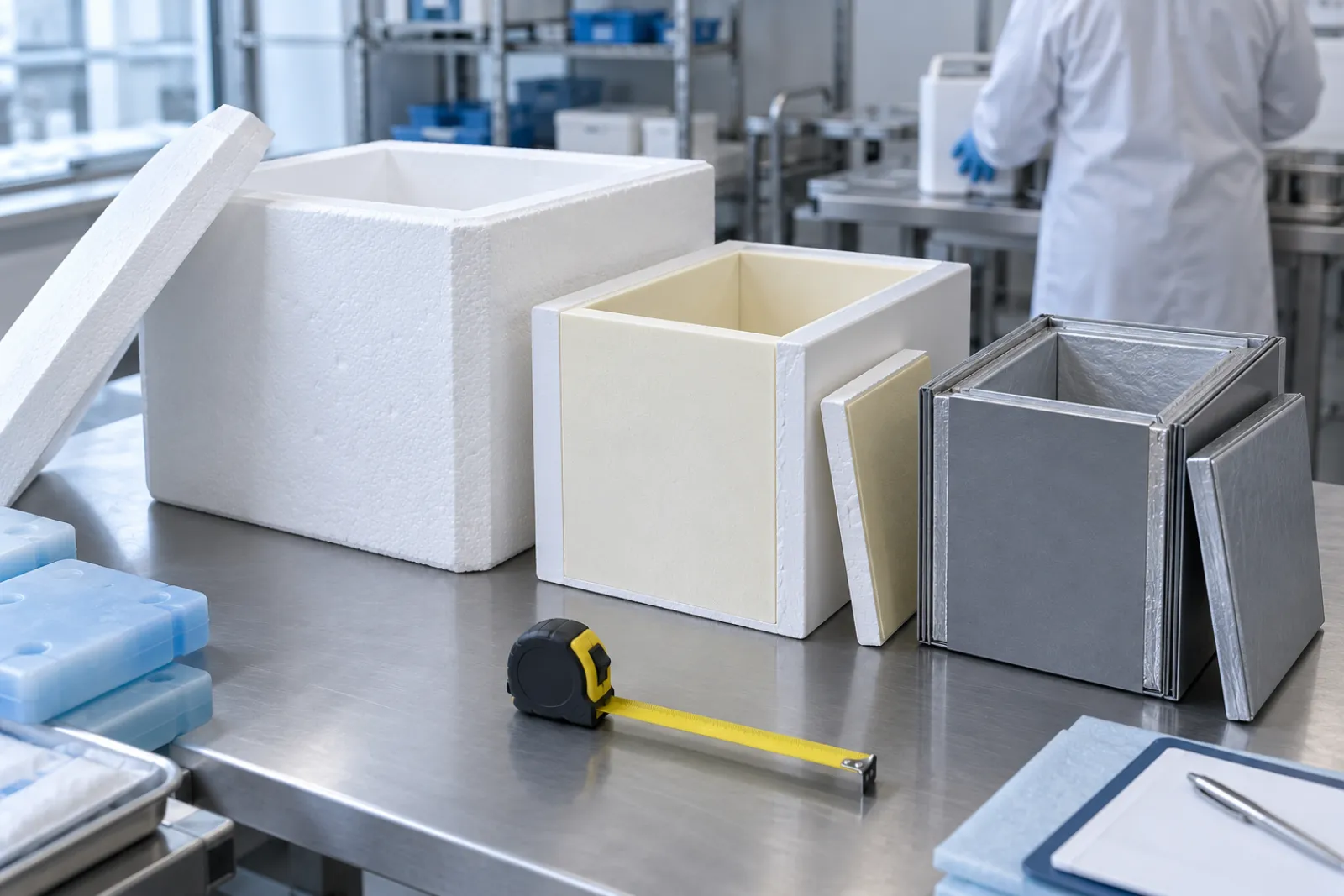
Selecting Insulated Shippers: Payload, Transit Time and Handling Constraints
Turn payload, transit time, ambient conditions, dimensions and handling into clear purchasing inputs for insulated shipper selection and supplier quotes.
Read guide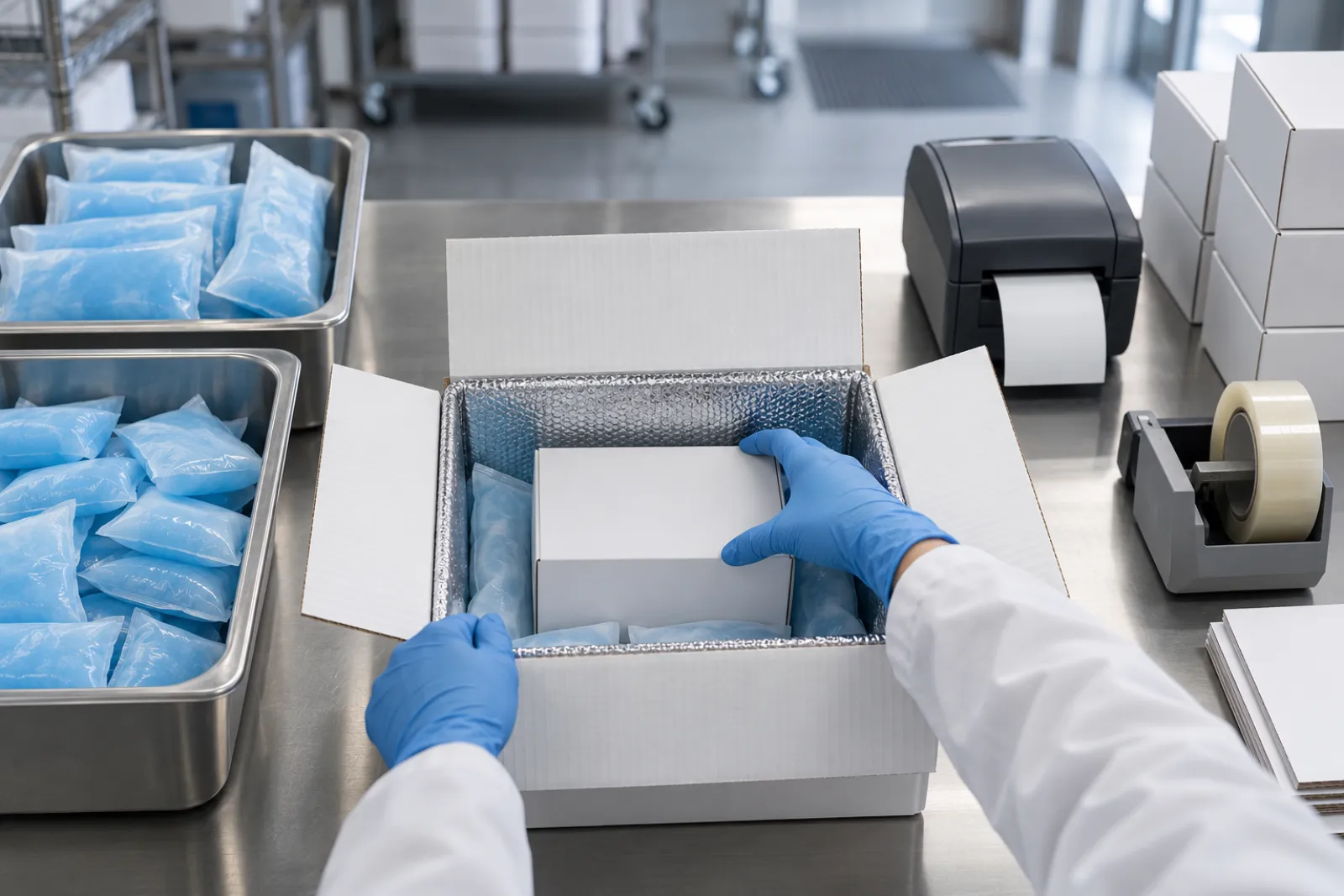
Designing a Cold Chain Packout Station: Process and Equipment Checklist
A practical checklist for designing a cold chain packout station: workstation layout, refrigerant staging, records, interfaces and what to confirm before buying.
Read guide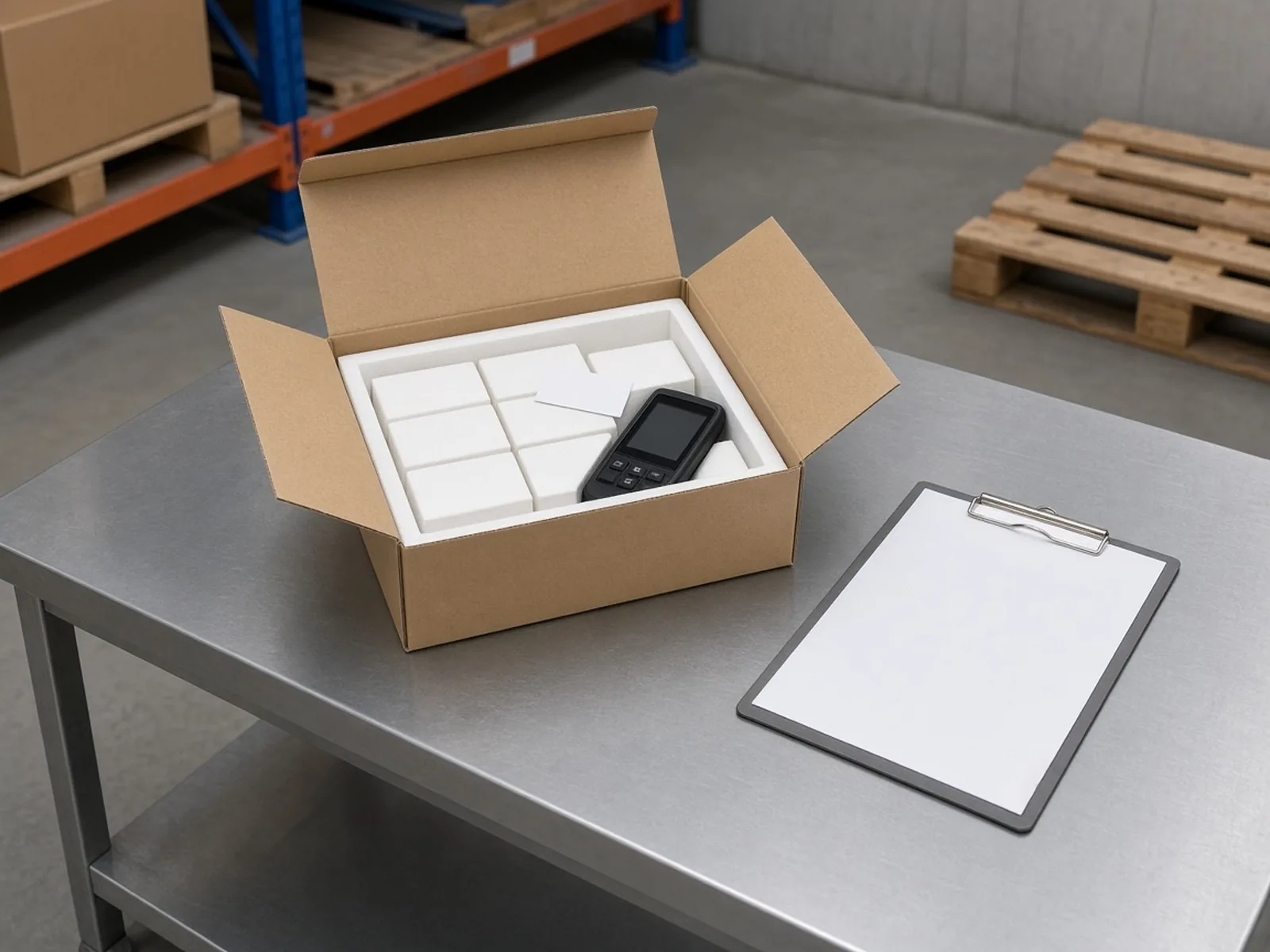
Cold Chain Packaging Problems: A Packout Failure Investigation Worksheet
After a damaged shipper or a temperature excursion, copy the packout, preconditioning, seal and handover records and hand that file to quality.
Read guide