
Designing a Cold Chain Packout Station: Process and Equipment Checklist
A practical checklist for designing a cold chain packout station: workstation layout, refrigerant staging, records, interfaces and what to confirm before buying.

What a packout station has to do
A packout station is where a product, a thermal shipper, refrigerant and a temperature record come together into one shipment. A bench with two operators and a conveyor-fed cell do the same job every time: assemble the shipper in the defined configuration, load the product, close the package, and leave a record that someone can check later.
This guide is a checklist for designing or reviewing that station. It covers the workstation, material staging, records and the interfaces to the steps before and after. It does not tell you which shipper or refrigerant to use. That decision comes first and sits in your validated pack configuration, not in the equipment.
For the wider set of automation topics, see the Automation section hub.
Define the inputs before you draw the layout
Layout work goes wrong when it starts from floor space. Write down these inputs first.
- Pack configurations. How many shipper sizes, refrigerant layouts and product formats are there? Each combination is a work instruction the station must support.
- Order profile. Single-unit orders, multi-unit orders or batch builds for one destination. This decides whether you need a bench or a flow line.
- Volume pattern. The peak hour matters more than the daily average. A station sized for the average becomes the bottleneck on dispatch day.
- Conditioning requirements. Refrigerant, and sometimes the shipper itself, must be at a defined state before packing. The station needs space and a defined hold time for that.
- Time out of control. The pack configuration sets how long components can sit at ambient before the pack is closed. The longest realistic dwell at your station has to fit inside that limit.
- Product temperature range. This comes from the product documentation, not from this guide.
If the station will be validated, record these inputs in the requirements document. A risk-based approach to equipment specification, such as the one in ASTM E2500, starts the same way: define what the process needs, then verify that the equipment meets it. Check the current edition of any standard you cite.
Station sequence
A typical sequence has seven steps: staging of conditioned refrigerant, shipper assembly, product pick and verify, pack configuration, logger start, close and label, dispatch staging. The diagram shows them in order, with the records that belong to each.
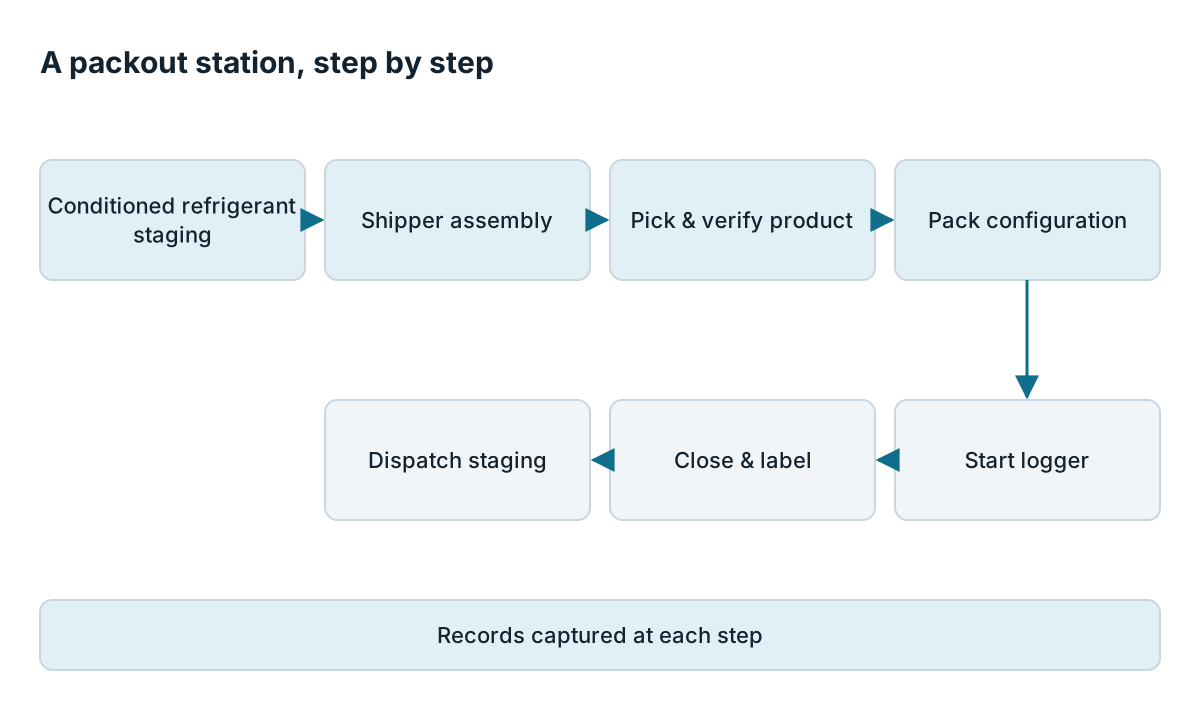
Four points follow from the sequence.
Keep the flow one-directional. Conditioned refrigerant enters at one end and finished packs leave at the other. If unused refrigerant goes back to the freezer, set a rule for how long it may be out and how it is tagged. Without that rule, returned packs mix with fresh ones.
Separate conditioned and unconditioned material. A marked bin or rack for each state is cheap and removes a common failure mode. Color alone is a weak control for operators who work quickly, so add a label that states the status.
Place the logger step on purpose. If the logger must be started before the pack leaves the station, put the start point inside the sequence and make the check visible, for example a scan or a recorded confirmation. Logger selection is a separate topic.
Decide where the pack is closed and sealed. Tape, closure and any tamper evidence belong at a defined spot with the right tools within reach. If the line has automatic case sealing downstream, the end-of-line packout guide covers how that interface works with insulated shippers.
Comparing station formats
| Format | Suits | Main strengths | Main watch points |
|---|---|---|---|
| Manual bench | Low volume, many pack configurations | Flexible, low capital, quick to change | Depends on operator discipline and work instructions; records often paper-based |
| Bench with guided steps (scan, display, scale) | Medium volume, regulated product | Verifies product, shipper and refrigerant IDs; creates records | Needs software ownership, change control and a fallback for when the system is down |
| Semi-automated line (conveyor, printer, sealer) | Repeatable pack configurations | Steady pacing, consistent closure and labeling | Changeover between configurations; shipper handling on conveyors |
| Fully automated cell | Few configurations, high volume | Low labor per pack | Limited tolerance for shipper variation; high qualification effort; justification needs real volume data |
If your order mix includes many shipper sizes, a guided manual or semi-automated format usually holds up better than a cell designed around one case. If your mix is stable and high volume, automation is worth pricing, but ask suppliers how the equipment handles a shipper that arrives slightly out of tolerance.
Material staging
Staging decides whether the station runs smoothly or stops every twenty minutes.
- Refrigerant. Define the container, the quantity per staging unit, the conditioning location and the replenishment trigger. Refrigerant may be bought or made on site. If you make it, the gel-pack filling and sealing guide covers how to specify that upstream process.
- Shippers and inserts. Keep them dry and flat, with different sizes visually distinct, and define how damaged shippers are removed.
- Closure materials. Tape, seals and any desiccant or void fill should sit within short reach of the closing step.
- Labels and documents. Keep them in a controlled location and limit what can be printed at the station. The labeling guide explains why label material and surface conditions need their own check.
Records and data
Decide what the station must record, then pick the lightest method that does it reliably. Typical items are the order or batch identifier, shipper and refrigerant identification, conditioning status, logger identifier, operator, time of closing, and any deviation. If the record is electronic and falls under a regulated system, check the electronic records requirements that apply to you, such as 21 CFR Part 11 in the United States, with your quality group.
Barcode and identification choices should follow a recognized scheme. GS1 General Specifications define identification keys and barcode rules and are a reasonable reference when labels must be read across partners. Confirm the current version and what your customers require.
Decide who owns the data after the pack leaves. Dispatch teams often need the logger identifier linked to the order, which ties directly to warehouse and dispatch handoffs.
Interfaces and utilities
List every interface in writing:
- Upstream: where products arrive, in what container, at what temperature, and how long they may wait.
- Downstream: where closed packs go, who collects them, and the maximum time before they move to controlled storage or transport.
- Software: order system, label printing, record storage, and the logger system if used.
- Machine states: if any equipment is automated, ask whether it reports states and faults in a standard way. PackML provides common machine states and an interface approach that many controls teams recognize. Ask suppliers what they support rather than assuming.
- Utilities: power, compressed air, network, lighting, floor loading and ambient control. A station in a cold room or anteroom has different constraints for labels, tape and operator gloves than one on a dry floor.
For powered equipment, ask for the supplier’s risk assessment approach. ISO 12100 describes general risk assessment and risk reduction for machinery, and in the EU the Machinery Regulation (EU) 2023/1230 sets the legal framework. Your safety staff should confirm which requirements apply in your location.
Ergonomics and failure modes
Operators are the control system on most stations, so design for them. Keep reach distances short, put heavy items at waist height, keep the work instruction at the point of use, and make the correct action the easiest one.
Common failure modes to design against:
- Refrigerant outside its conditioning window.
- A shipper size that does not match the pack configuration.
- A logger not started, or started on the wrong shipper.
- Closure applied but label or seal skipped.
- Records completed after the fact from memory.
- Changeover left incomplete between configurations.
For each one, decide what prevents it, what detects it, and who acts.
Station design checklist
Use this list in design reviews and in supplier discussions.
- Pack configurations, volumes and peak hours are written down and agreed.
- Conditioning window, maximum ambient dwell and replenishment trigger are defined.
- Flow is one-directional, with separate marked areas for conditioned and unconditioned material.
- Each step has a work instruction at the point of use.
- Logger start and verification are built into the sequence.
- Records required per pack are listed, with owner and storage location.
- Label and barcode requirements are agreed with downstream partners.
- Upstream and downstream interfaces, including time limits, are documented.
- Utilities and environmental conditions are confirmed for the actual location.
- Machine safety approach and applicable regulations are confirmed for powered equipment.
- Changeover and cleaning steps are defined and short enough to be followed.
- Failure modes are listed with prevention and detection.
- Acceptance evidence is agreed before purchase.
When you are ready to ask suppliers for quotes, the equipment RFQ checklist lists what to include so quotes can be compared on the same basis.
Scope note: This guide covers station design and process interfaces. It does not set temperature limits, choose a shipper or refrigerant, or decide whether any product may be released. Those depend on your product documentation, your validated pack configuration and your quality system.
Limitations of this guide
This is a general checklist. It does not use measured data, and it does not replace a site assessment, a process risk assessment or a qualification plan. Standards and regulations are named for context only; check the current versions and the requirements that apply in your market. Supplier statements about speed, accuracy or suitability should be confirmed by evidence from your own product and pack configuration.
Related guides

How to Specify a Gel-Pack Filling and Sealing Process
How to define refrigerant, film, fill quantity, sealing and cleaning requirements before you ask suppliers about gel-pack filling and sealing equipment.
Read guide
Labeling Refrigerated Packages: Materials, Surface Conditions and Line Integration
How to separate label-material fit from labeling-equipment fit for refrigerated packages, with surface conditions, line integration and a checklist for suppliers.
Read guide
Cartoning, Case Packing and Case Sealing in a Cold Chain Packout Line
How retail cartoning, shipping case packing, case sealing and insulated packaging steps differ in a cold chain line, and what to check at each interface.
Read guide
Cold Chain Equipment Procurement: A Practical RFQ Checklist
Turn capacity, environment, interfaces, evidence, service and acceptance needs into a clear RFQ, with a copy-ready field table for packout equipment buyers.
Read guide