
Labeling Refrigerated Packages: Materials, Surface Conditions and Line Integration
How to separate label-material fit from labeling-equipment fit for refrigerated packages, with surface conditions, line integration and a checklist for suppliers.

Two fit questions
When a label falls off a refrigerated package or a barcode will not scan, people tend to blame the printer or the applicator. Often the label material is the cause. Labeling refrigerated packages raises two separate fit questions:
- Material fit. Does the label, meaning the face stock and the adhesive together, stick to this surface under these conditions and stay readable for the full journey?
- Equipment fit. Can the printer and applicator place that label accurately, at the speed and in the position the line needs, and can the result be verified?
You need an answer to both. A good applicator cannot rescue a label that will not bond to a cold, damp or frosted surface, and a good label will not help if the applicator places it crooked on shippers of varying sizes. Ordinary labels do not work everywhere, and no guide can promise they will. Test fit on your surface, in your conditions, with your label.
For other automation topics, see the Automation section hub.
Surface and condition inputs to define
Write these down before talking to label or equipment suppliers.
- Substrate. Corrugated board, coated or printed carton, expanded polystyrene, other foam, plastic film, rigid plastic, or a reusable shipper with a molded surface. Each has a different surface energy, texture and dust level.
- Surface temperature at application. The package may have come from a cold room, may contain frozen refrigerant, or may be at ambient. Its surface may be colder than the room.
- Moisture. Condensation forms when a cold package meets warmer humid air, and frost forms on very cold surfaces. Water at the interface stops a standard adhesive from bonding.
- Time and temperature after application. Will the package go into a freezer, a cold room, a truck or an air shipment? Adhesives and face stocks behave differently across temperatures, and what matters is the range your package will actually see.
- Handling. Abrasion, stacking, conveyor contact, and whether the label must survive repeated handling or reuse of the shipper.
- Placement area. Flat or textured, available size, and whether the label wraps an edge.
- Variable data. Barcode symbology, human-readable text, handling marks, and lot or order data. These decide the printing method and resolution.
The diagram shows the stack from surface to scan.
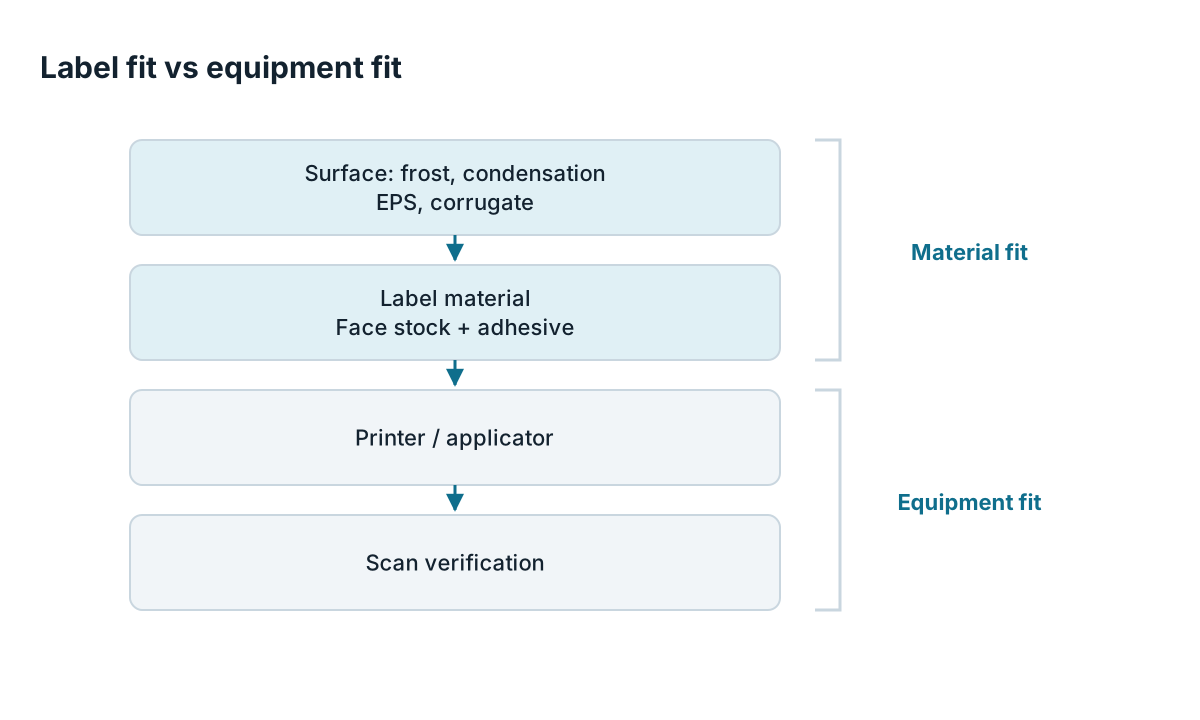
Failures usually start at the top of the stack and show up at the bottom. A scan failure may trace back to condensation under the label rather than the scanner.
Label material questions for suppliers
Put these questions to the label supplier, not the equipment supplier.
- What face stock and adhesive are proposed, and for what substrate and temperature range are they specified? Ask for the supplier’s own data sheet.
- Is the adhesive meant for application to cold or damp surfaces, or only for use at low temperature after application at room temperature? These are different properties.
- Is the face stock compatible with the print method, whether thermal transfer, direct thermal or another, and is the print durable under condensation and abrasion?
- How should the label be stored, and what shelf life applies?
- Can the supplier provide samples to apply under your actual conditions?
If the packaging is expanded polystyrene or textured corrugate, ask specifically about conformability to rough surfaces. A label that bonds on smooth film may bridge the peaks of a textured surface and lift at the edges. If packages arrive cold and damp, consider whether conditions can change upstream, for example by labeling before the package is chilled or after it has equilibrated, before you go looking for a more aggressive adhesive.
Direct thermal printing is convenient, but its printed image can be sensitive to heat, light and abrasion. Thermal transfer uses a ribbon and generally suits longer-lived marks. Pick the one that fits the shipment’s life, and confirm with the supplier.
Equipment choices
| Option | Suits | Strengths | Watch points |
|---|---|---|---|
| Manual print and apply at the station | Low volume, varied shippers | Flexible; operator can inspect surface | Placement varies; operator must handle condensation |
| Print-and-apply on a conveyor | Medium to high volume, defined shipper range | Consistent position and data | Needs stable package presentation; sensors for varying heights |
| Label applicator with pre-printed labels | Fixed content, separate print step | Simple applicator | Variable data must be handled elsewhere |
| Inline print with scan verification | Regulated or high-value shipments | Closed loop check of readability and content | Adds integration, data handling and reject logic |
If the line runs mixed shipper sizes, ask how the applicator finds the target surface and what happens when a package arrives rotated or tilted. If packages are wet or frosted at the applicator, ask whether the equipment can wipe or dry the area, or whether that has to be a separate step.
Integrating labeling into the line
Where labeling sits relative to other steps affects both material fit and equipment fit.
Before or after closing. Labeling after case sealing means the label may cross a tape seam or flap line. Labeling before closing may be simpler but leaves the outer surface unlabeled. The packout station guide shows where closing and labeling sit in a station sequence, and the end-of-line packout guide covers how labeling relates to case sealing and palletizing.
Data source. Generate the label from the order or batch record so nobody retypes the content. Confirm what happens when the order system is unreachable.
Verification. Decide whether to scan every label or sample. For identifiers and barcodes, the GS1 General Specifications are a common reference for what a readable label should carry in supply chains. Check the current version and what your partners require.
Machine interface. For automated equipment, ask what states and fault signals the applicator exposes to the line controller. PackML is a recognized approach to machine states. Ask what the supplier supports and what that means in practice.
Records. If label data are linked to electronic records in a regulated process, review the relevant rules with your quality group. For example, 21 CFR Part 11 applies to some electronic records and signatures in the United States.
Safety. Applicators have moving parts. Ask for the supplier’s risk assessment; ISO 12100 describes the general method.
Some applications add their own demands. Clinical trial kits may need multiple language or blinded labeling, which affects label design, as discussed in the clinical trial kit guide. In dispatch, scan reliability at carrier and warehouse handoffs matters most, which links to the warehouse and dispatch guide.
Testing before you commit
Reproduce the real condition in the trial, not the demonstration condition.
- Apply labels to packages taken from the real temperature condition, not from a dry bench.
- Hold labeled packages through the intended temperature and handling cycle.
- Check adhesion at edges, print legibility and barcode scan rate at the end of the cycle.
- Run the trial with the expected shipper size range, not at a single size.
- Record the label lot, surface condition and ambient condition used.
Ask suppliers to state in writing what was tested, under what conditions, and what it does not cover. Test results from a different substrate or temperature do not carry over.
Labeling checklist
- Substrate, surface temperature and moisture at application are described.
- Temperature and handling range after application is described.
- Label supplier has provided face stock, adhesive and print method data for these conditions.
- Samples have been applied and held under real conditions.
- Printer or applicator suits the shipper size range and presentation.
- Label position is defined, including relation to seams and flaps.
- Barcode and data requirements are agreed with partners.
- Verification method and reject handling are defined.
- Line interface, machine states and fault signals are documented.
- Order system fallback is defined.
- Safety risk assessment is requested for powered equipment.
Scope note: This guide separates label-material fit from equipment fit. It does not promise that any label or applicator will work on your packages, and it does not name products. Suitability has to be shown by trials on your surfaces and under your conditions.
Limitations of this guide
This is general guidance, not test data. We have not tested labels, adhesives or applicators, and nothing here replaces supplier data or your own trial. Standards are named for context only; check current versions and the requirements that apply to your product and market.
Related guides
Designing a Cold Chain Packout Station: Process and Equipment Checklist
A practical checklist for designing a cold chain packout station: workstation layout, refrigerant staging, records, interfaces and what to confirm before buying.
Read guide
Cartoning, Case Packing and Case Sealing in a Cold Chain Packout Line
How retail cartoning, shipping case packing, case sealing and insulated packaging steps differ in a cold chain line, and what to check at each interface.
Read guide
Planning a Clinical-Trial Kit Shipping Workflow
Map kit components, labeling, handovers and temperature evidence for clinical trial kit shipping, with clear owners and an escalation path for excursions.
Read guide
Temperature-Sensitive Dispatch: A Warehouse Handover Checklist
A cold chain dispatch checklist covering pick checks, logger start, documents, carrier handover, data responsibility and exception escalation fields.
Read guide