
Planning a Clinical-Trial Kit Shipping Workflow
Map kit components, labeling, handovers and temperature evidence for clinical trial kit shipping, with clear owners and an escalation path for excursions.

Scope: why kits differ from commercial shipments
A clinical-trial kit is a set of items prepared for one study site, often for one participant visit or one supply period. It may hold investigational product, comparators, ancillary supplies, instructions and a temperature monitor. Quantities are small, destinations are many, and each kit must be traceable to a study, a site and sometimes a participant. That changes how packout is planned compared with commercial pharmaceutical shipping, even though many physical steps look similar.
Scope note: This guide does not state temperature limits for any investigational product, and it does not make usability, release or excursion disposition decisions. Product temperature limits and release decisions come from product documentation and the responsible quality function, working with the sponsor. This guide describes how to organize the workflow, not what is acceptable.
The sponsor holds overall responsibility for the study. Depots, couriers, packaging vendors and sites each own parts of the workflow under written agreements. In the EU, Regulation 536/2014 sets the framework for conducting clinical trials, and good distribution practice guidance covers distribution responsibilities. Both are context only. Your regulatory affairs and quality teams define which rules apply to each study and country, and you should always check current versions.
For the commercial equivalent, see our guide to pharmaceutical shipping packout. This article is part of the Applications section.
The workflow at a glance
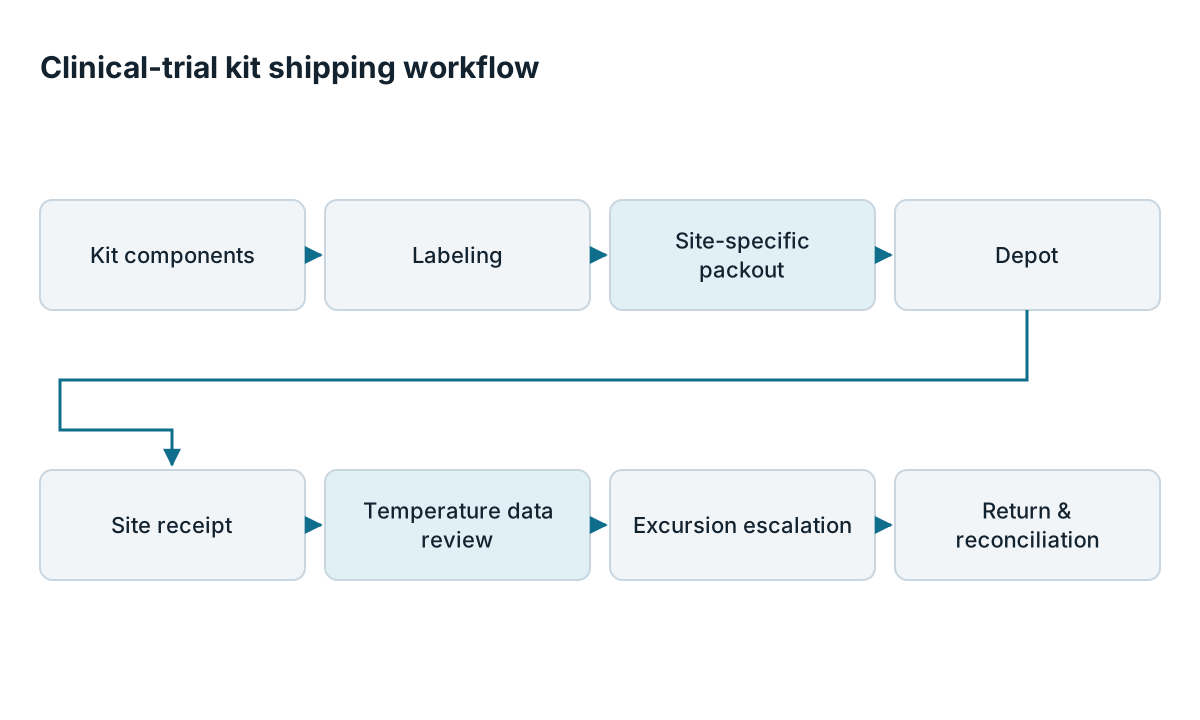
Assign one accountable owner and one record to each of the eight steps, then check the hand-offs between them. The sections below follow the same order.
Kit components
Start with a bill of materials per kit type. List the primary product, any diluent or accessory, the instructions, the return materials and the monitoring device. For each component, record who supplies it, whether it has its own storage condition and whether components can share a shipper.
Components with different conditions are a common source of confusion. If one item in a kit needs a different condition from another, decide with the sponsor’s quality team whether they ship together or separately, and write the answer into the kit specification. Packout staff should not make that choice on the day.
Labeling
Labeling in clinical supply is controlled by study-specific rules. Content, language and format vary by country, and the sponsor’s regulatory function owns them. The shipping team makes sure the right label goes on the right kit and that the outer shipping label matches the kit contents and destination.
Define these points:
- Which labels are applied before packout, such as kit and product labels, and which at the station, such as shipping and handling labels.
- How kit identity is read and confirmed, whether by barcode or by manual check. Identification keys and barcodes often follow GS1 conventions, so confirm what your depot and sites can scan.
- How relabeling or label changes are controlled during a study.
- How blinding is protected where a study is blinded, since temperature labels or packing lists must not reveal the treatment.
Our article on cold chain labeling equipment explains how to specify printing and verification on the equipment side. Get your label rules from the sponsor before talking to vendors.
Site-specific packout
Many studies ship to sites in different regions with different transit times. Site-specific packout means selecting a qualified configuration that suits the lane to that site. The configuration, its qualified duration and its monitoring requirements come from the packaging specification the sponsor’s quality function approves. The packout team follows the written instruction for the lane and does not choose by judgment.
Keep the packout record simple: kit identifier, shipper configuration identifier, refrigerant conditioning record, logger identifier and time of closing. If your packout step is partly automated, make sure the same data points are captured. Our guide to temperature data logger selection describes how to define logger requirements, including how start and association with a kit are recorded.
Depot, transit and site receipt
Shipments often pass through a depot or distribution center before reaching a site. Each handover creates risk: waiting time on a dock, a weekend hold or a missed pickup. For each handover, define who is responsible for the box, what check is performed on receipt and where it is recorded. Our warehouse handover checklist provides a template for dispatch-side checks.
At the site, the receiver needs simple instructions. State who may open the box, what to do with the logger or its display, whom to contact, and where to store the contents while awaiting instruction. Do not ask sites to judge usability. That decision sits with the sponsor’s quality function, so the instruction should tell the site to quarantine the kit and contact the named person if anything looks wrong.
Temperature data review and excursion escalation
Temperature data has value only if someone reviews it against a defined rule. Define:
- Who retrieves or receives the data and within what timeframe.
- Who reviews it and against which approved criteria.
- Who is told when a result falls outside those criteria, and through what channel.
- Who decides disposition. That belongs to the sponsor’s quality function, not to the depot or courier.
An excursion escalation path needs names, roles and contact methods as well as a policy statement. Include out-of-hours cover when kits ship on Fridays or before holidays.
Return and reconciliation
At the end of a visit period or study, unused or returned kits and loggers need to be accounted for. Plan return shipping with the same care as outbound: packaging for return, labels, documentation and a record of what came back. Reconciliation compares what was sent, used and returned, which depends on clean records from every earlier step.
Typical failure modes
Small shipment volumes hide process weaknesses until a kit goes wrong. Frequent causes include a kit assembled to an outdated specification, a label version changed mid-study without a matching change at the depot, a logger started but never linked to the kit it travelled with, and a site that holds a delivered box on a loading bay because the instructions did not say whom to call. Another common gap is an excursion alert that reaches a courier or depot contact who has no authority to decide anything. Each of these is a handover problem, not an equipment problem, so when a workflow underperforms, check the handovers first.
Who owns what
| Step | Typical owner | Record produced | Common gap |
|---|---|---|---|
| Kit components | Sponsor supply and quality | Kit specification and bill of materials | Mixed storage conditions not addressed |
| Labeling | Sponsor regulatory with packaging vendor | Label approval and application record | Outer label does not match contents |
| Site-specific packout | Packaging vendor or depot | Packout record with logger identity | Wrong configuration for lane |
| Depot | Depot operator | Receipt and dispatch record | Unrecorded waiting time |
| Site receipt | Site staff with monitor or sponsor contact | Receipt confirmation | Unclear instructions at site |
| Temperature data review | Sponsor quality or delegate | Review record | No defined review timeframe |
| Excursion escalation | Sponsor quality | Deviation record | Contact route not covered after hours |
| Return and reconciliation | Depot and sponsor supply | Reconciliation record | Missing logger or kit identity |
Questions to ask service providers
- Which steps are performed by your staff, which by subcontractors, and how are handovers recorded?
- How do you link a logger to a kit, and how do we obtain that record?
- How do you handle a late or missed pickup, and who is notified?
- What is your process when a site reports damage or an unexpected result?
- How do you protect blinding in packing lists and shipping documents?
Workflow planning checklist
- Bill of materials written for each kit type, with storage condition per component from product documentation.
- Sponsor quality named as decision-maker for usability and excursion disposition.
- Label rules received from sponsor regulatory, including blinding constraints.
- Qualified shipper configuration assigned per lane or region.
- Packout record defined, including logger identifier and closing time.
- Handover points mapped from packout to site, each with named owner and record.
- Data review timeframe and criteria approved by quality.
- Escalation contacts defined, including out-of-hours cover.
- Return and reconciliation process written and communicated to sites.
Limitations of this guide
This guide offers general planning information. It does not specify temperature limits, does not interpret clinical trial regulation for any country and does not replace the sponsor’s quality system or your regulatory advisers. Standards and regulations change, so check the current version and your own obligations. Cold Chain Practice has not tested or validated any workflow or equipment described here.
Related guides
How to Specify a Cold Chain Temperature Data Logger
A specification checklist for a cold chain temperature data logger: range, accuracy, logging interval, export method and calibration documents to request.
Read guide
Labeling Refrigerated Packages: Materials, Surface Conditions and Line Integration
How to separate label-material fit from labeling-equipment fit for refrigerated packages, with surface conditions, line integration and a checklist for suppliers.
Read guide
Pharmaceutical Shipping Packout: What Buyers Must Define Before Equipment Selection
Build packout requirements from product documentation, lane assessment and quality input before you shortlist equipment. Owners, interfaces and records.
Read guide
Temperature-Sensitive Dispatch: A Warehouse Handover Checklist
A cold chain dispatch checklist covering pick checks, logger start, documents, carrier handover, data responsibility and exception escalation fields.
Read guide