
Dry Ice Shipping Regulations: IATA PI 954 and DOT
Separate the US hazardous materials table from IATA Packing Instruction 954, and mark net dry-ice mass on each package before acceptance.
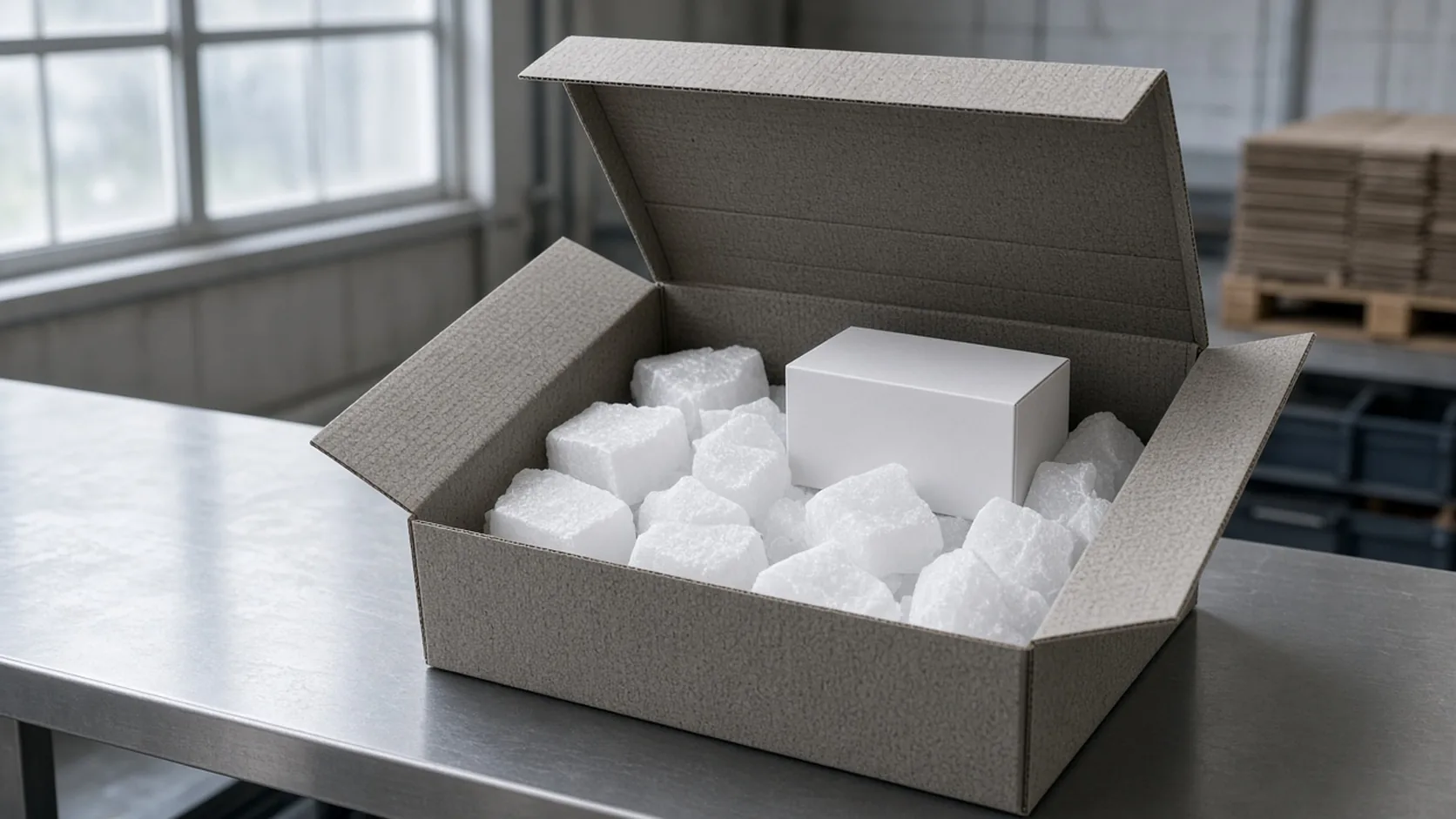
A gas-tight shipper can rupture as dry ice sublimates, and a package marked with the consignment total can fail an acceptance check that is scored per package. Dry ice shipping regulations split in two: the US Hazardous Materials Table and 49 CFR 173.217 set the DOT baseline for aircraft and vessel, and IATA Packing Instruction 954 is what the air acceptance checklist actually scores.
For cargo, UN 1845 is class 9, proper shipping name “Carbon dioxide, solid” or “Dry ice,” with a 200 kg net limit per package on both passenger-aircraft and cargo-aircraft columns of the US table. That 200 kg figure is a per-package maximum, not a consignment maximum. IATA’s dry-ice acceptance form for Edition 68, dated 1 January 2027, checks the same 200 kg per package and adds a Class 9 label that the US table does not assign. This page is the document check. Coolant duration and carrier surcharges stay in the refrigerant and packout cost guides. The applications section is the parent for the shipping workflow.
Quick specs from the table and the acceptance form
Read the row before designing the box. The values below are the published limits and marks, not a packout recipe.
Table: scroll horizontally if needed to see every column.
| Input or item | Published value | Why it matters |
|---|---|---|
| Identification | UN1845, class 9, no packing group | Basic description on the alternative air document |
| Proper shipping name | “Carbon dioxide, solid” or “Dry ice” | The word “or” in the table is a choice of names |
| US symbols | A and W | HMR applies to aircraft and vessel, not to every highway move |
| US label code | None | No hazard label is assigned by column 6 |
| Columns 9A and 9B | 200 kg net per package, both | Passenger aircraft/rail and cargo aircraft share the cap |
| Small-quantity refrigerant path | Not exceeding 2.5 kg (5.5 lb) per package | 173.217(c)(5), only with the vent rule and the stated marks |
| IATA Edition 68 quantity check | 200 kg or less per package | Does not apply when the dry ice is offered in a ULD |
| IATA Class 9 label | Required on that checklist | Different from the US label code of None |
Column 9 limits are net unless the table says otherwise (49 CFR 172.101(j)(2)). Stowage category C means on deck only on a cargo vessel or a passenger vessel (49 CFR 172.101(k)(3)). Column 10B shows code 40; the meaning of that code is in 49 CFR 176.84 and is not restated here.
Which move is even inside the regulation
The letter A means the entry is subject to the Hazardous Materials Regulations only when offered or intended for transportation by aircraft, unless the material is a hazardous substance or a hazardous waste. The letter W does the same for vessel. Either description may still be used on another mode if every requirement of the entry is met (49 CFR 172.101(b)(2) and (b)(6), table as displayed 16 October 2026).
A domestic highway tender of ordinary frozen food with dry ice is therefore outside this table unless the dry ice is a hazardous substance or hazardous waste, or the shipper chooses to apply the entry. An aircraft or vessel tender is inside it. Cold shipping, in the sense of a temperature-controlled service, does not change that split: the shipping-terms guide separates the service name from the dangerous-goods description.
Rule of thumb: If net dry ice in one package exceeds 2.5 kg on an aircraft or vessel tender, skip 173.217(c)(5) and use the net-mass mark plus the alternative written description in 173.217(c)(4), then test that package mass against the 200 kg column. If net dry ice is 2.5 kg or less per package, used only as a refrigerant, and the package vents, (c)(5) is the US exception path.
What 49 CFR 173.217 requires once the mode is in scope
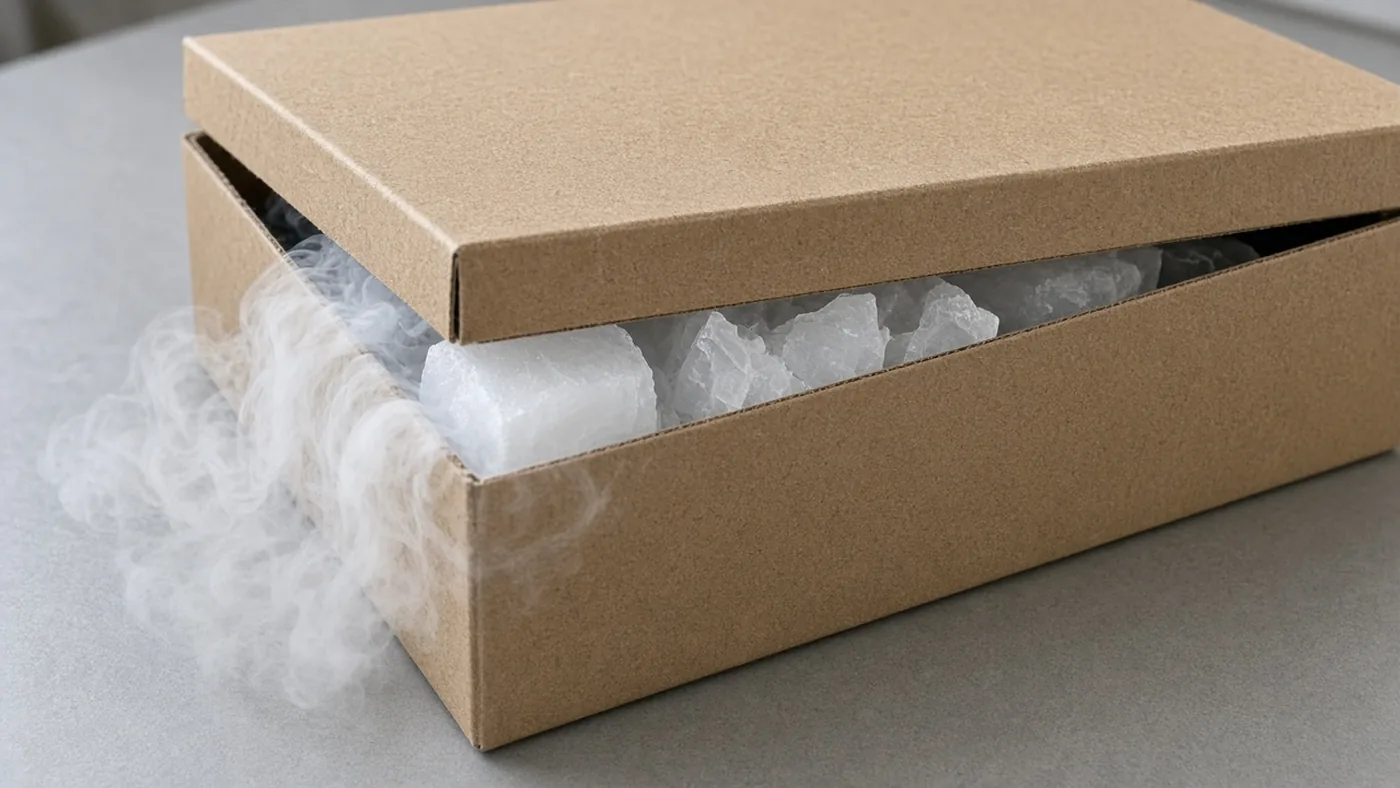
For aircraft or water, dry ice must be packed so carbon dioxide gas can leave the packaging and pressure cannot build up enough to rupture it. The packaging follows the general requirements in 49 CFR 173 subpart B and does not have to meet part 178 (49 CFR 173.217(a), CFR edition of 1 October 2024). The open seam in the photograph above is the physical point of that rule.
On a vessel, each transport vehicle and freight container gets “WARNING CO2 SOLID (DRY ICE)” on two sides. Other packagings are marked “CARBON DIOXIDE, SOLID—DO NOT STOW BELOW DECKS.” That second mark matches stowage category C: on deck only.
On an aircraft, four further rules sit on top of the vent:
- Mark the net mass of dry ice on the outside of the package. The same mark applies to a unit load device when the ULD is the packaging (173.217(c)(1)).
- The shipper makes arrangements with the operator for each shipment (173.217(c)(2)).
- Columns 9A and 9B do not apply when dry ice refrigerates something other than a hazardous material inside a ULD, the ULD is identified to the operator, and the ULD vents (173.217(c)(3)).
- A shipping paper is not required if alternative written documentation states the proper shipping name, class 9, UN 1845, the number of packages, and the net quantity in each package, included with the description of the materials (173.217(c)(4)).
The 2.5 kg path is narrower than “small box, skip the paperwork.” It applies only when the dry ice does not exceed 2.5 kg (5.5 lb) per package, is used as a refrigerant for the contents, the package vents under paragraph (a), and the package is marked “Carbon dioxide, solid” or “Dry ice,” the name of the contents being cooled, and either the net weight or an indication that the net weight is 2.5 kg (5.5 lb) or less (173.217(c)(5)).
A separate exception drops the shipping paper and the certification when dry ice refrigerates diagnostic or treatment material, such as frozen medical specimens, if paragraphs (a) and (c)(2) are met and the package is marked with the dry-ice name and an indication of that diagnostic or treatment purpose (173.217(d)). It does not erase the vent or the operator arrangement. Pharmaceutical and kit lanes still start from the product file in the pharmaceutical packout guide and the clinical-trial kit guide.
What the IATA PI 954 check adds
The retrieved IATA form is an acceptance checklist for dry ice when a Shipper’s Declaration for Dangerous Goods is not required. It covers dry ice packaged alone or with non-dangerous goods. The form is printed “EDITION 68, 1 JANUARY 2027.” On 20 October 2026 that edition is ahead of the flight date. Use it as the published next-edition check, and confirm the edition in force on the day of carriage. A “No” on any applicable item means the shipment is not accepted; the form says to give the shipper a duplicate.
The air-waybill “Nature and Quantity of Goods” box, or alternate transport documentation, is checked for UN1845, the words “Carbon dioxide, solid” or “Dry ice,” the number of packages unless those packages are the whole consignment, and the net weight of dry ice in kilograms. State and operator variations are a separate item.
Quantity item 6 asks whether the dry ice per package is 200 kg or less. The note above that item says the following questions do not apply when the dry ice, or packages containing it, is offered in a ULD. That lines up with the US ULD exception in 173.217(c)(3), but the two texts are not the same sentence: the US exception is limited to dry ice refrigerating other than hazardous materials, with the ULD identified to the operator and able to vent.
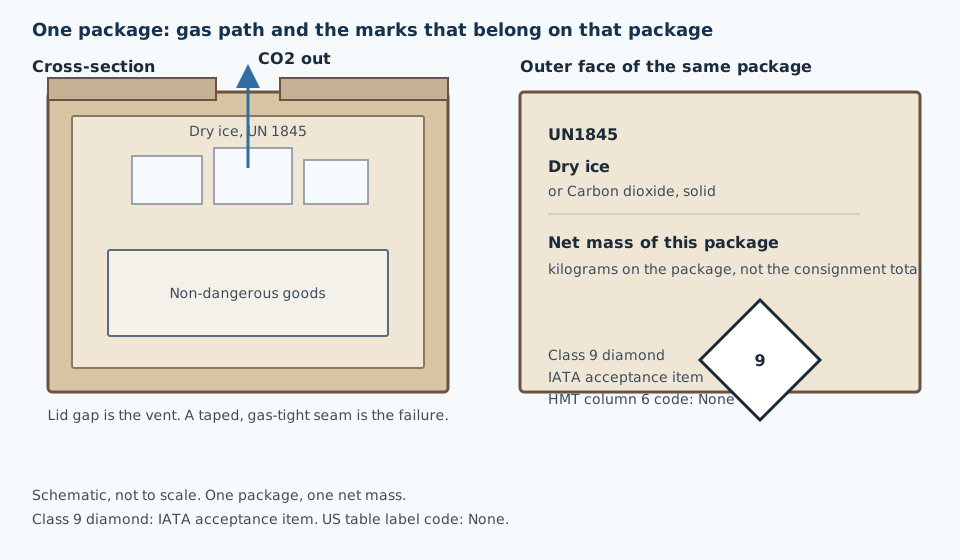
Package checks require the same number of packages as the air waybill, packages free from damage and leakage, and packaging that conforms to Packing Instruction 954 and is vented to release gas. Marks are UN1845, the proper shipping name, the full name and address of shipper and consignee, and the net weight of dry ice within each package. The name and address on the package may differ from the air waybill. A Class 9 label must be properly affixed. Irrelevant marks and labels are removed or obliterated.
That Class 9 label is the sharp difference from DOT. Column 6 of the US table for UN1845 is “None,” and column 6 is where required hazard labels are coded (49 CFR 172.101(g)). An IATA acceptance check can still demand the Class 9 label. Affixing it for the air checklist does not mean the US table assigned it.
For an overpack, required marks and labels must be visible or reproduced, the word “Overpack” is marked when the inner marks are not visible, and the total net weight of dry ice in the overpack is marked.
Worked example: four packages, one air waybill
The limit is applied to each package. The document total is the sum. Use assumed net masses of 12 kg, 18 kg, 22 kg and 45 kg of dry ice, each refrigerating non-dangerous food, none of them loaded as a ULD.
N_awb = 12 + 18 + 22 + 45 = 97 kg
Each package is under 200 kg, so each passes column 9A, column 9B, and Edition 68 item 6. The air waybill net weight is 97 kg. The package that holds 45 kg is marked 45 kg, not 97 kg. The 12 kg package is marked 12 kg.
None of the four is at or under 2.5 kg, so 173.217(c)(5) is unavailable. Each package still needs the vent from paragraph (a), the net-mass mark from (c)(1), the operator arrangement from (c)(2), and the alternative written description from (c)(4) if no shipping paper is used. A fifth package at 1.8 kg, vented, marked with the dry-ice name, the name of the food being cooled, and “1.8 kg” or “2.5 kg or less,” is the package that can use (c)(5).
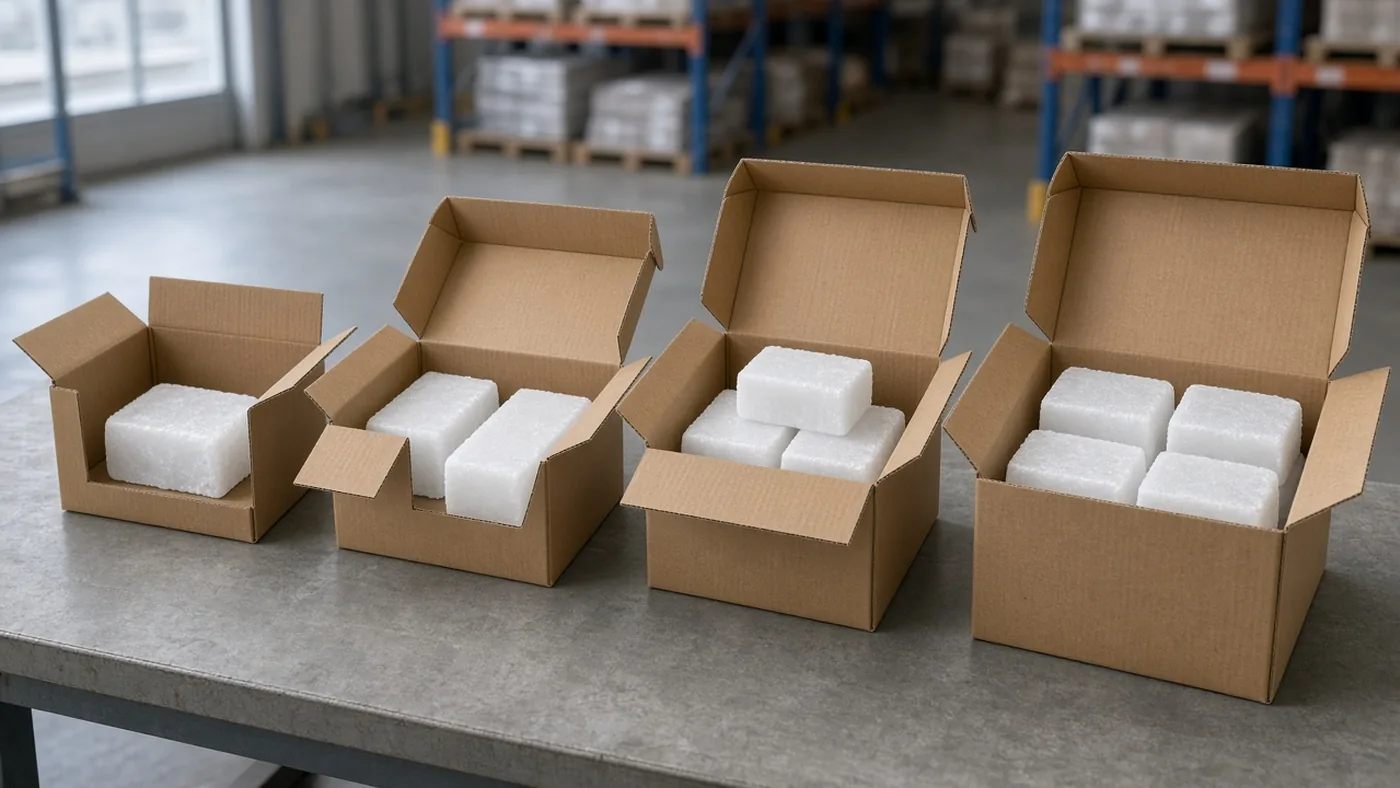
If those four packages go into one overpack and the inner marks are hidden, the overpack is marked “Overpack” and with the 97 kg total net dry-ice mass, and the UN number, name, and Class 9 label are reproduced on the outside. Hiding the 45 kg mark behind an overpack wall is an acceptance failure even when the arithmetic total is right.
Where acceptance fails, and what prevents it
Table: scroll horizontally if needed to see every column.
| Check | Dominant failure mode | Prevention |
|---|---|---|
| Vent | Pressure buildup ruptures a gas-tight shipper, or the PI 954 vent item is marked No | Leave a release path that matches 173.217(a); do not tape the lid into a seal |
| Net mass on the package | The consignment total is written on every box, so one package appears over 200 kg or the wrong package is loaded | Mark the net mass of the dry ice inside that package |
| 2.5 kg exception | A 6 kg package is tendered with only the small-quantity wording | Above 2.5 kg, use (c)(1) and (c)(4) and the 200 kg test |
| Class 9 | The US label code “None” is treated as permission to skip the IATA label | Affix the Class 9 label when the IATA checklist applies |
| Overpack | Inner marks are covered and the overpack has no total net mass | Reproduce the marks and mark the overpack total |
| Edition date | The 1 January 2027 form is used on a 2026 flight, or an older form is used after that date | Match the checklist to the DGR edition in force on the flight date |
| ULD | The 200 kg package cap is ignored, or it is applied, for the wrong reason | US (c)(3) and the IATA ULD note both have conditions; read the one that governs the tender |
A failed check has a cost that never appears on a rate card. The Edition 68 form says a single “No” stops acceptance. Dry ice keeps sublimating while the freight sits, so the net mass marked at the first tender is not the net mass at the second tender. Reweigh, remark, and only then tender again. That labor, the missed uplift, and the lost refrigerant are the hidden cost. A FedEx dry ice shipping cost calculator, or any carrier surcharge tool, prices a shipment the operator has already agreed to carry. It does not set the 200 kg cap or the vent rule. Build the surcharge question only after the marks pass, using the structure in the packout cost guide. The parcel-carrier checklist is where FedEx, UPS, DHL and USPS acceptance documents are separated from the packout. Who weighs the package at dispatch is in the warehouse handover checklist.
When this does not apply
Passenger baggage is a different provision from cargo PI 954. This page does not state a baggage allowance. Highway-only domestic freight that is not a hazardous substance or hazardous waste is outside symbols A and W unless the shipper elects the entry. If the goods beside the dry ice are themselves dangerous goods, the “declaration not required” checklist does not clear those goods. Vessel moves still carry the two-side warning and the below-decks prohibition even when no aircraft is involved. Nothing here is a coolant-duration test or a carrier price.
Takeaway: Mark the net kilograms on each package, keep a vent path, and apply the 200 kg cap to that package. Use the Class 9 label when the IATA checklist is the acceptance document, and name the DGR edition dated for the flight.
Prepared by Cold Chain Practice Editorial Desk.
Related guides

Chilled and Frozen Food Packaging: Product Packing vs Thermal Shipping
Separate primary food packaging from thermal shipping packaging, and see where the equipment boundary sits between product packing and cold chain packout.
Read guide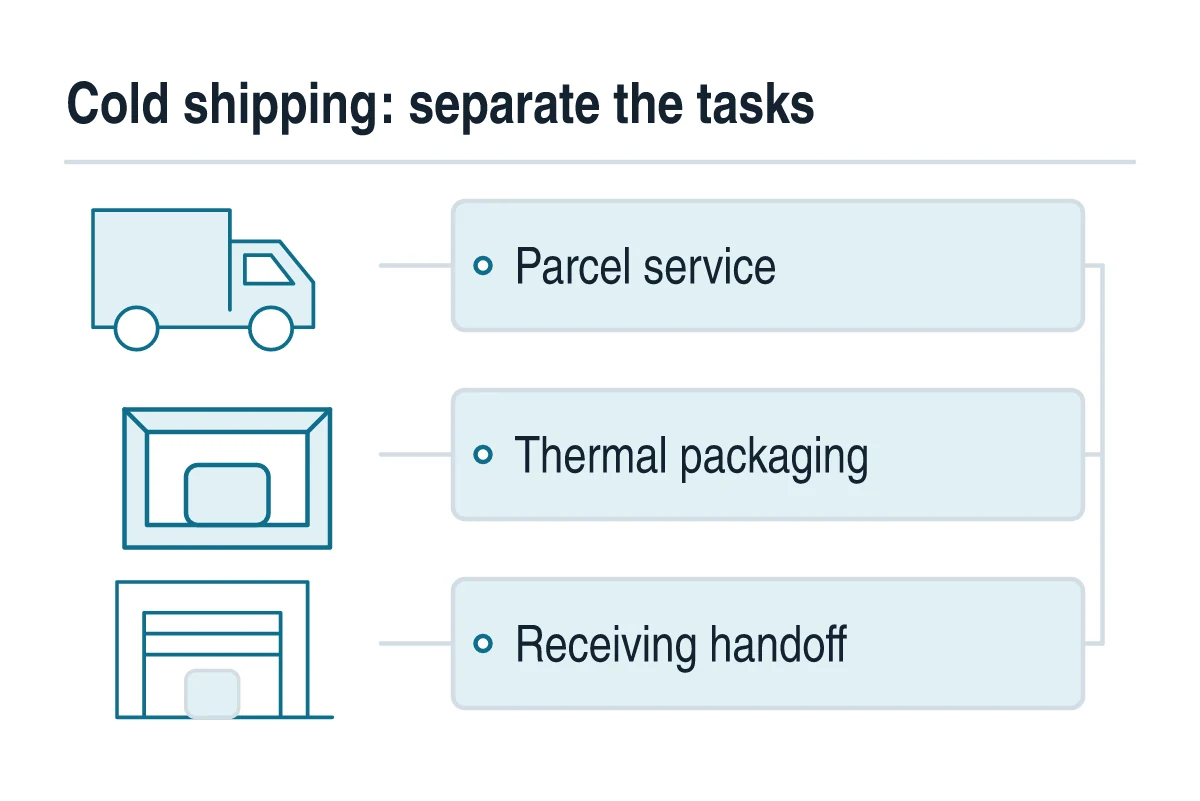
Cold Shipping Checks: FedEx, UPS, DHL and USPS
Separate parcel service from thermal packaging, check each carrier's official dry-ice rules, and record who owns preparation, transit and receipt.
Read guide
Pharmaceutical Shipping Packout: What Buyers Must Define Before Equipment Selection
Build packout requirements from product documentation, lane assessment and quality input before you shortlist equipment. Owners, interfaces and records.
Read guide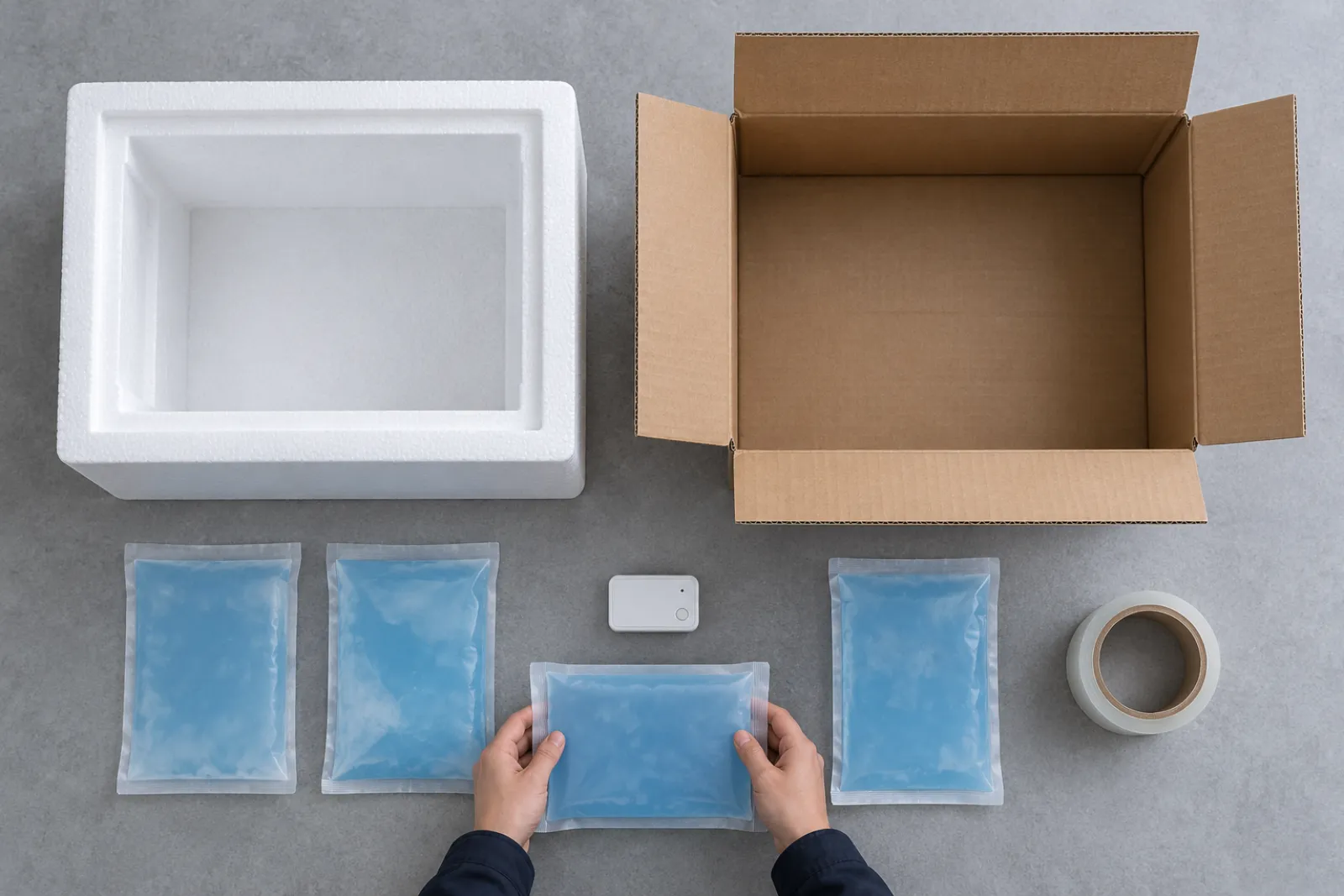
Cold Chain Packout Cost: A Transparent Comparison Worksheet
A transparent cost worksheet for cold chain packout: materials, labor, monitoring, return logistics and losses, with formulas and blank cells you fill in.
Read guide