
Cold Shipping Checks: FedEx, UPS, DHL and USPS
Separate parcel service from thermal packaging, check each carrier's official dry-ice rules, and record who owns preparation, transit and receipt.
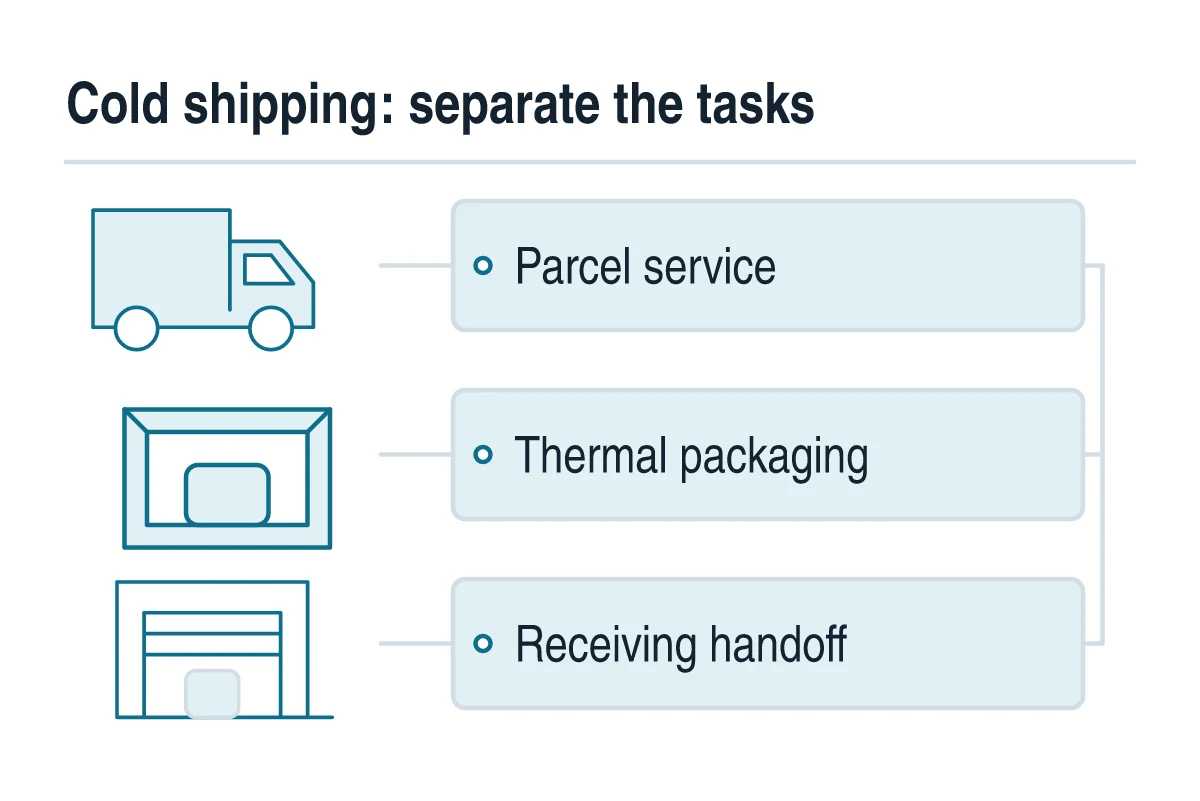
Choosing a parcel service without checking the packout can leave temperature-sensitive goods exposed to delays and damage. Confirm acceptance and the exact service first, then assess the box, coolant and receiving handoff as separate decisions.
This checklist is for US shippers researching FedEx cold shipping boxes, UPS cold shipping or comparable DHL and USPS parcel options for food and other non-pharmaceutical goods. It identifies documents and questions; it does not book transport, specify a temperature band or certify a packout. Cold Chain Practice has no carrier partnership and does not represent FedEx, UPS, DHL or USPS. The applications section covers the wider shipping workflow.
Quick specs: inputs to settle before comparing carriers
Start with the shipment specification, rather than a carrier brand. The following fields provide a common basis for asking different networks the same questions.
Table: scroll horizontally if needed to see every column.
| Input or item | Typical value or source | Why it matters |
|---|---|---|
| Contents and starting condition | Product owner’s specification | Defines the protection task |
| Origin and destination | Actual addresses and country | Lets the carrier assess the lane |
| Service and transport mode | Current carrier booking terms | Identifies the acceptance rules to review |
| Box and coolant configuration | Supplier instructions and your packout record | Defines what is inside the parcel |
| Intended transit and delay scenario | Lane plan and carrier information | Sets the packaging assessment window |
| Receiver and storage handoff | Consignee’s receiving procedure | Gives arrival an accountable owner |
Keep packaging design questions in the insulated shipper selection guide. Here, the output is a record of what the carrier has agreed to handle and what your team still owns. A quote showing a delivery service is not, by itself, a thermal performance report.
Takeaway: Use the same product, route and packout description for every carrier inquiry.
Separate the transport service from the cold box
Treat transport, packaging and receipt as three interfaces to document. A box’s supplier instructions and the carrier’s service terms answer different questions; neither substitutes for the other.
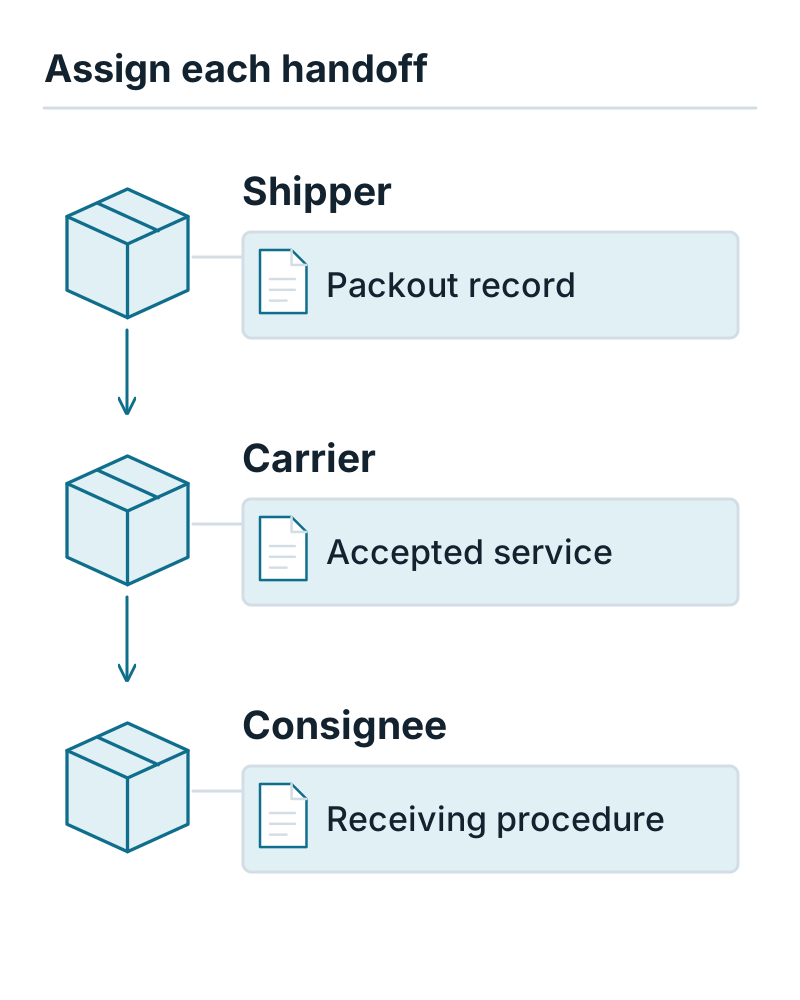
Table: scroll horizontally if needed to see every column.
| Interface | Record to request or keep | Question to resolve |
|---|---|---|
| Product to packout | Contents, initial condition, packing sequence and configuration | Who confirms that this configuration suits this shipment? |
| Packout to carrier | Accepted contents, coolant, mode, service and tender location | What exactly is accepted, and under which conditions? |
| Carrier to consignee | Delivery arrangement and receiving contact | Who takes custody and moves it to the intended storage? |
| Shipment to review | Tracking, temperature evidence and exceptions | Who reviews arrival and decides what action follows? |
When a provider offers more than ordinary carriage, request the written scope: packaging provision, controlled storage, monitoring, intervention or another specifically agreed task. Leave each field blank until documented. The distinction between active and passive packaging helps frame this discussion, but does not establish the conditions of a particular parcel service.
Common mistake: Buying an insulated box and recording the carrier name as proof of temperature control. Keep the packaging evidence and service agreement side by side.
Takeaway: Assign a document and an owner to each interface before tendering the shipment.
What to confirm with each carrier
Use the carrier’s own current documents as your starting point. These are document checks, not a ranking of cold-shipping services or an assertion that all four accept the same goods.
FedEx: distinguish the packing guide from a booked cold-shipping option
FedEx’s US perishables guide discusses insulated packaging and coolant, and separately links to cold-shipping options. If you are searching for FedEx cold shipping boxes, ask which current box and instructions apply to your contents and lane; this page gives no box-specific temperature or duration.
Record whether you are supplying the thermal packout or purchasing an identified packaging option. Then request the applicable booking terms, tender arrangements and any dry-ice instructions. Use current official product documentation instead of treating an old biological-specimen PDF found in search results as a present-day catalogue.
UPS: match the coolant rules to the actual route
UPS’s coolants and refrigerants page distinguishes ground, domestic air and international dry-ice preparation. It also identifies destinations that need air processing. Select the branch with UPS rather than applying a rule from a different route.
Ask which booking system fields, markings and acceptance steps apply to your non-medical contents. For a separately offered temperature-controlled service, obtain its scope in writing. Do not infer a universal UPS shipping temperature range from a packaging page or from healthcare wording.
DHL: confirm the division, then commodity acceptance
DHL Express’s What Can I Ship guidance makes perishable acceptance conditional on product, packing, network movement and destination requirements. It lists dry ice among items that may need approval and says restricted goods require written agreement.
For an Express shipment, request confirmation for the actual contents and coolant before booking. If the proposed service comes from another DHL division, get that division’s documents. General DHL packing advice does not establish a cold-chain service or thermal guarantee.
USPS: check mailability and the air/surface distinction
Read USPS section 349.3 and Packaging Instruction 9A together. The instruction prohibits dry ice in international mail and limits domestic air mailpieces to 5 pounds of dry ice. Surface preparation follows a different branch and cannot be routed by air.
Have USPS confirm the applicable service and mailing preparation for the complete contents. The presence of a domestic dry-ice provision is not acceptance of every perishable commodity, and does not establish refrigerated handling.
Table: scroll horizontally if needed to see every column.
| Carrier | Official document to open | Question to put in your record |
|---|---|---|
| FedEx | Perishables guide, then relevant service and packaging terms | Which box instructions and booked service apply to this lane? |
| UPS | Coolants and Refrigerants; current service terms | Which mode and preparation branch apply? |
| DHL Express | What Can I Ship; applicable written approval | Are these contents and coolant accepted under this account and route? |
| USPS | Publication 52 and Packaging Instruction 9A | Is the complete mailpiece mailable under the proposed air or surface preparation? |
Use the packout cost worksheet to compare your own quotes after these boundaries are resolved. Keep transport, packaging and handling costs separate; this checklist supplies no prices.
Takeaway: Save the exact official document and carrier response used for your shipment decision.
Dry ice: acceptance, venting and paperwork are separate checks
Check dry ice explicitly even when the contents are ordinary food. UPS’s dry-ice guidance warns against airtight packing, and USPS Instruction 9A requires a container that releases carbon dioxide gas. Venting is not proof that the carrier accepts the parcel.
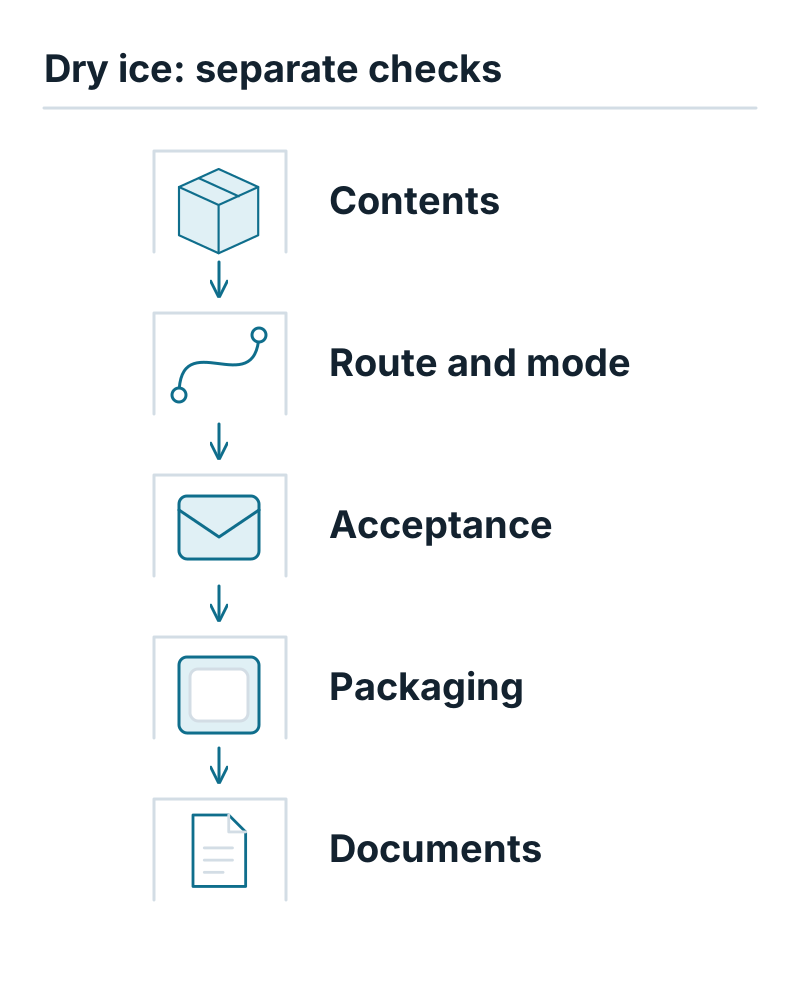
Use a record with separate fields for contents classification, actual route/mode, net coolant quantity, acceptance response, packaging instructions and marking/documentation instructions. Ask the carrier’s appropriate support team to identify the current rule set for that combination. Do not carry an air-shipment exception across to another carrier, destination or commodity.
Keep thermal sizing separate from mailing eligibility. A published acceptance limit is not a recommendation for how much coolant your product needs. The refrigerant comparison guide helps organize product protection questions; the quantity and arrangement belong to the assessed packout.
Common mistake: Treating a permitted dry-ice quantity as a recipe. First establish the packout’s protection needs, then check whether the proposed shipment is accepted.
Takeaway: Resolve both packout suitability and the carrier’s current preparation conditions.
Build a lane record that survives a handoff
Write one shipment record that another operator can follow without reconstructing your carrier conversation. Link the record to the saved source documents and the packing procedure, then give receiving its own named action.
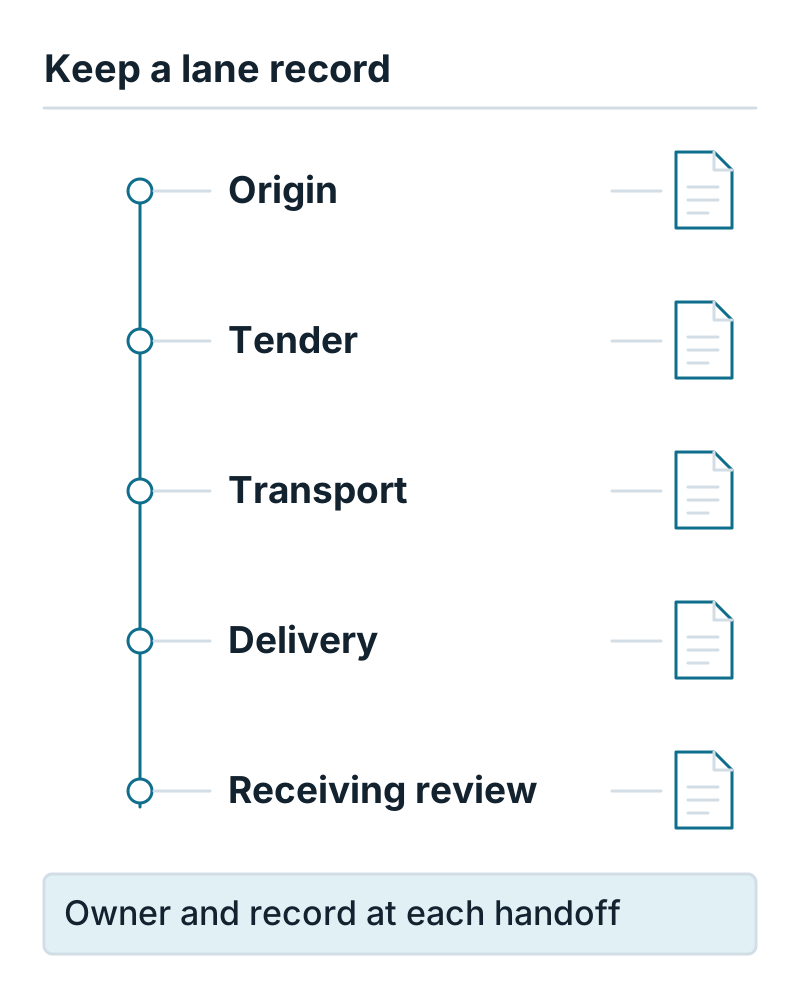
Table: scroll horizontally if needed to see every column.
| Stage | Record field | Practical check |
|---|---|---|
| Packing | Packout version and initial product condition | Does the operator have the matching instructions? |
| Tender | Location, cutoff and acceptance contact | Has the carrier confirmed this tender route? |
| Transit | Service, tracking and exception contact | Who follows up when the itinerary changes? |
| Delivery | Named receiver and receiving arrangement | Does arrival trigger an actual handoff? |
| Review | Required records and decision owner | Who reviews exceptions under your own procedure? |
For temperature evidence, specify what the data logger records and who retrieves it. Decide whether you need a live or downloadable workflow based on the action a person can take. Tracking scans alone do not answer the same question as a product-temperature record.
The warehouse dispatch guide supplies a broader handover checklist. Add a delay scenario to your own record: who contacts the carrier, who contacts the consignee and who has authority to decide the next step? This is a planning exercise, not a promise that the carrier will replenish coolant or intervene.
Takeaway: Give each handoff a responsible person, a record and a next action.
When this does not apply
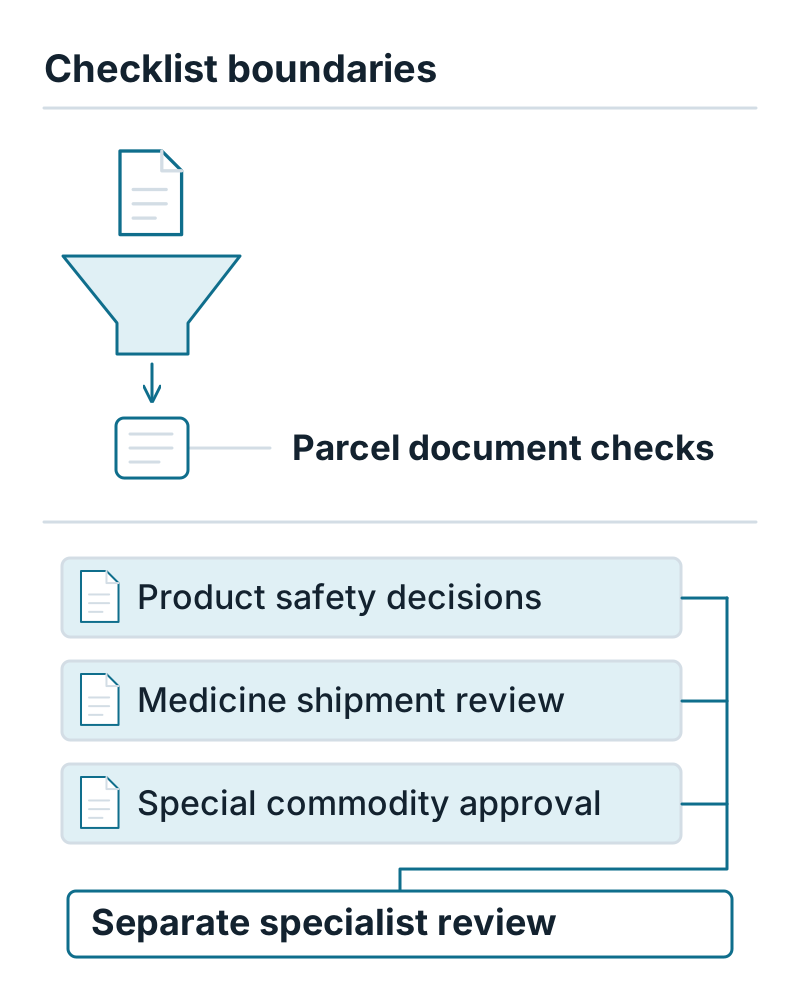
Use this page only as a document-checking aid for non-pharmaceutical parcel planning. It does not authorize medicine, clinical material, infectious substances, live animals or other special commodities, and does not decide whether food is safe to use.
A cold-shipping option that needs a separate contract or an approved account deserves its own review. International commodity and customs decisions also extend beyond this checklist. Send those questions to the carrier and the responsible specialists before scheduling a shipment.
For the difference between retail food packaging and thermal transport, use the chilled and frozen food guide. Where a supplier presents thermal qualification evidence, the qualification report review guide helps identify the configuration and conditions it actually covers.
Takeaway: Escalate product safety and special-commodity decisions instead of inferring approval from a generic packing guide.
FAQ: parcel shipping questions
How much is it to ship a cold package?
There is no price established by this checklist. Start a transport estimate at the official FedEx rate request, using your actual origin, destination, dispatch date and packed parcel details. Separately request the box, coolant and preparation costs, and resolve commodity acceptance before booking.
Does FedEx give you free boxes for shipping?
FedEx’s packing-supplies page offers selected complimentary packaging for expedited services with a FedEx account. That statement does not establish that a thermal box is free. The perishables guide’s cold-shipping section provides a separate package-ordering entry; confirm the exact item, instructions and terms there.
Does UPS allow dry ice shipping?
UPS publishes dry-ice preparation guidance, but acceptance depends on the applicable contents and route. Identify the correct domestic ground, air or international branch with UPS before booking.
How much does it cost to ship dry ice with USPS?
First resolve mailability under Publication 52, then use the USPS Retail Postage Price Calculator for the eligible service. Have the destination, mailing date, total packed weight and dimensions ready; keep net dry-ice weight separately in the preparation record. A postage estimate does not authorize an otherwise ineligible parcel or route.
What are the rules for shipping with dry ice?
Start with the actual carrier’s official instructions for the contents, quantity, origin, destination and mode. The carrier table above identifies documents to open; it is not a complete marking or declaration checklist.
How much dry ice do you need to ship a package?
Determine the quantity from an assessed packout for the product and journey, then check carrier acceptance. A mailability limit or a general sublimation estimate does not establish a suitable quantity for your shipment.
Takeaway: Resolve eligibility before pricing, and identify the exact packaging item before assuming it is included.
Method and review
We checked the linked official US carrier documents on October 8, 2026 and organized them into questions and records. The responsibility matrices and handoff sequence are editorial planning aids, not carrier contract terms or an independent packaging test. Source dates here are access dates; verify the current documents again before dispatch. Sources and limitations below identify the documents and their scope.
Further reading: insulated shipper selection defines packaging inputs; warehouse dispatch helps assign custody; packout cost keeps the comparison on your own cost basis.
Takeaway: Keep the accessed documents with your shipment record and recheck them before dispatch.
Prepared by Cold Chain Practice Editorial Desk.
Related guides

Selecting Insulated Shippers: Payload, Transit Time and Handling Constraints
Turn payload, transit time, ambient conditions, dimensions and handling into clear purchasing inputs for insulated shipper selection and supplier quotes.
Read guide
Temperature-Sensitive Dispatch: A Warehouse Handover Checklist
A cold chain dispatch checklist covering pick checks, logger start, documents, carrier handover, data responsibility and exception escalation fields.
Read guide
Cold Chain Packout Cost: A Transparent Comparison Worksheet
A transparent cost worksheet for cold chain packout: materials, labor, monitoring, return logistics and losses, with formulas and blank cells you fill in.
Read guide
Pharmaceutical Shipping Packout: What Buyers Must Define Before Equipment Selection
Build packout requirements from product documentation, lane assessment and quality input before you shortlist equipment. Owners, interfaces and records.
Read guide