
Temperature-Controlled Air Freight: Active ULD Containers vs Passive Pallet Shippers and Tarmac Handover Checks
Compare active ULD containers and passive pallet shippers for temperature-controlled air freight, prepare air freight quote inputs, and run tarmac handover checks.
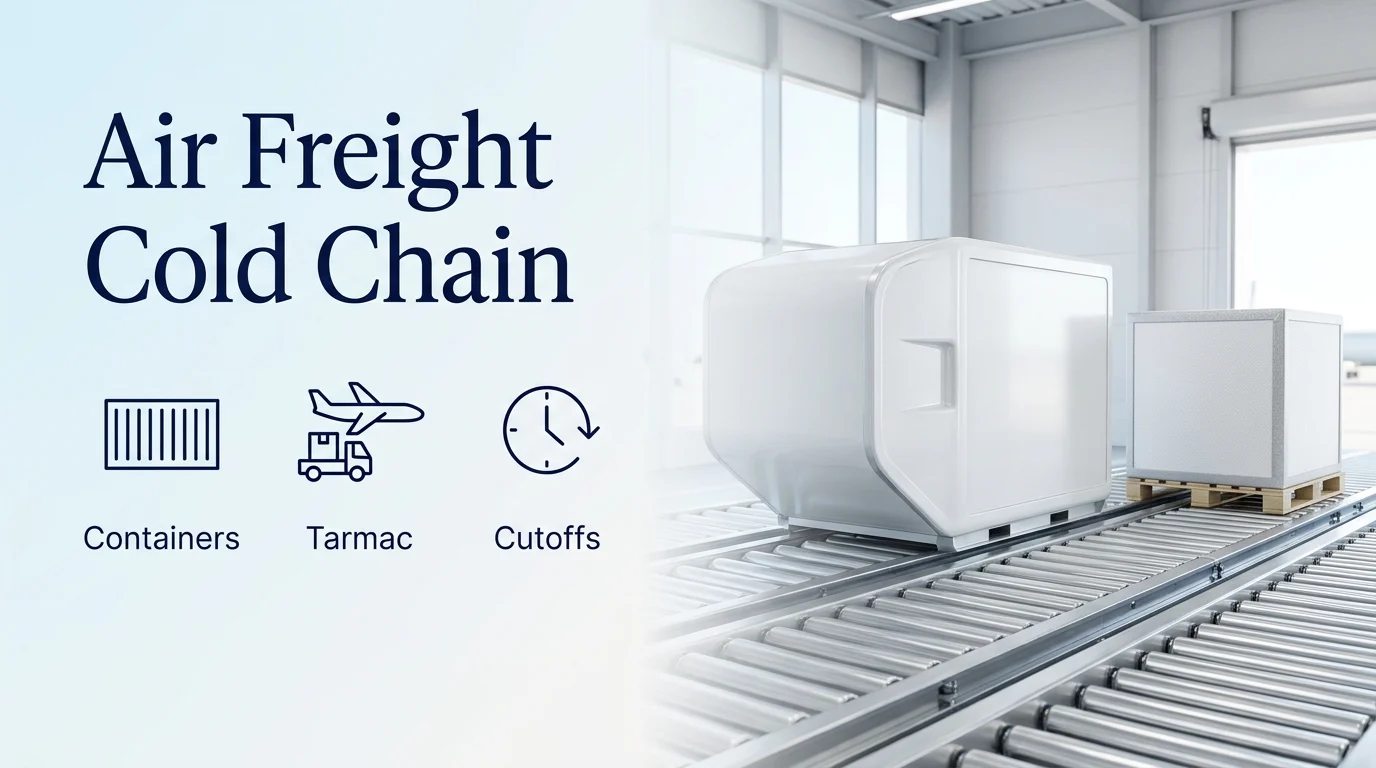
Planning a temperature-controlled air freight shipment starts with separating aviation equipment from freight packaging and matching the container format to airport ramp infrastructure.
WHO defines active systems as actively powered systems using electricity or other fuel source to maintain a temperature-controlled environment inside an insulated enclosure under thermostatic regulation (e.g. cold rooms, refrigerators, temperature-controlled trucks, refrigerated ocean and air containers).
WHO defines passive systems as systems which maintain a temperature-controlled environment inside an insulated enclosure, with or without thermostatic regulation, using a finite amount of pre-conditioned coolant in the form of chilled or frozen gel packs, phase change materials, dry ice or others.
Use this guide to compare direct-locking aviation containers against passive pallet shippers, verify airport tarmac and charging handovers, and structure a dhl air freight quote or ups air freight quote request. For broader mode comparisons, visit the Applications hub and our active vs passive cold chain packaging guide.
Aviation ULD containers vs non-ULD passive pallet shippers
Before requesting carrier rates or selecting an enclosure, confirm whether the load unit is an aircraft Unit Load Device or a pallet shipper that requires airline pallet build-up.
Aircraft Certified ULDs must adhere to EASA, FAA and national governing bodies and pass scheduled MRO (Maintenance Repair Operation) tests; as aircraft equipment, a ULD is exempt from customs clearance and locks into the airplane cargo hold without single-use plastics or netting.
A passive pallet shipper is not automatically an air freight ULD; its pallet format, external dimensions and total weight must suit the transport chain, insulation and cooling components require additional room beyond usable product volume, and a central measurement point alone does not necessarily represent the entire load unit.
Sonoco ThermoSafe’s Pegasus ULD is the first FAA and EASA approved advanced passive bulk temperature-controlled container (TCC) offered under a leasing program; it is classified as a Unit Load Device (ULD) (aircraft equipment) that locks into the aircraft’s lower deck cargo hold without placing the container onto a PMC (aircraft pallet) or using straps and nets.
Each station in Sonoco ThermoSafe’s Pegasus ULD global service network (including partnerships with ACL Airshop, Unilode Aviation Solutions, and Focus WFS) is an FAA 145 facility capable of performing required ULD Maintenance, Repair, and Operation (MRO) and on-site preconditioning of PCM Bottles (Phase Change Material) in temperature-controlled chambers.
Passive bulk air freight containers use vacuum insulated panels (VIPs) and coolants to hold temperature for up to 120 hours without electrical or mechanical operation, whereas active containers require airport electrical outlet plugs to charge and often arrive at the shipping site needing time to be cooled to the correct temperature.
As reported by Pharmaceutical Commerce on May 15, 2018, Envirotainer reached 1,000 RAP e2 five-pallet containers and over 4,000 RKN single-pallet ULDs in global circulation (5,500 active powered units total), noting that passive non-powered containers have lower tare weight but limited duration unless chill packs within are changed out for fresh ones.
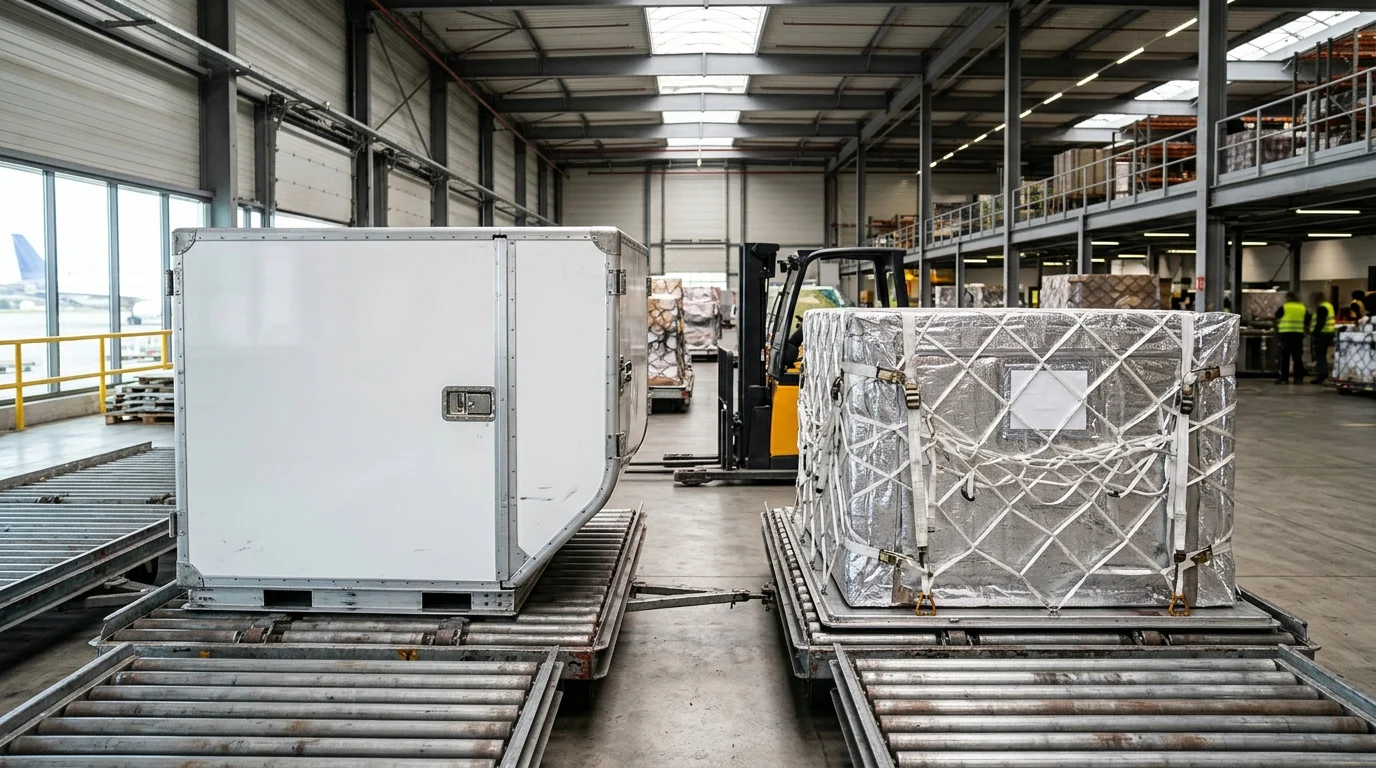
Active and hybrid air freight container specifications by footprint
Never transfer tare weight, internal cube, charging amperage, or battery autonomy from one container family to another. Record the exact model name on the air waybill and in the freight quote request.
Single-pallet active and hybrid containers
The Envirotainer RelEye RKN is a single-pallet active container with IATA ULD Type Code RKN, ATA Code LD-3, and AS36100 Identifier 2K4C, external dimensions of 1945 x 1534 x 1626 mm (76.6 x 60.4 x 64 inch), internal dimensions of 1240 x 1354 x 1320 mm (48.8 x 53.3 x 52 inch), and door opening of 1354 x 1320 mm (53.3 x 52 inch).
The Envirotainer RelEye RKN has a tare weight of 583 kg (1285.3 lbs), a maximum gross weight of 1588 kg (3500.9 lbs), and a maximum net weight of 1005 kg (2215.6 lbs).
The Envirotainer RelEye RKN has a power rating of 100–240 V AC, 50–60 Hz, Max 16 A, an IP15B rating, a container set temperature range of +4°C to +30°C (+39.2°F to +86°F), temperature control accuracy of ±2°C for set point 5 °C and ±3°C for set point 20°C, qualification from +2 °C to +8 °C, battery autonomy of 130h at +20°C (+68°F) ambient, and a charging time of 10 h (0 - 100%, 230 V).
The Envirotainer RelEye RKN features 18 built-in sensors for Live Monitoring and Control Tower services, monitoring 8 cargo space temperatures, 2 ambient temperatures, cargo space and ambient relative humidity (RH %), battery level (%), door openings, cargo loaded status, and GPS location.
The Envirotainer E-Tech RKN e1 is a 1 Euro / 1 US pallet container utilizing compressor cooling and electric heating technology, with external dimensions of 2007 x 1534 x 1626 mm, internal space of 1340 x 1315 x 1315 mm, a free set point of 0°C to +25°C, and 58 h battery autonomy.
The Envirotainer RKN e1 has a tare weight of 635 kg (1400 lbs.), internal dimensions of L 1340 x W 1315 x H 1315 mm, autonomy of 58 hours, and payload capacity of 1 Euros / 1 US Pallet.
The CSafe RKN uses compressor-driven cooling with electric heating and an Air Recirculation System (ARS), with a user-selectable temperature range of +4°C to +25°C, autonomy of 130+ hours, internal dimensions of L 1219 x W 1273 x H 1277 mm, a tare weight of 646 kg (1425 lbs.), a max payload weight of 941 kg (2075 lbs.), and a payload capacity of 1 Euros / 1 US pallet.
The DoKaSch Opticooler RKN has a free set point range of +2°C- +30°C, battery-only autonomy of 30 hrs at Ambient 20 °C / Set 5 °C and 70 hrs at Ambient 15 °C / Set 20 °C, internal dimensions of L 1250 x W 1220 x H 1230 mm, a tare weight of 650 kg (1433 lbs.), and a payload of 1 Euros / 1 US pallet.
The SkyCell 1500X is a hybrid container leveraging multi-layer insulation, heat distribution technology and integrated phase change material (PCM), supporting +2 °C to +8 °C (COL), +15 °C to +25 °C (CRT), and +2 °C to +25 °C (ERT), with 270 hours autonomy, internal dimensions of L 1235 x W 1035 x H 1300 mm, a tare weight of 379 kg (835 lbs.), and a payload of 1 Euros / 1 US pallet.
Mid-size and multi-pallet active containers
The Envirotainer RelEye RLP has a free set point temperature range of 4°C-30°C, autonomy of 170 hours, internal dimensions of L 2475 x W 1354 x H 1320 mm, a tare weight of 880 kg (1,940 lbs.), and a payload of 3 Euros / 2 US Pallet.
The Envirotainer RelEye RAP holds 5 Euro pallets (4 US pallets) with IATA ULD Type Code RAP, ATA Code LD-09, and AS36100 Identifier 2A8C, external dimensions of 3175 x 2235 x 1626 mm (125 x 88 x 64 inch), internal dimensions of 2466 x 2055 x 1320 mm (97.1 x 80.9 x 52 inch), and door opening of 2055 x 1320 mm (80.9 x 52 inch).
The Envirotainer RelEye RAP has a tare weight of 1100 kg (2425.1 lbs), a maximum gross weight of 4625 kg (10196.4 lbs), and a maximum net weight of 3525 kg (7771.3 lbs).
The Envirotainer RelEye RAP has a power rating of 100–240 V AC, 50–60 Hz, Max 16 A, an IP15B rating, a container set temperature range of +4°C to +30°C (+39.2°F to +86°F), temperature control accuracy of ±2°C for set point 5°C and ±3°C for set point 20°C, qualification from +2 °C to +8 °C, battery autonomy of 170h at +20°C (+68°F) ambient, and a charging time of 11h (0 - 100%, 230 V).
The Envirotainer E-Tech RAP e2 is a 5 Euro / 4 US pallet container with external dimensions of 3175 x 2235 x 1626 mm, internal space of 2465 x 2055 x 1260 mm, a free set point of 0°C to +25°C, and 60 h autonomy.
The Envirotainer RAP e2 has a tare weight of 1100 kg (2425 lbs.), internal dimensions of L 2465 x W 2055 x H 1260 mm, autonomy of 60 hours, and a payload of 5 Euros / 4 US Pallet.
The CSafe RAP uses compressor-driven cooling with electric heating and an Air Recirculation System (ARS), with a user-selectable temperature range of +4°C to +25°C, autonomy of 120+ hours, internal dimensions of L 2477 x W 2083 x H 1295 mm, a tare weight of 1213 kg, a max payload weight of 4819 kg (10625 lbs.), and a payload capacity of 5 Euros / 4 US pallets (236 cu ft).
The DoKaSch Opticooler RAP has a free set point range of +2°C- +30°C, battery-only autonomy of 40 hrs at Ambient 20 °C / Set 5 °C and 120 hrs at Ambient 15 °C / Set 20 °C, internal dimensions of 2460 x 2 023 x 1 320 mm, a tare weight of 1100 kg, and a payload of 5 Euros / 4 US pallet.
Container qualification, packing, and route profiling rules
Under Clause 6.8.3 on the qualification of insulated passive containers, container qualification should include full details of the packaging assembly, the thermal conditioning regime, the minimum and maximum shipping volume, weight and thermal mass, and the correct placement of temperature monitors.
Under Clause 6.8.4 on the qualification of active containers, active containers must be qualified to ensure the container is capable of maintaining the TTSPP within the temperature range needed to meet the manufacturer’s product stability profile while taking account of the transport route and anticipated ambient temperature profile.
Under Clause 6.9 on shipping container packing, TTSPP shipping containers must be packed to the exact specified configuration, protect freeze-sensitive products against temperatures below 0 °C when frozen packs are used, protect products against adverse effects when dry ice is used as a coolant, and label packages containing dangerous goods (including dry ice).
Under Clause 7.2.2 on labelling air-freighted shipments, packages where TTSPPs are to be air-freighted should be labelled using the standard International Air Transport Association (IATA) time and temperature-sensitive symbol in accordance with Chapter 17 of the IATA Perishable Cargo Regulations on individual shipping packages, overpacks or bulk containers.
Supplement 14 on transport route profiling qualification, a technical supplement to WHO Technical Report Series, No. 961, 2011, Annex 9, states that ambient temperature along a transport route should generally be sampled once every 10–30 minutes, and a sample size of 30 trips on a given route over the course of a year is considered statistically valid.
ISTA Standard 7E is designed to evaluate external temperature exposures of individual packaged-products shipped through a parcel delivery system (used standalone or in conjunction with ISTA Standard 20), and the cycle profiles in 7E are general simulations not intended to represent worst case thermal exposure in the small parcel shipment environment.
When a packout or active container uses solid carbon dioxide, review our dry ice shipping regulations guide and align route logger placement with the shipping lane qualification plan.
Tarmac exposure windows, thermal blankets, and airport handover checks
Check how the airline and ground handler manage tarmac staging, thermal covers, and customs storage before tendering freight.
Pharma.Aero’s Airside Transportation Survey notes that a pharma shipment must first be declared correctly so temperature-controlled service can be booked; general cargo is typically stored in an ambient non-temperature-controlled environment and positioned at the aircraft bay without controlled temperature protection, typically a minimum of 2 hours before Estimated Time of Departure.
Pharma.Aero reports that in most airports, documented Standard Operating Procedures (SOPs) support priority management (Last Out of warehouse, Last In Aircraft / First Out Aircraft, First in warehouse) and Service Level Agreements (SLA’s) defining maximum tarmac transport times, with inbound on-tarmac time exposure that could be defined as the time between flight arrival (chocks on) and when pharma cargo is lodged into the temperature-controlled warehouse.
In Pharma.Aero’s Airside Transportation Survey, most respondents indicated regular use of thermal blankets, and 80% of them find thermal blankets a satisfactory solution for defined ambient temperature ranges and lanes, noting that thermal blankets do not have the capability to control temperatures, only insulate against brief exposure, and must be considered for protection on 6 sides (including bottom to protect from radiation from tarmac).
Compare foil and phase-change cover constructions in our insulated pallet covers and thermal blankets guide.
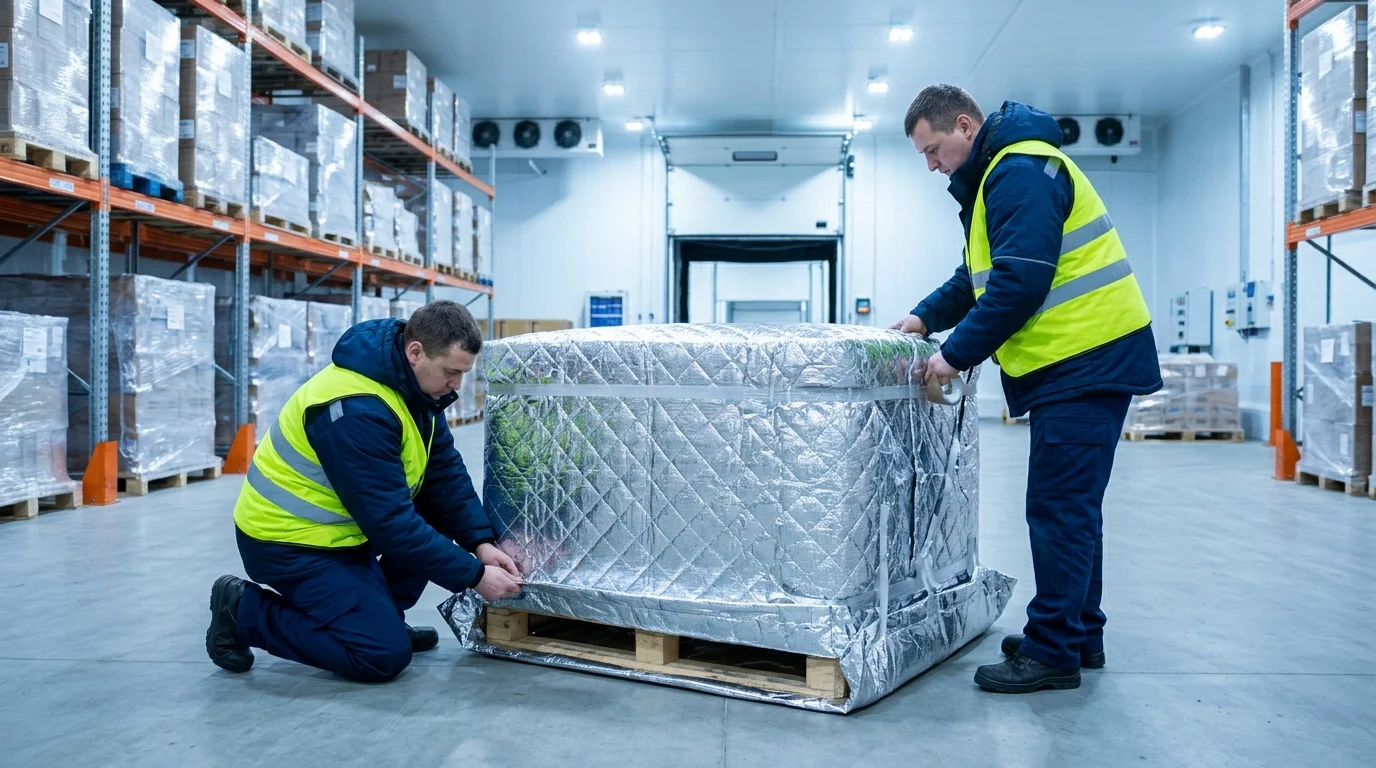
Apron offloading, customs holding, and station audits
Under Clause 1.1.2 on offloading, TTSPP shipments must be removed as soon as possible after arrival from the wharf or airport apron to a safe and suitable temperature-controlled storage location to minimize the risk of theft and to avoid exposure to adverse ambient conditions.
Under Clauses 1.1.3 and 1.1.4, TTSPP shipments must be stored in a secure warehouse under manufacturer-recommended conditions until authorized for removal by customs, and customs staff should be supported by personnel with suitable pharmaceutical training when clearance involves opening and resealing temperature-controlled packaging.
The IATA CEIV Pharma certification assesses an organization based on the checklist in Appendix D of the Guidelines for CEIV Pharma Audit of the IATA Temperature Control Regulations (TCR), including how empty Unit Load Devices (ULDs) are handled, temperature mapping and monitoring, tarmac transportation, and aircraft loading and unloading.
The IATA CEIV Pharma certification process requires that at least two (2) staff pass the course Audit, Quality and Risk Management for Temperature Controlled Cargo, followed by an on-site facility assessment over a period of three (3) to four (4) days.
Airline handling codes, connection windows, and airport cold rooms
IAG Cargo’s Constant Climate service uses Special Handling Codes Active - ACT and Passive - PCT, with a booking window up to 14 days before STD, freight and document cut-off 150 min before STD subject to station capability, freight availability 90 min after ATA subject to station capability, and a recovery promise of notification within 2 hours of ATD and arrival within 24 hours of original STA subject to flight schedule if cargo does not fly as booked.
IAG Cargo’s Constant Climate minimum connection times are 180 mins unitised / 240 mins loose at London Heathrow (LHR) and 240 mins unitised / 300 mins loose at Madrid Barajas (MAD).
IAG Cargo operates approximately 100 Constant Climate stations worldwide and its New Premia facility at London Heathrow maintains chambers at 2–8°C, 15–25°C, and −20°C, equipped with 29 ULD cold cells and direct airside access.
Amerijet’s Miami Airport facility stores pharmaceuticals in computer-monitored chambers with 24/7 monitoring and alarm systems at 15° C to 25° C for ambient shipments and 2° C to 8° C for chilled shipments, while frozen cargo is handled using active temperature-controlled containers.
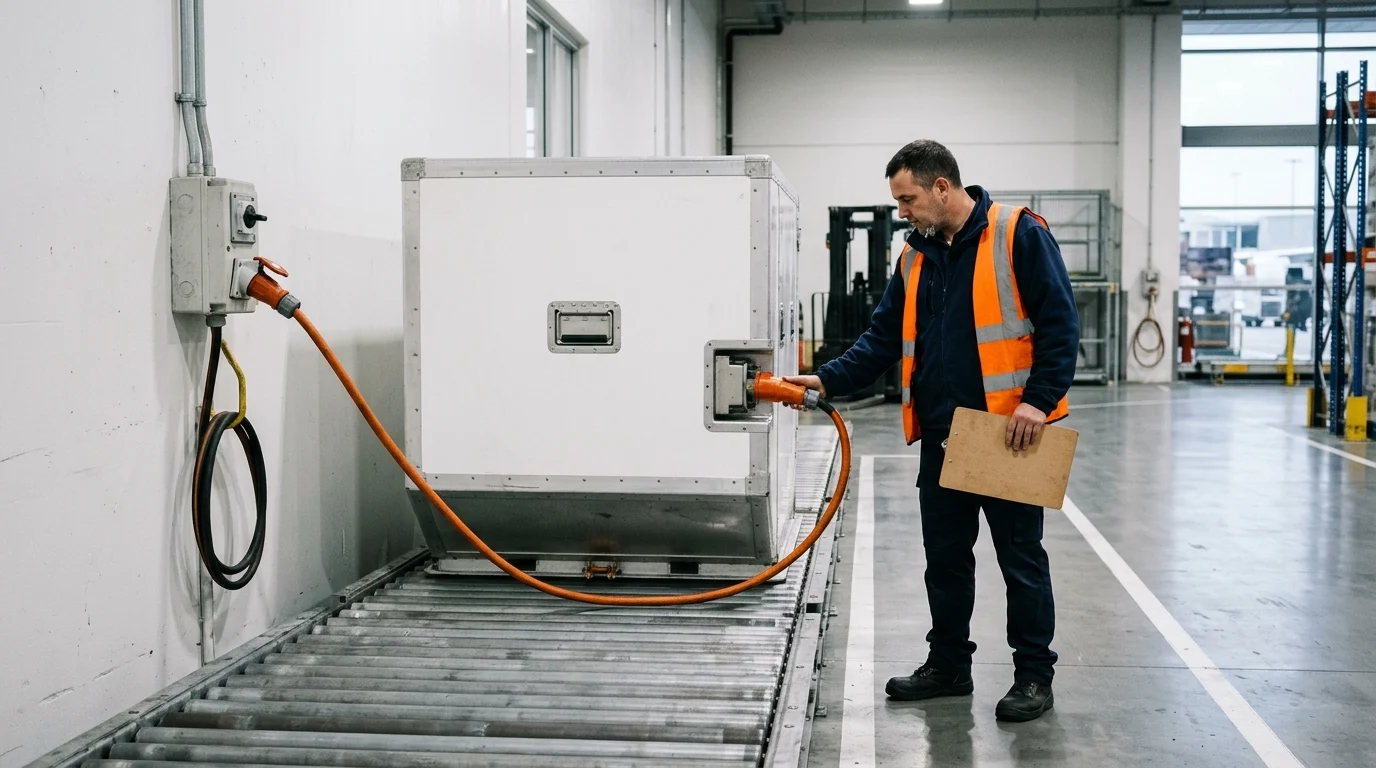
Table: scroll horizontally if needed to see every column.
| Handover stage | Verification record to complete |
|---|---|
| Booking declaration | Service tier, active or passive special handling code, and container model identifier |
| Origin dispatch | Pre-cooling completion, battery charge or coolant conditioning record, and tender cutoff |
| Tarmac staging | Priority staging sequence, tarmac transport SLA window, and all-around cover installation |
| Transit hub connection | Unitised versus loose connection window, cold-room chamber assignment, and plug-in charging log |
| Destination arrival | Chocks-on timestamp, cold-room lodging timestamp, and customs inspection training support |
Include these station verification records in your quality agreement using the pharmaceutical cold chain couriers GDP audit checklist.
Preparing a temperature-controlled air freight quote: DHL and UPS inputs
When requesting a dhl temperature-controlled air freight proposal, a dhl air freight quote, or a ups air freight quote, specify the service tier, lane risk assessment scope, cross-dock transfers, and container leasing arrangement before comparing rates.
DHL Global Forwarding’s pharmaceutical air freight portfolio comprises DHL AirControlnet (non-temperature-controlled GxP compliant shipments with lane risk assessment), DHL AirThermonet (temperature-controlled GxP compliant air freight with 24/7/365 visibility and monitoring, real-time tracking/IoT monitoring where requested, and SOP deviation intervention), and DHL LifeConEx (customized white-glove solutions with Same Day Specialty Courier process management).
DHL Thermonet operates a GDP-compliant network covering over 2,000 trade lane pairs across more than 60 major DHL Global Forwarding locations by 2014, on 6 continents, using its LifeTrack IT system and SmartSensor RFID technology to provide 24/7/365 proactive monitoring and intervention, visibility through up to 17 touch points, and in-transit ambient temperature monitoring.
UPS announced on June 22, 2026 a $48 million investment in 27 IATA CEIV Pharma-certified temperature-controlled freight cross-dock facilities across the Americas, Europe, and Asia to preserve 2–8°C, 15–25°C, and frozen conditions during transitions between air and ground transport, supported by 24/7/365 control-tower monitoring.
UPS Healthcare operates more than 19.2 million square feet of cGMP and GDP-compliant distribution space globally.
If you are quoting small parcels rather than palletized air cargo or aviation containers, use our UPS refrigerated and frozen parcel shipping cost guide.
Table: scroll horizontally if needed to see every column.
| Quote input category | What to specify in the RFQ brief |
|---|---|
| Forwarder and service tier | Named carrier program, control-tower monitoring scope, and intervention protocol |
| Load unit classification | Aircraft ULD model code, passive ULD, or non-ULD pallet shipper dimensions and gross weight |
| Thermal and power profile | Target temperature range, required autonomy, coolant conditioning, or station plug-in charging |
| Origin, hub, and destination | Airport pair, freight acceptance cutoff, unitised or loose transit connection, and customs cold room |
| Commercial and return terms | Chargeable weight basis, container lease window, repositioning terms, and dangerous goods lines |
Active ULD vs passive pallet shipper selection and RFQ checklist
Copy these fields into your air freight tender package and complete them for each candidate lane:
- Equipment boundary: Is the unit an aviation ULD container that locks directly into the lower deck or a passive pallet shipper built up onto an airline pallet?
- Model and footprint: Which exact container model, pallet capacity, internal dimensions, tare weight, and net payload limit apply?
- Thermal reserve: Does the lane rely on battery autonomy with airport plug-in charging or on preconditioned phase-change material, gel packs, or dry ice?
- Booking and handling code: Have you declared the shipment under the carrier’s active or passive temperature-controlled handling code and recorded the tender cutoff?
- Tarmac and blanket protocol: Are priority loading sequences, tarmac transport time limits, and bottom-insulated thermal covers specified in the station agreement?
- Hub and customs infrastructure: Do origin, transit, and destination stations provide matching cold-storage chambers, charging outlets, and trained customs inspection support?
- Quote reconciliation: Does the forwarder quote itemize freight weight charges, container leasing, coolant or recharging services, and cross-dock transfer handling?
Sources
- World Health Organization — Model guidance for the storage and transport of time- and temperature-sensitive pharmaceutical products
- World Health Organization — Transport route profiling qualification supplement
- International Air Transport Association — Pharmaceutical cold chain audit and temperature control program
- International Safe Transit Association — Thermal transport packaging testing overview
- Pharma.Aero — Airside Transportation Survey White Paper
- IAG Cargo — Constant Climate Product Specifications and Container Specification List
- Envirotainer AB — RelEye RKN Technical Datasheet, RelEye RAP Technical Datasheet, and E-Tech Product Specifications
- Sonoco ThermoSafe — Pegasus ULD Global Network Release and Air Freight Container Choice Guide
- THERMOCON — Pallet Shipper Glossary
- DHL Global Forwarding — Pharma and Temperature Controlled Air Freight Solutions and DHL Thermonet Customer Flyer
- Pharmaceutical Commerce — UPS Cold-Chain Cross-Dock Buildout Report and Envirotainer Fleet Milestone Report
- Amerijet International — Temperature Controlled Freight Shipping Specifications
Related guides
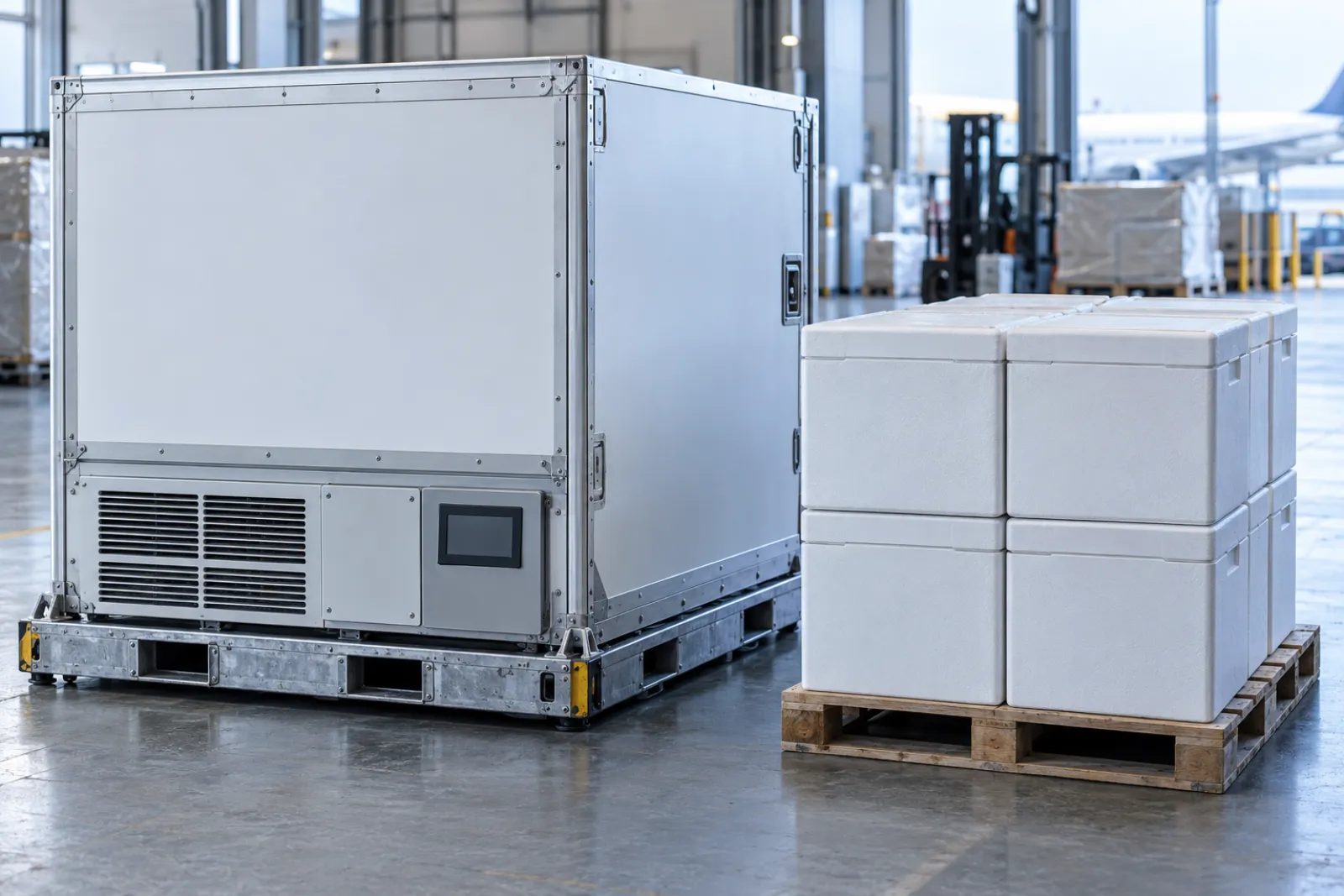
Active vs Passive Cold Chain Packaging: A Buyer's Comparison
Compare active and passive cold chain packaging by system boundary, route constraints and operating conditions, without a universal winner.
Read guide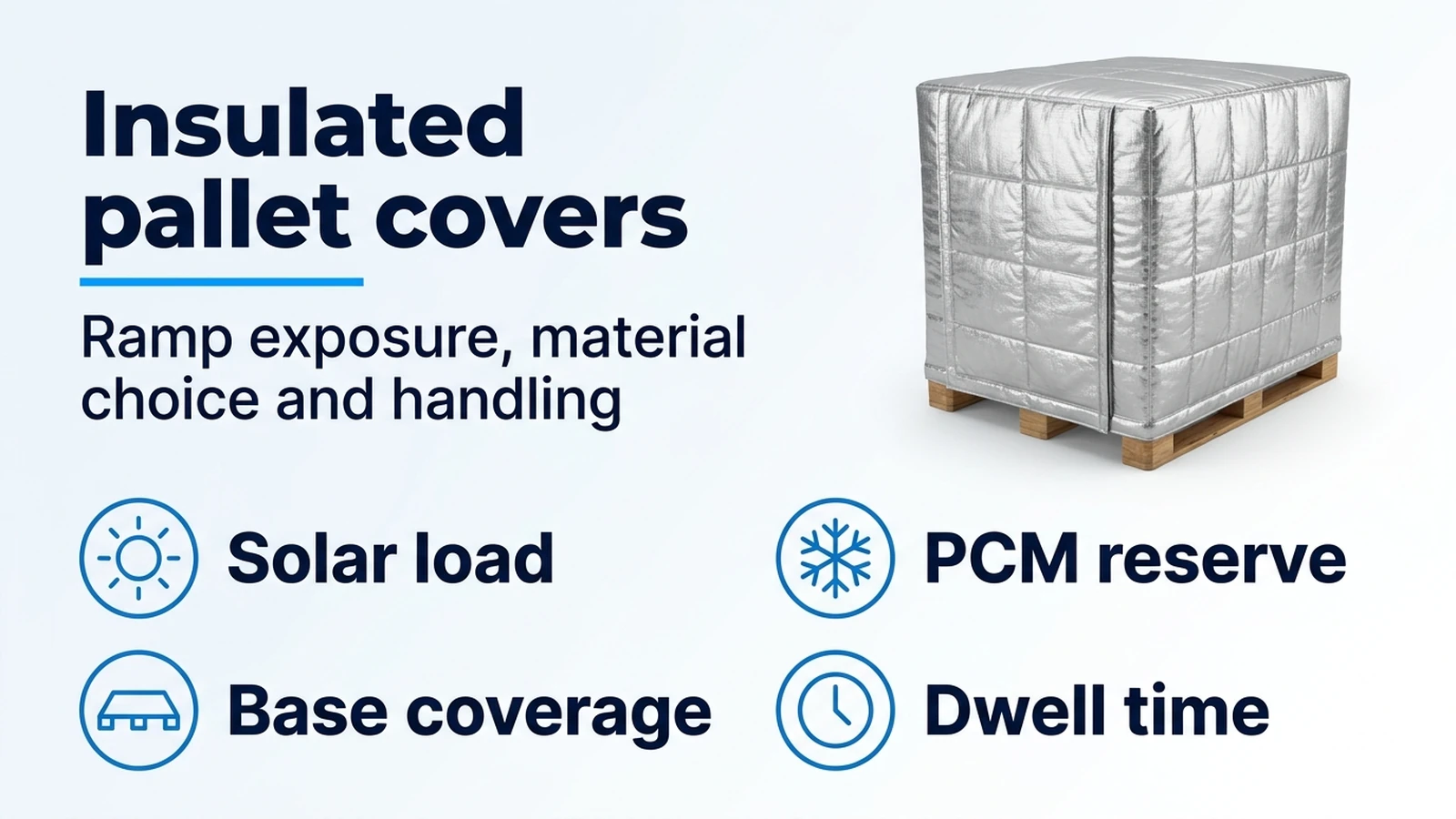
Insulated pallet covers and thermal blankets: compare ramp protection
Compare reflective bubble-foil and PCM pallet covers for dock, tarmac and yard exposure, including solar load, handling costs and limits of 7E-style evidence.
Read guide
Pharmaceutical Cold Chain Couriers GDP Audit Checklist: Specialty vs Integrator QTA, Customs Cold Rooms, and Excursion SLAs
Audit pharmaceutical couriers and temperature-controlled shipping companies across EU GDP QTA clauses, customs cold rooms, ULD charging, and excursion SLAs.
Read guide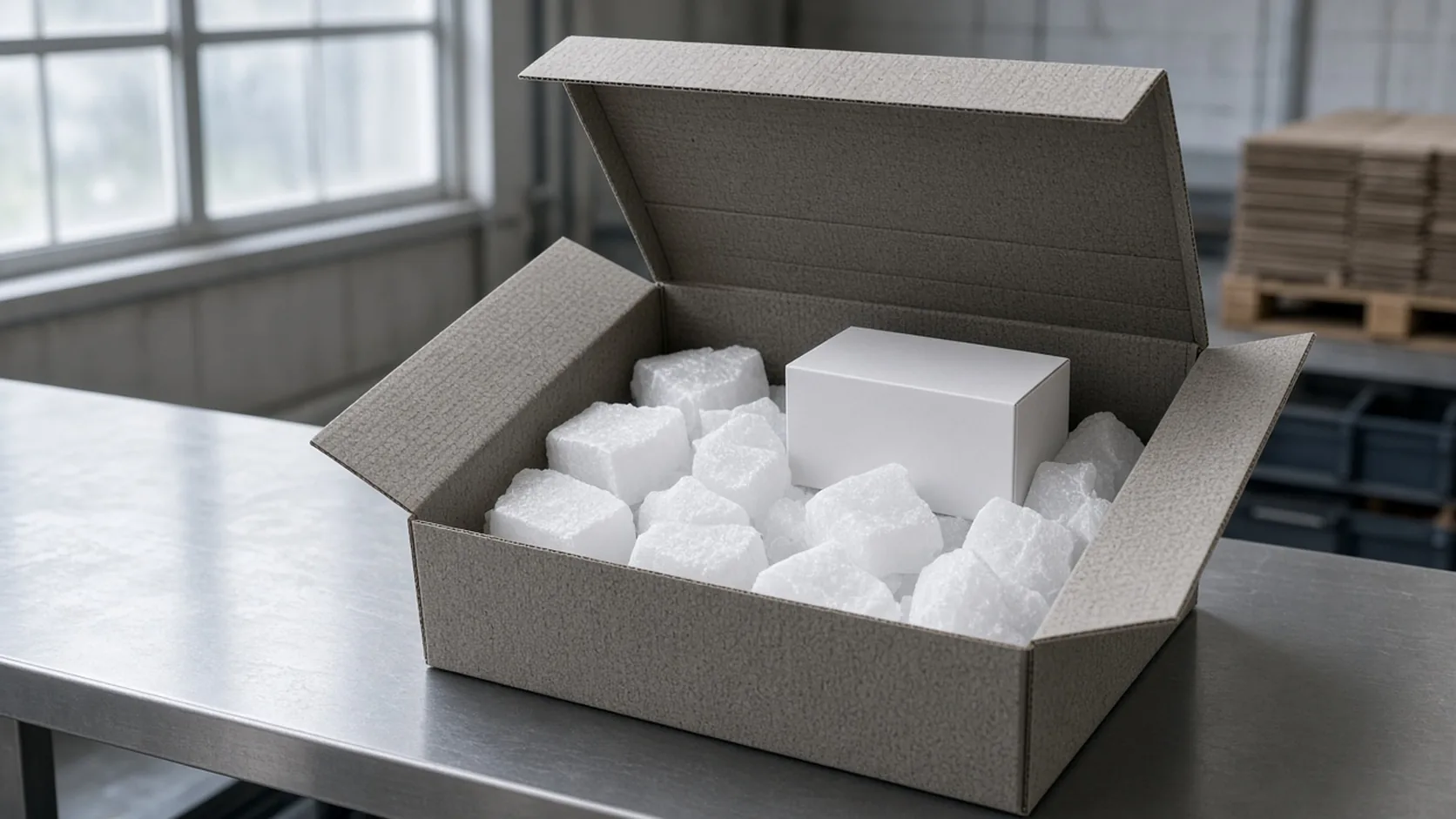
Dry Ice Shipping Regulations: IATA PI 954 and DOT
Separate the US hazardous materials table from IATA Packing Instruction 954, and mark net dry-ice mass on each package before acceptance.
Read guide