
Insulated pallet covers and thermal blankets: compare ramp protection
Compare reflective bubble-foil and PCM pallet covers for dock, tarmac and yard exposure, including solar load, handling costs and limits of 7E-style evidence.
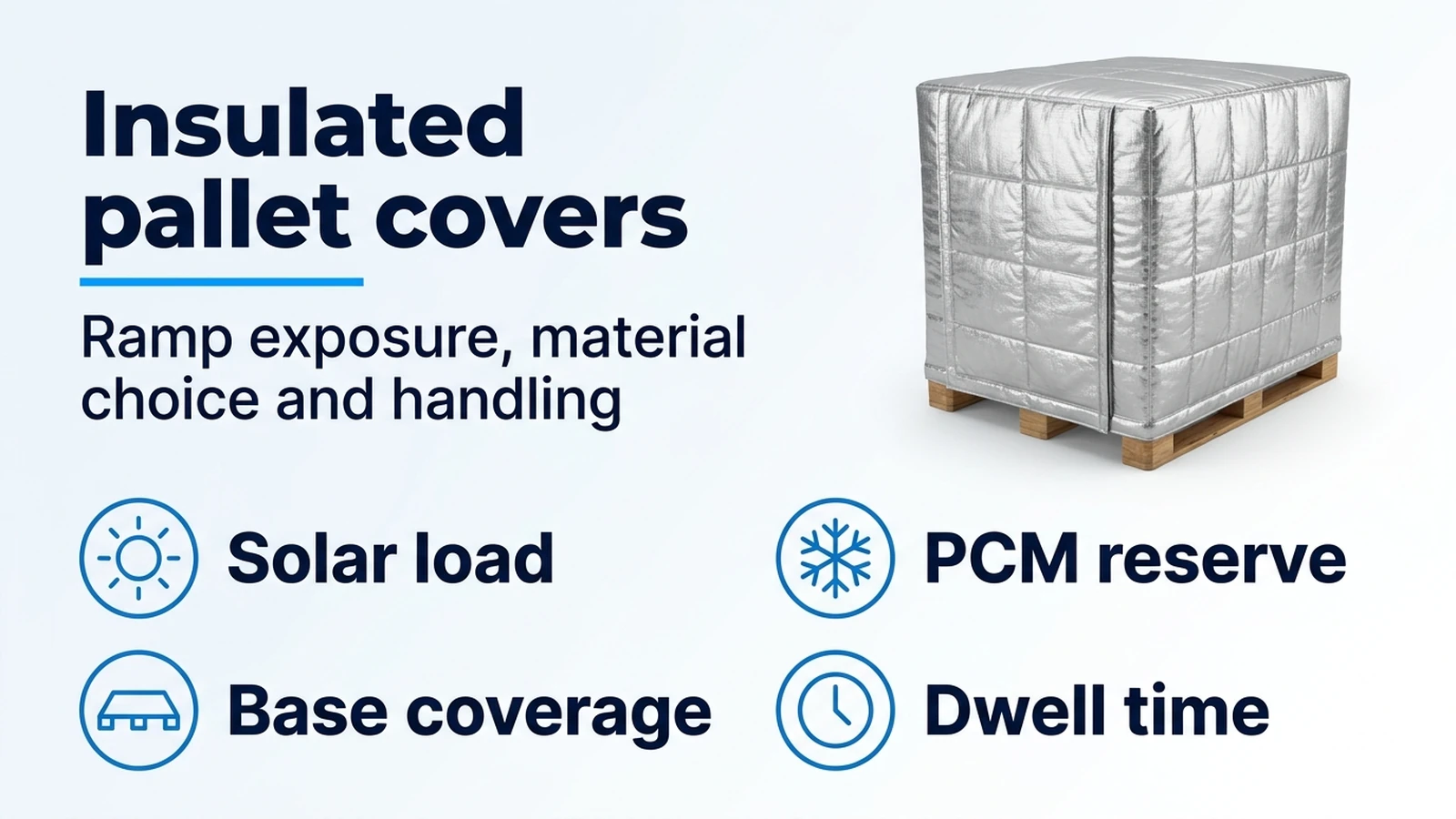
Ramp warm-up can consume a shipment’s temperature margin before loading; insulated pallet covers and thermal blankets can reduce that exposure when their construction and handling match the transfer. Use them to protect an intact pallet across a defined dock, tarmac or yard interval; choose a qualified parcel shipper when individual packages must maintain their specified conditions through a parcel journey.
Choose a reflective multi-layer cover when reducing incident radiant heat is the main task and lane evidence supports the exposure time. Consider a phase-change composite when a documented thermal reserve is needed as well. Neither material name establishes a holding duration: check the complete loaded configuration, its starting state and the uncovered interfaces. Leaving a pallet uncovered is an option only where the documented product tolerance and handling controls support that exposure. The packaging section connects these transfer decisions with the wider transport system.
Which cover construction matches the transfer?
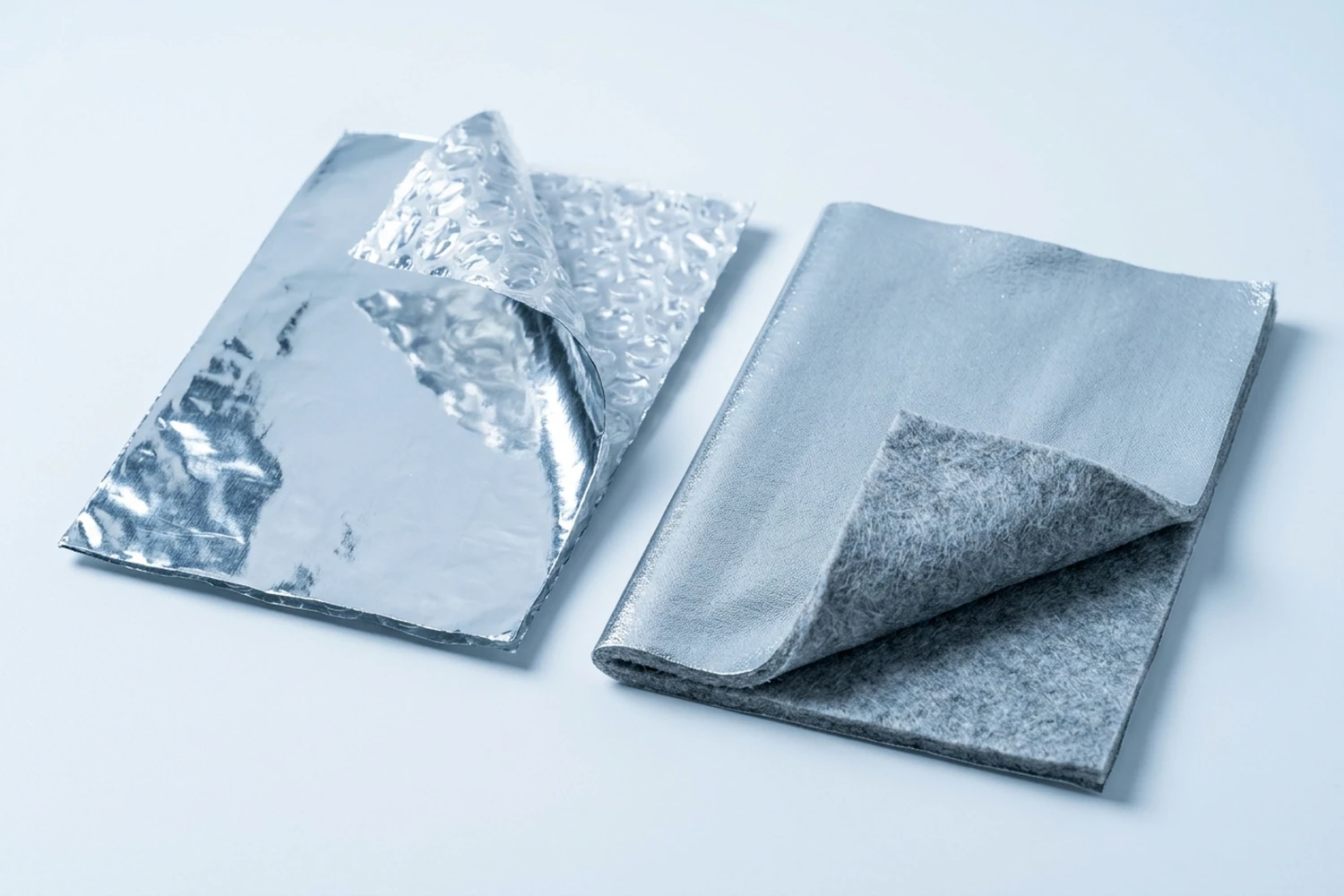
Reflective bubble-foil covers primarily resist heat gain; PCM composites add energy storage during phase change. A fitted cover encloses a specified load shape, while a draped thermal blanket needs its overlaps and lower edges secured consistently. Names alone do not establish either construction or six-sided coverage.
Astro-Cooler’s pallet-cover description identifies a reflective aluminum foil layer plus bubble construction. TLX Cargo’s PCM cover page describes PCM encapsulated within blanket fibres and a low-emissivity outer coating. These establish examples of material families, rather than performance ratings for every cover in those families.
Table: scroll horizontally if needed to see every column.
| Option | Mechanism and suitable decision | Operating burden | Dominant Failure Mode & Prevention |
|---|---|---|---|
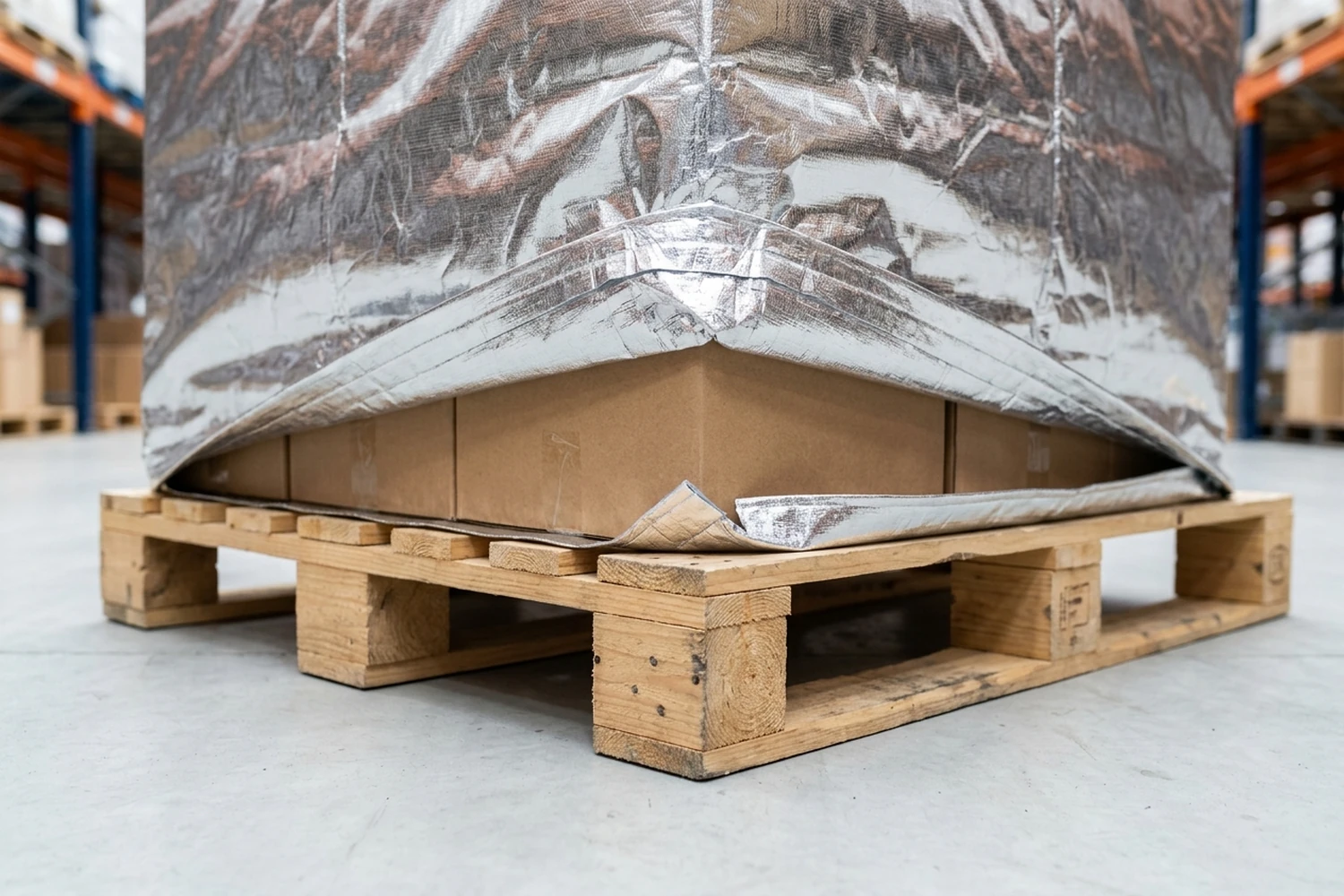
| Reflective multi-layer cover, including bubble-foil | Reduce radiant gain while the layered assembly slows other heat transfer; evaluate for a bounded exposed transfer | Fit, secure, remove and inspect the cover; preserve the specified layer arrangement | An open skirt or missing base leaves a heat path around the material. Test the actual lower-edge/base arrangement and inspect tears and compressed layers. |
| Phase-change composite cover | Add a finite thermal reserve around the material’s transition interval, alongside the cover’s barrier function | Verify the required initial PCM state, preparation procedure, handling and any return cycle | PCM begins the transfer with insufficient usable reserve, or the exposure exhausts it. Verify conditioning and assess the complete exposure sequence, including delays. |
| Loaded pallet without a thermal cover | Rely on existing product packaging, product tolerance and controlled transfer conditions; adds no cover-specific thermal buffer | Control dwell, staging location and transfer responsibility | Unexpected sun or a queue invalidates the accepted exposure. Use documented time limits and a defined move-to-controlled-storage response. |
The failure modes in this table are engineering checks for the configuration, rather than measured failure rates or a ranking of suppliers. A pallet of qualified parcel shippers also differs from a pallet of ordinary cartons: record what protection already exists inside the load.
Why does sun change the decision?
Air temperature alone does not describe an exposed pallet’s heat load. Direct sunlight reaches the top and sun-facing sides; a hot apron also presents a radiant source beneath and around the load. Warm air, contact paths and the pallet’s starting temperature remain relevant even when a reflective surface reduces one heat-transfer mechanism.
The U.S. Department of Energy’s insulation guidance explains that reflective barriers reduce radiant heat gain and need an adjacent air space for that function. This is a physical principle from building guidance, not a pallet R-value: a shiny layer pressed against another surface cannot be assigned an air-space assembly rating without evidence for that arrangement. Solar absorption and long-wave thermal emission also concern different spectral ranges; a quoted infrared reflection percentage does not establish solar protection.
Pharma.Aero’s airside survey, section 4.3.1, specifically calls attention to six-sided protection, including the bottom against radiation from the tarmac. Its blanket guidance emphasizes brief exposure and time management, with application to preconditioned goods in a controlled environment and removal after exposure ends. That guidance supports examining the base interface, rather than assuming a hood protects the whole load.
Rule of thumb: If a report documents only shaded air-temperature cycling, require evidence covering radiant exposure before using that cover to justify unshaded ramp or yard dwell. A hotter chamber setpoint alone does not establish that the cover has been assessed under sunlight and ground radiation.
PCM adds another variable: its usable energy reserve depends on the quantity, transition interval and starting state. Restoring that reserve requires the specified preparation conditions. Returning a cover to a nominal room temperature does not by itself demonstrate readiness for the next transfer.
How much solar energy reaches the cover face?
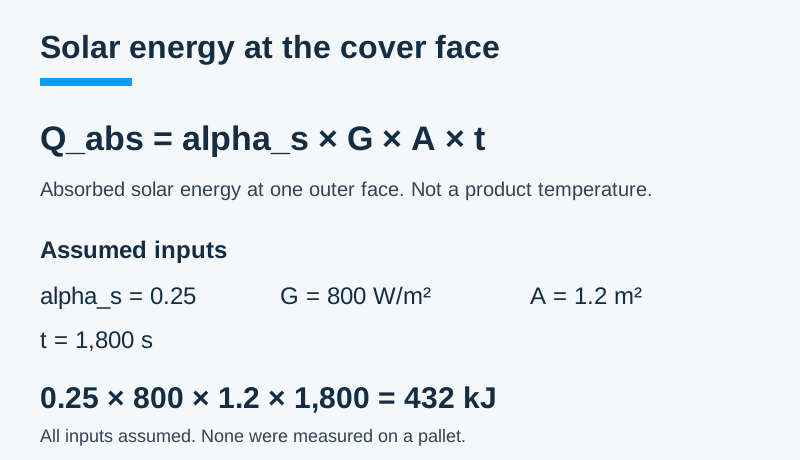
A simple energy balance shows why exposed area and dwell matter, but it cannot predict product temperature or cover holding time. For constant irradiance incident on a selected face:
Q_abs = α_s × G × A × t
Here Q_abs is solar energy absorbed at the outer face in joules; α_s is its dimensionless solar absorptance; G is incident solar irradiance in W/m²; A is exposed area in m²; and t is time in seconds.
Illustrative arithmetic — all inputs assumed, none measured: α_s = 0.25, G = 800 W/m², A = 1.2 m² and t = 1,800 s give Q_abs = 0.25 × 800 × 1.2 × 1,800 = 432,000 J = 432 kJ at the outer face.
This assumed absorptance is not a specification for foil or PCM covers. Some absorbed energy can leave the outer surface; the fraction reaching the payload depends on the assembly and surroundings. The calculation excludes other faces, ground radiation, convection and internal heat generation. Converting it into a product temperature rise would require further measured inputs. Its practical use is to identify why a longer queue or a newly exposed side needs review.
What does a 7E-style test prove for a pallet shroud?
A temperature-cycle test supports the configuration and exposure documented in its report. ISTA’s public 7E overview, printed pages 1–3, describes profiles derived from parcel shipping, allows standalone use and distinguishes that use from certification requiring Standard 20. It identifies the profiles as general simulations rather than customized worst-case lane exposure, and describes field verification within the qualification sequence.
For a pallet shroud, a report using a 7E-style cycle can therefore support comparison under that cycle. It does not establish ISTA certification, validate a different pallet arrangement or demonstrate solar and ground-radiation performance unless those exposures are documented separately.
Before accepting the cover for the transfer, resolve these pallet-specific questions:
- Does the tested load match the pallet height, carton arrangement and starting temperatures, including the PCM state where applicable?
- Are the fitted skirt, overlaps, fastening and base arrangement reproducible with normal fork access?
- Does the evidence address the actual sun-facing surfaces, lower interface, wind and exposure sequence?
- Were temperatures assessed at vulnerable product locations, including perimeter and bottom cartons, rather than using under-cover air alone?
- What happens after a missed loading slot, a torn cover or a partly completed transfer?
These are proposed acceptance questions for a lane trial, not additional requirements attributed to 7E. Keep the chamber comparison and the site exposure assessment identifiable in the evidence package.
Which costs change after the cover is purchased?
The useful comparison is cost per successfully protected transfer, including warm-up risk, cover condition and the handling step. Purchase cost alone leaves the main operating differences unresolved.
Table: scroll horizontally if needed to see every column.
| Cost factor | What to record | Decision it changes |
|---|---|---|
| Product warm-up on the ramp | Starting product temperatures, exposed dwell and exceptions requiring quality review, hold or loss | Whether the cover and transfer controls preserve sufficient temperature margin |
| Damage and reuse | Tears, failed fastenings, layer compression, cleaning and accepted versus rejected returns | How many inspected, usable cycles the operation actually achieves |
| Extra handling step | Time to retrieve, fit, secure, remove and store each cover, including rework | Staffing and staging capacity at peak dispatch |
| PCM preparation and returns | Required initial state, preparation capacity, readiness verification and return availability | Whether the composite is ready when the next pallet needs it |
Cover installation should not create an unplanned queue outside controlled storage. Assign installation, removal and exception ownership within the warehouse dispatch process. For a composite whose preparation depends on PCM selection, the refrigerant-selection guide explains the next material decision.
When is a parcel shipper the right object instead?
Choose a qualified parcel shipper when the shipment will travel as individual packages needing a defined thermal configuration for that journey. A cover can remain useful around palletized shippers during a transfer, but its evidence does not replace the individual packout evidence after depalletization. The insulated-shipper selection guide covers the parcel configuration inputs.
For an intact pallet with a bounded exposure, compare covers against that transfer first. If the assessed dwell or product sensitivity exceeds the supported protection, change the transfer controls or evaluate a more capable transport system through the active-versus-passive packaging guide.
Method and sources
This comparison uses public construction descriptions, an industry airside survey and the public ISTA overview, accessed 19 October 2026. Material mechanisms inform the comparison; proposed failure checks and lane-trial questions are engineering interpretation. The energy example uses assumed inputs throughout and supplies no product holding-time claim.
Source locators: Astro-Cooler, opening construction description; TLX Cargo, construction paragraph and About PCMs; Pharma.Aero, January 2020 survey, printed page 6; DOE, How? section; ISTA 7E October 2010 public overview, printed pages 1–3. The overview establishes the cited scope; a test report must identify the edition and procedure actually used.
Updated 19 October 2026.
Related guides
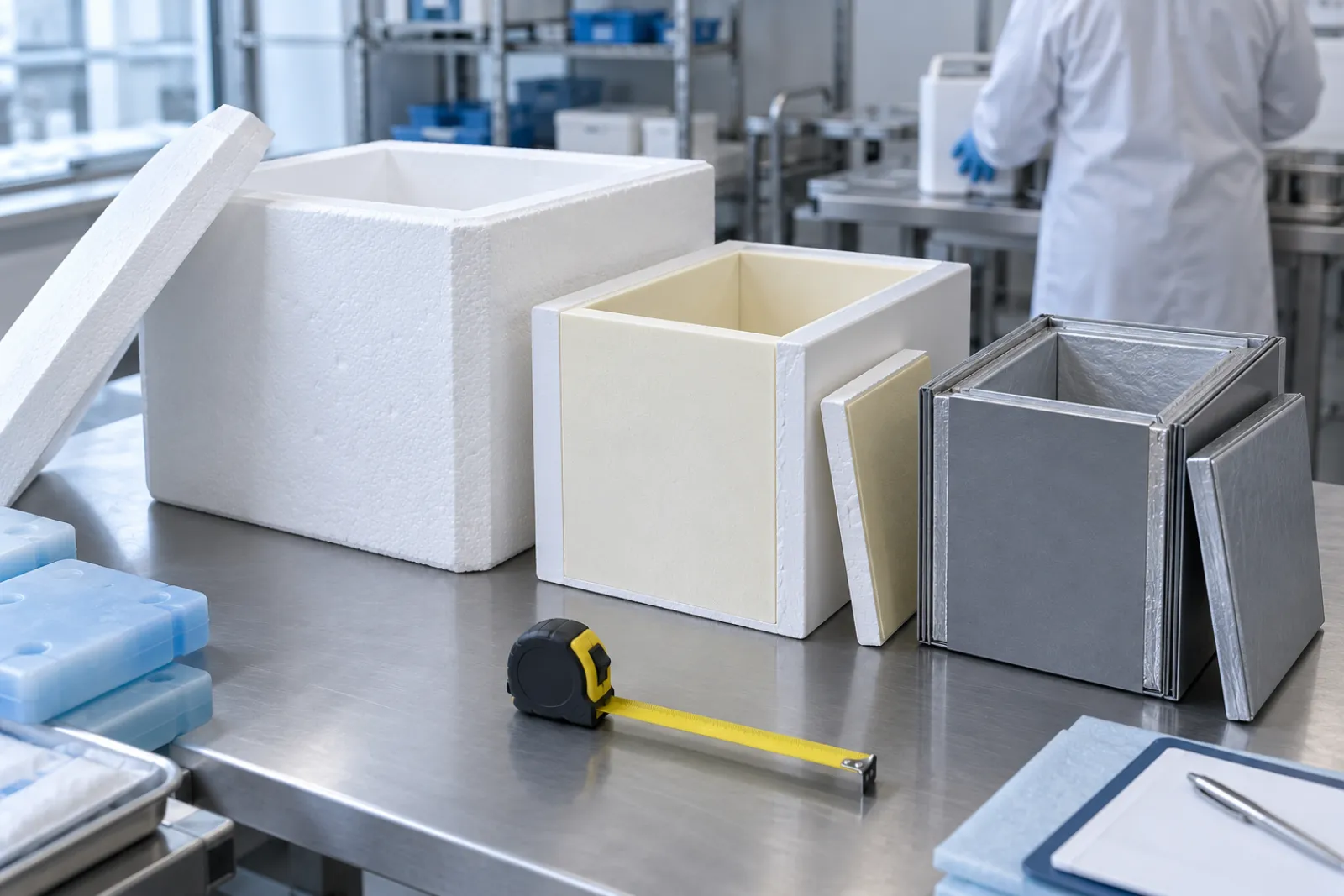
Selecting Insulated Shippers: Payload, Transit Time and Handling Constraints
Turn payload, transit time, ambient conditions, dimensions and handling into clear purchasing inputs for insulated shipper selection and supplier quotes.
Read guide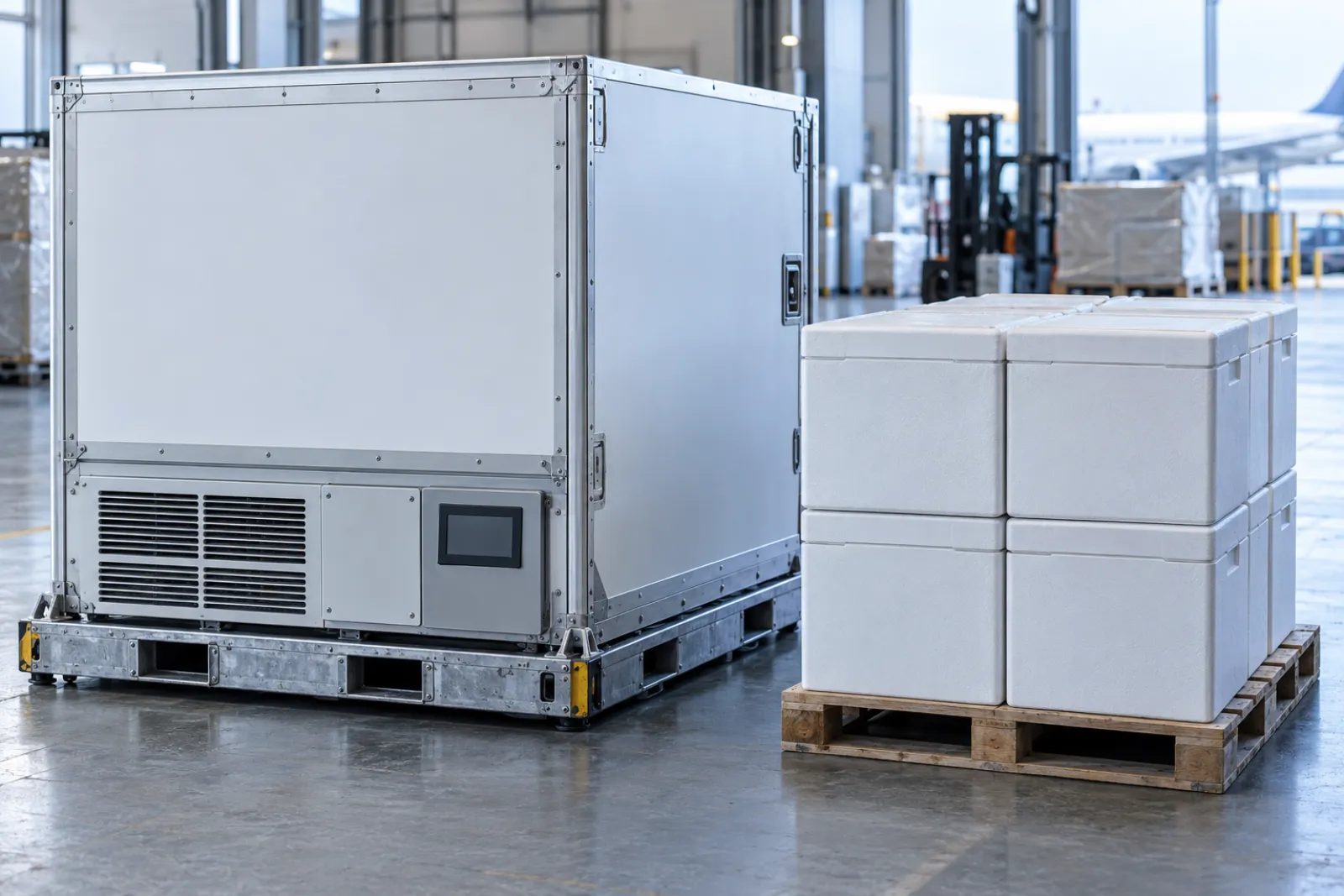
Active vs Passive Cold Chain Packaging: A Buyer's Comparison
Compare active and passive cold chain packaging by system boundary, route constraints and operating conditions, without a universal winner.
Read guide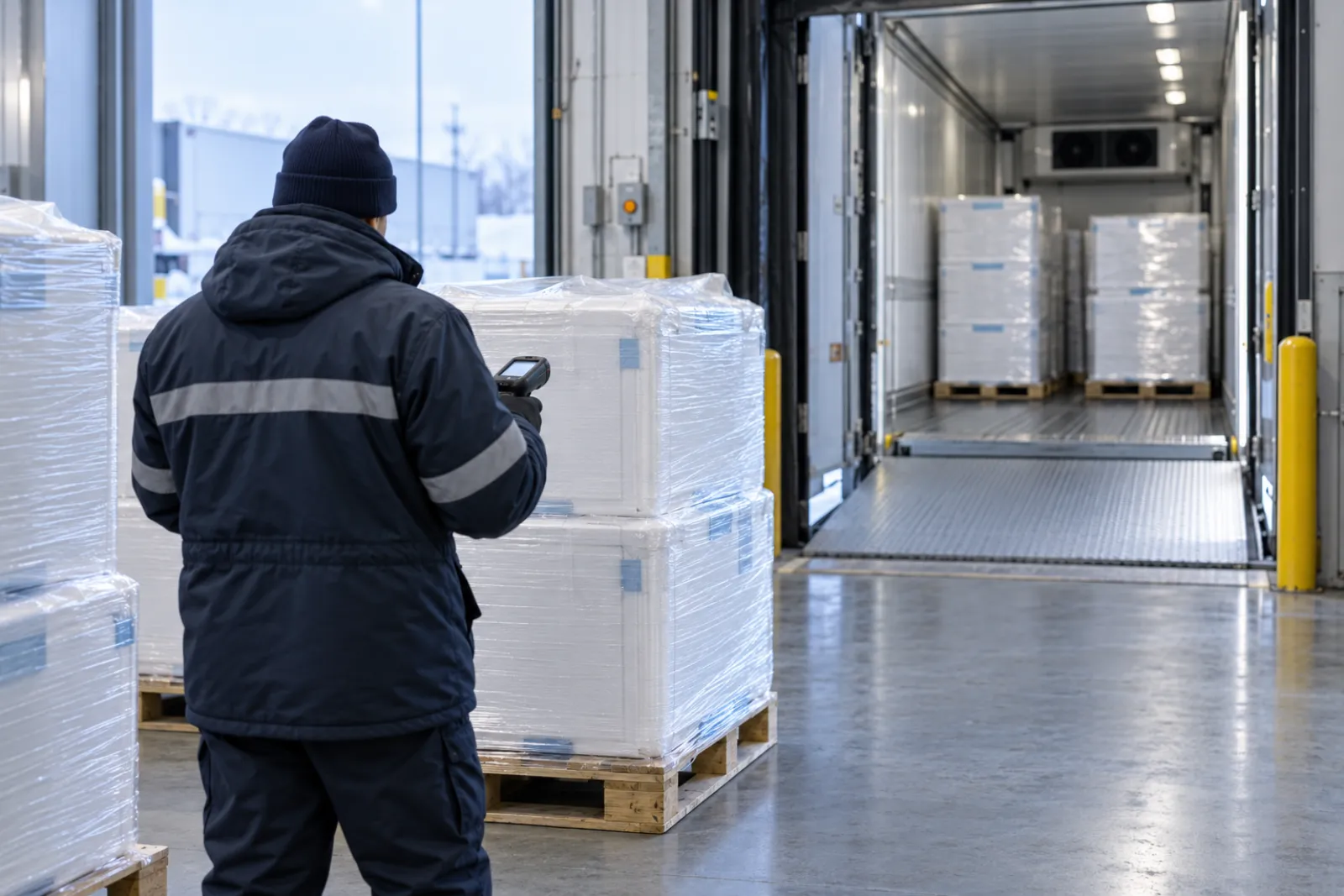
Temperature-Sensitive Dispatch: A Warehouse Handover Checklist
A cold chain dispatch checklist covering pick checks, logger start, documents, carrier handover, data responsibility and exception escalation fields.
Read guide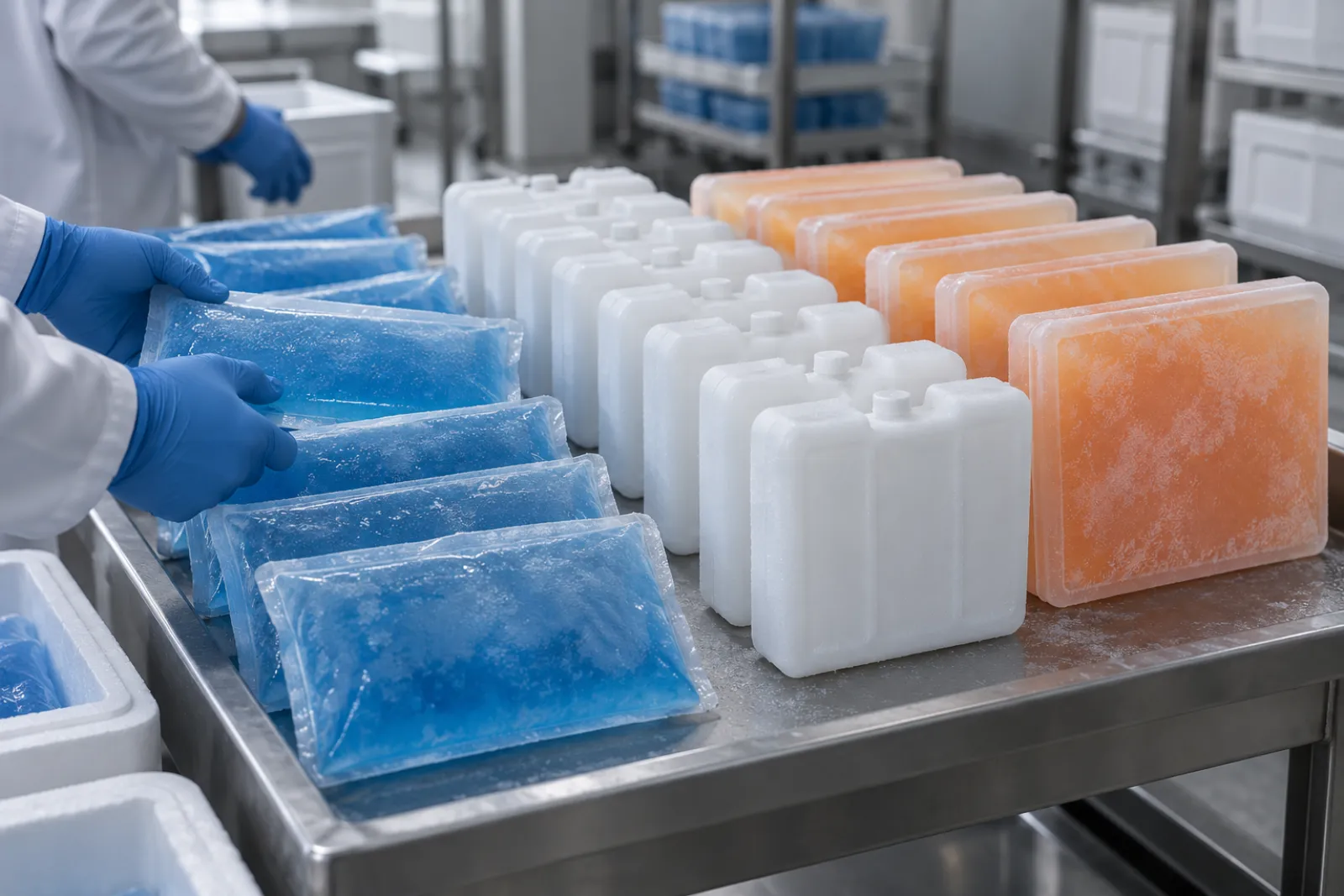
Comparing Water-Based Gel Packs and Other PCM Refrigerants
Compare cold chain refrigerants by formulation, phase-change range, conditioning and encapsulation instead of relying on a simple gel versus PCM label.
Read guide