
Types of Temperature-Controlled Packaging: A Comparison Chart
Describe temperature-controlled packaging by mechanism, use cycle and shipment scale, then record who prepares, powers, returns and inspects each system.
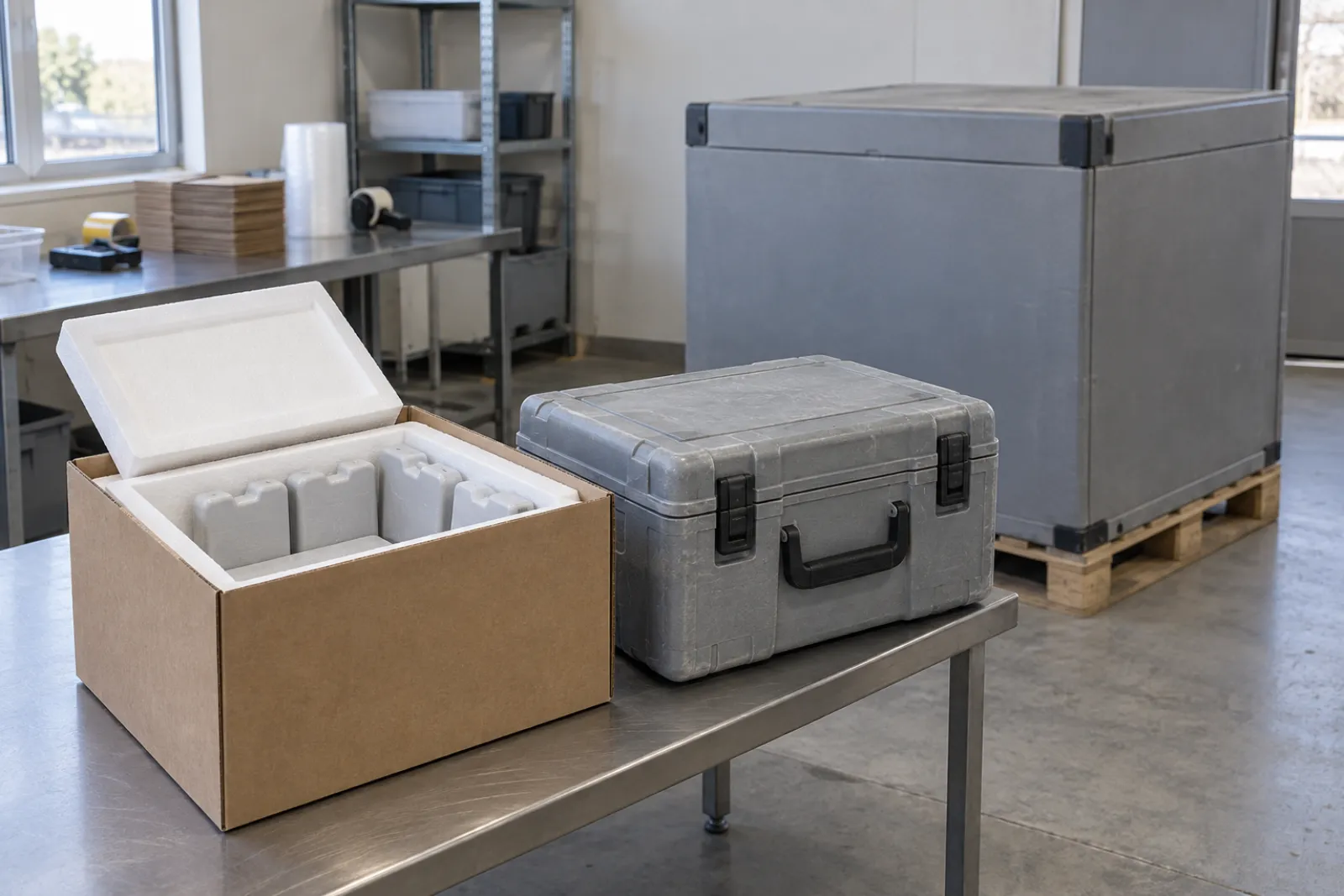
A temperature-controlled package is not one “type” from a fixed list. It is described by at least three separate fields: how the temperature is controlled (active or passive, or the supplier’s own term for anything else), how often the system is used (single-use or reusable), and the scale it ships at (parcel or bulk, as the supplier and carrier document it). Each field brings its own operating work, such as conditioning coolant, keeping a unit charged, getting boxes back or inspecting them before reuse. This guide gives a chart of those fields and a blank matrix for recording who does each task and which document proves it, so supplier proposals can be compared on the same terms. It sits within the packaging section.
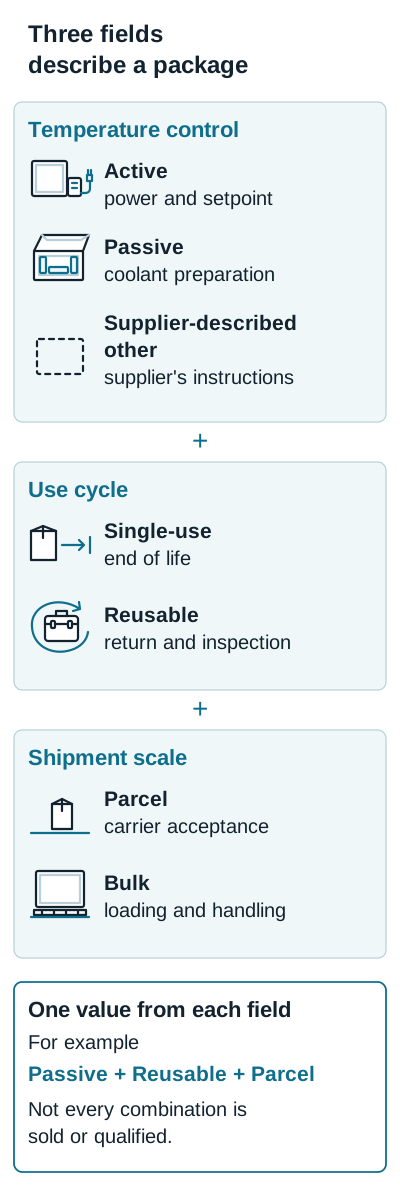
Three fields, not one list of types
Published lists of packaging types often mix answers to different questions. “Passive”, “reusable” and “pallet shipper” are not alternatives to one another; one system can be all three. This guide therefore compares systems on three fields. Use cycle and mechanism sit side by side in the scope of the WHO technical supplement on qualifying shipping containers, which covers “all single-use and reusable active, passive, hybrid, and cryogenic dry/vapour shipping containers or systems” for pharmaceutical distribution. Scale is not part of that wording; it is recorded from supplier and carrier documents.
- Temperature-control mechanism. WHO defines active systems as externally or on-board powered systems that use electricity or another fuel to maintain a temperature-controlled environment inside an insulated enclosure under thermostatic regulation. Passive systems maintain that environment with a finite amount of preconditioned coolant, such as chilled or frozen gel packs, phase-change materials or dry ice. The active versus passive comparison covers how the two behave on a route.
- Use cycle. Single-use systems are shipped once; reusable systems come back to be inspected, refurbished where needed and reissued.
- Shipment scale. Parcel systems travel as individual boxes; bulk systems are pallet-sized containers or pallet covers moved as freight. No source used here sets a numerical line between them, so record scale as the supplier and carrier describe it.
A useful system description takes one value from each field, for example “passive, reusable, parcel”. That is a description, not a recommendation, and it does not imply that every combination is sold or has been qualified for your product. One manufacturer’s public FAQ, for instance, documents passive ranges that are reusable in parcel and bulk sizes, and other passive ranges that are single-use in parcel and pallet sizes. Those examples show the fields vary independently; they say nothing about the performance of any box.
If a supplier uses a further label such as “hybrid”, record its own description of what controls the temperature. WHO lists hybrid systems in its scope but the supplement gives no definition, so the label alone does not tell you what the system does or what work it brings.
Comparison chart: what each label means in practice
Read each row within its own field. The last two columns turn a label into work and evidence, which is where proposals usually differ.
Table: scroll horizontally if needed to see every column.
| Field | Label | What it describes | Operating question it raises | Document to obtain |
|---|---|---|---|---|
| Mechanism | Active | A powered unit regulates the temperature inside the enclosure | Where does power come from at each stage, who sets and checks the setpoint, and who maintains the unit? | Operating instructions, setpoint and power arrangements, maintenance records |
| Mechanism | Passive | Insulation plus a finite amount of preconditioned coolant | Who prepares the coolant, to which instruction, and who assembles the packout in the tested configuration? | Qualification or thermal report for the configuration; packout and conditioning instructions |
| Mechanism | Supplier-described other | Whatever the supplier states, for example a design that is activated rather than preconditioned | What exactly must be done before use, and by whom? | The supplier’s description and operating instructions for that design |
| Use cycle | Single-use | Shipped once, then disposed of or recycled by component | Who handles end of life at the receiving site, under which instruction? | End-of-life or recycling instructions in the product user guide |
| Use cycle | Reusable | Returned, inspected, refurbished where needed and reissued | Who gets units back, who inspects them, and who decides a unit can ship again? | Return or service agreement; inspection and refurbishment procedure; requalification approach |
| Scale | Parcel | Individual boxes moving through parcel or courier networks | Does the carrier accept the box, size and contents on this service? | Carrier acceptance terms and the supplier’s documented payload range |
| Scale | Bulk | Pallet-sized or pallet-accepting containers and systems moved as freight | Who books, loads and handles the unit at each transfer, and what payload configuration was tested? | Documented payload and load configuration; handling instructions |
For passive systems, the configuration report and the conditioning instructions belong together. The WHO supplement says full details of the packaging assembly must be defined, tested and documented, including the conditioning regime for the components, the product loading arrangement and the location of temperature monitors, and that qualification must take account of the route, transport modes and expected ambient profile. Turning those inputs into a shipper specification is covered in selecting an insulated shipper, and coolant choice in comparing gel packs and PCM refrigerants. Carrier acceptance for parcel-scale boxes is covered in cold shipping checks for FedEx, UPS, DHL and USPS.
Where type labels mislead
A few shortcuts cause most of the confusion when proposals are compared.
- A battery in the box does not make it active. WHO lists temperature data-logging devices among ancillary packaging components. A logger’s battery powers measurement, not temperature control, so a passive shipper with a logger is still passive. Logger requirements are a separate decision, covered in specifying a temperature data logger.
- Passive does not mean single-use. Reusable passive containers are documented in both parcel and bulk sizes.
- Bulk does not mean active. Single-use, pallet-sized passive systems are also documented.
- Preparation differs by design. Conditioning, as one manufacturer defines it, is chilling or freezing coolant to the correct temperature for use. The same FAQ describes an evaporative-cooling design activated by a button, which it says removes the need for preconditioning. Record “preparation or activation required by this system’s instructions” rather than assuming one routine for every passive box.
- A thermal cover is not a complete container. The same FAQ presents pallet thermal covers as passive protection that can serve as a secondary layer alongside temperature-controlled shippers. Treat a cover as one component unless a report covers it as the qualified system.
Operating responsibilities: owner and evidence matrix
Copy this matrix once for each system you are considering. Each row is a task that one of the three fields can create. The owner and document columns are intentionally empty: a blank means the answer has not been confirmed, not that the task does not apply. Mark a row “not applicable” only with a stated reason, such as “passive system, no power required, per operating instructions version __”.
Table: scroll horizontally if needed to see every column.
| Task | Arises from | Named responsible party | Original document and version | Project value or evidence location | Open question |
|---|---|---|---|---|---|
| Preparation or activation (conditioning coolant, or the design’s own activation step) | Passive or supplier-described mechanism | ____ | ____ | ____ | ____ |
| Power and charge arrangements at each stage, including holds | Active mechanism | ____ | ____ | ____ | ____ |
| Assembly and load configuration as tested | Every mechanism | ____ | ____ | ____ | ____ |
| Monitoring setup, device placement and data handoff | Every system that carries a monitor | ____ | ____ | ____ | ____ |
| Return of reusable units from receivers | Reusable cycle | ____ | ____ | ____ | ____ |
| Inspection, refurbishment and the decision to reissue | Reusable cycle | ____ | ____ | ____ | ____ |
| Requalification approach for reused units | Reusable cycle | ____ | ____ | ____ | ____ |
| Carrier acceptance and handling at transfers | Parcel or bulk scale | ____ | ____ | ____ | ____ |
| End-of-life route for each component | Single-use cycle, and reusable units retired from use | ____ | ____ | ____ | ____ |
Notes on filling it in:
- Preparation and assembly. Take the conditioning regime and load arrangement from the system’s qualification report and instructions. A sequence written for the packing bench is the subject of designing a packout station.
- Inspection and refurbishment. One manufacturer describes its refurbishment of named reusable products as cleaning, visual inspection, checking key components and replacing them if required. That describes its own service centers; it is not a test you can apply to a box that merely looks intact. WHO adds that reusable systems should be periodically requalified because of age, physical damage, changes in the materials or other performance loss, and that the process is generally user-defined. Record your actual approach rather than a calendar borrowed from elsewhere. The return loop itself is covered in reusable thermal shipper operations.
- End of life. The same FAQ says many components are recyclable depending on local regulations and gives different guidance for cartons, foam, vacuum panels and refrigerant bricks. “Single-use” does not mean every component is recyclable; take the route from the product’s user guide and the receiving site’s rules.
Possible parties include the supplier or a service provider, your logistics team, the packing site, the carrier, the receiver and your quality team. None is assigned here; the matrix is complete only when each row names a party and the document that gives them the task.
Ownership follows the contract, not the type
The same packaging type can come with very different work attached. One supplier’s services page sets out three arrangements: customers buy and own the inventory and add services; the supplier owns leased parcel inventory under a multi-year contract with service options; or the supplier owns a rented bulk fleet and adds release and return logistics. Each lists its own services and states whether it applies to parcel, pallet or bulk solutions.
So before filling the “named responsible party” column, read the actual purchase, lease, rental or service agreement and note which tasks it covers. Do not assume that a rental includes inspection, or that buying the asset leaves no service obligations with the supplier. The cost side of these arrangements, including returns and losses, can be laid out in the packout cost worksheet.
Documents to collect before comparing proposals
Put these on file for each system before ranking anything:
- The qualification or thermal report for the exact configuration, including payload, conditioning and test profile. Reading one is covered in thermal packaging qualification reports.
- The current operating instructions: preparation or activation, assembly, power and handling.
- The return, service or rental agreement where one applies, with the tasks it covers.
- A named owner for every applicable row of the matrix.
The product’s own temperature requirements come from its documentation and your quality system, never from a packaging label. The WHO supplement used here is pharmaceutical guidance; food shipments follow their own rules. Sector-specific starting points are in pharmaceutical shipping packout and chilled and frozen food packaging.
Questions about single-use products and stated durations
Can a single-use shipper be used more than once?
Not on the strength of how it looks. One manufacturer’s FAQ answers this question by stating that its single-use products are qualified for one-time use under ISTA 7D test profiles. That is a statement about its products, not a universal rule, but the principle carries over: reuse needs evidence that covers the intended use cycle for that exact system. Without it, plan a single-use system as single-use.
Why does a supplier’s website duration differ from its qualification report?
Because summaries are simplified. The same manufacturer explains that its website and sales material round durations to common figures for easier reading, and directs users to the thermal or qualification report for each product, which records the exact conditions, probe locations and scenarios tested. Compare systems on their reports and test profiles, not on brochure hours.
Limitations of this guide
This guide organizes labels and responsibilities. It does not test or rank packaging, state any duration or temperature performance, or say that a configuration suits a particular product, lane or market. The definitions come from WHO guidance written for pharmaceutical distribution, and the examples come from one manufacturer’s public pages, cited as documents rather than endorsements. Named suppliers are sources only; Cold Chain Practice does not supply packaging or services.
To use it, read the related guides linked above, copy the matrix for each system under consideration, and confirm every responsible party and source document with your quality and logistics teams before shipments are planned. The warehouse dispatch handover checklist picks up where the packaging work ends.
Related guides
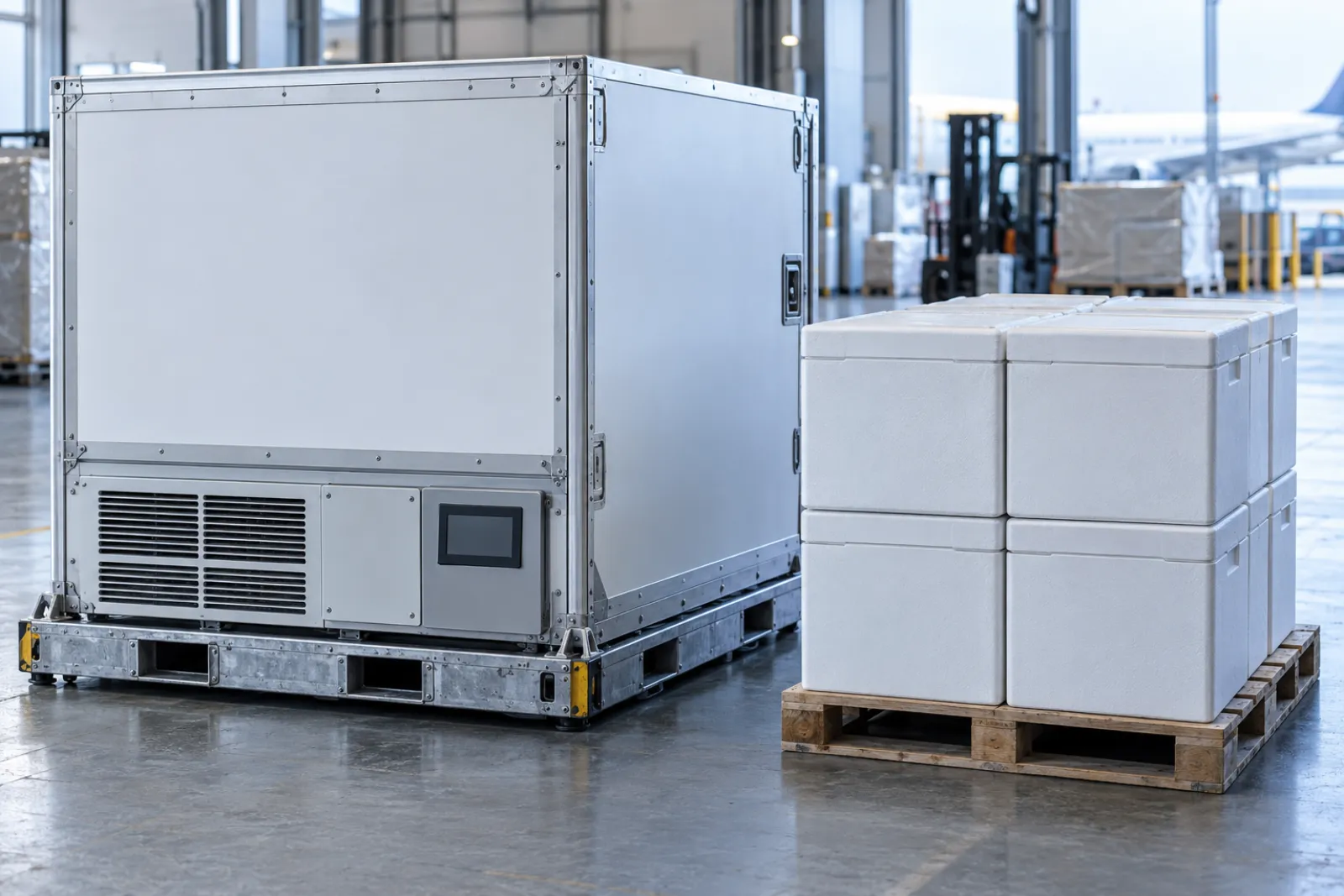
Active vs Passive Cold Chain Packaging: A Buyer's Comparison
Compare active and passive cold chain packaging by system boundary, route constraints and operating conditions, without a universal winner.
Read guide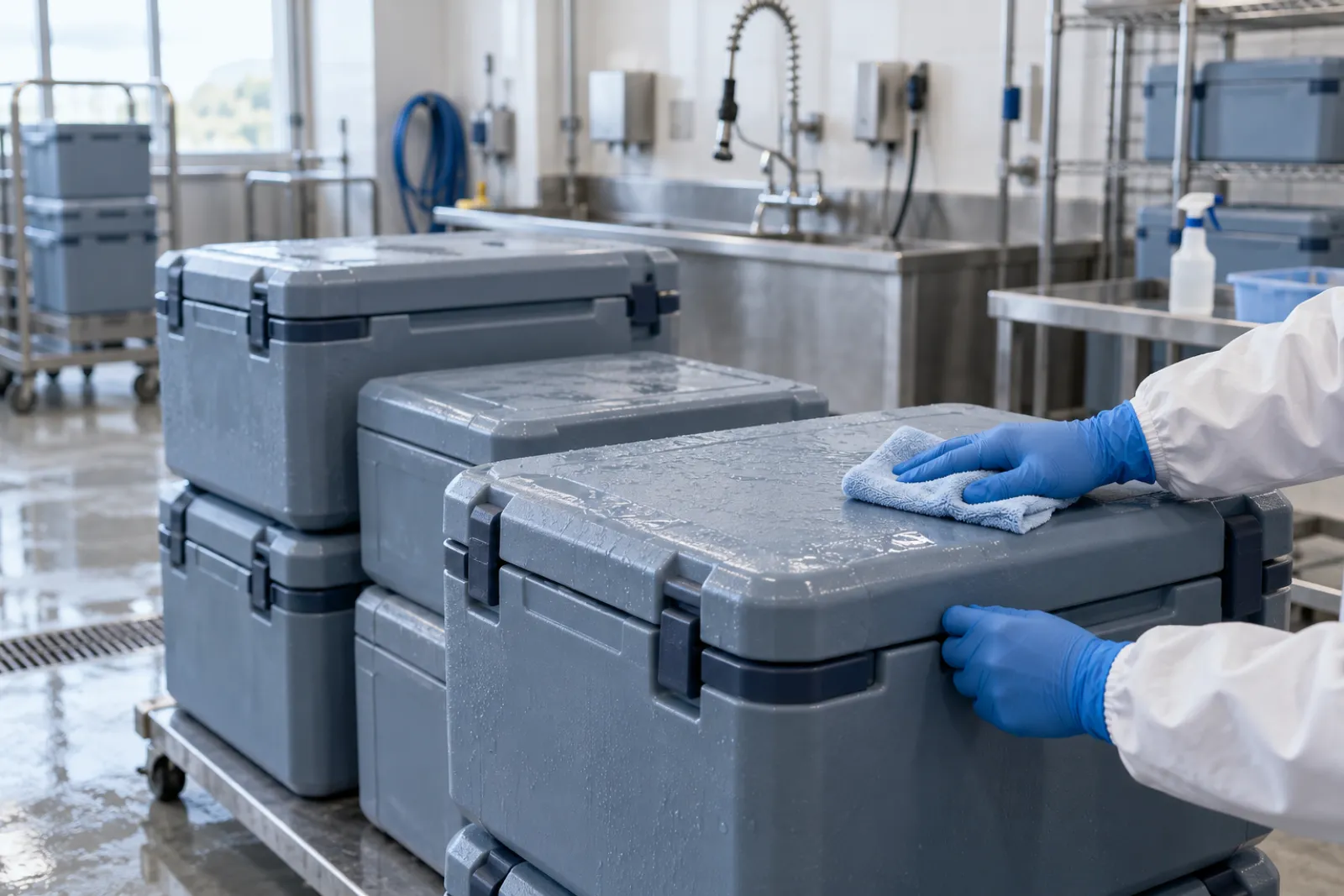
Reusable Thermal Shippers: Return Logistics, Cleaning and Rotation
Compare return flows, cleaning responsibility, rotation, losses and total cost when you run reusable thermal shippers, with a checklist for operations teams.
Read guide
Selecting Insulated Shippers: Payload, Transit Time and Handling Constraints
Turn payload, transit time, ambient conditions, dimensions and handling into clear purchasing inputs for insulated shipper selection and supplier quotes.
Read guide
Thermal Packaging Qualification Reports: Reading Conditions and Limitations
How to read a thermal packaging qualification report: check the test object, payload, temperature profile, duration, acceptance criteria and stated limits.
Read guide