
StePacPPC Cucumber Pouch: MAP and Moisture Claims
Read StePacPPC's pouch announcement as a supplier claim, separate moisture from atmosphere evidence, and prepare questions for an IFPA assessment.
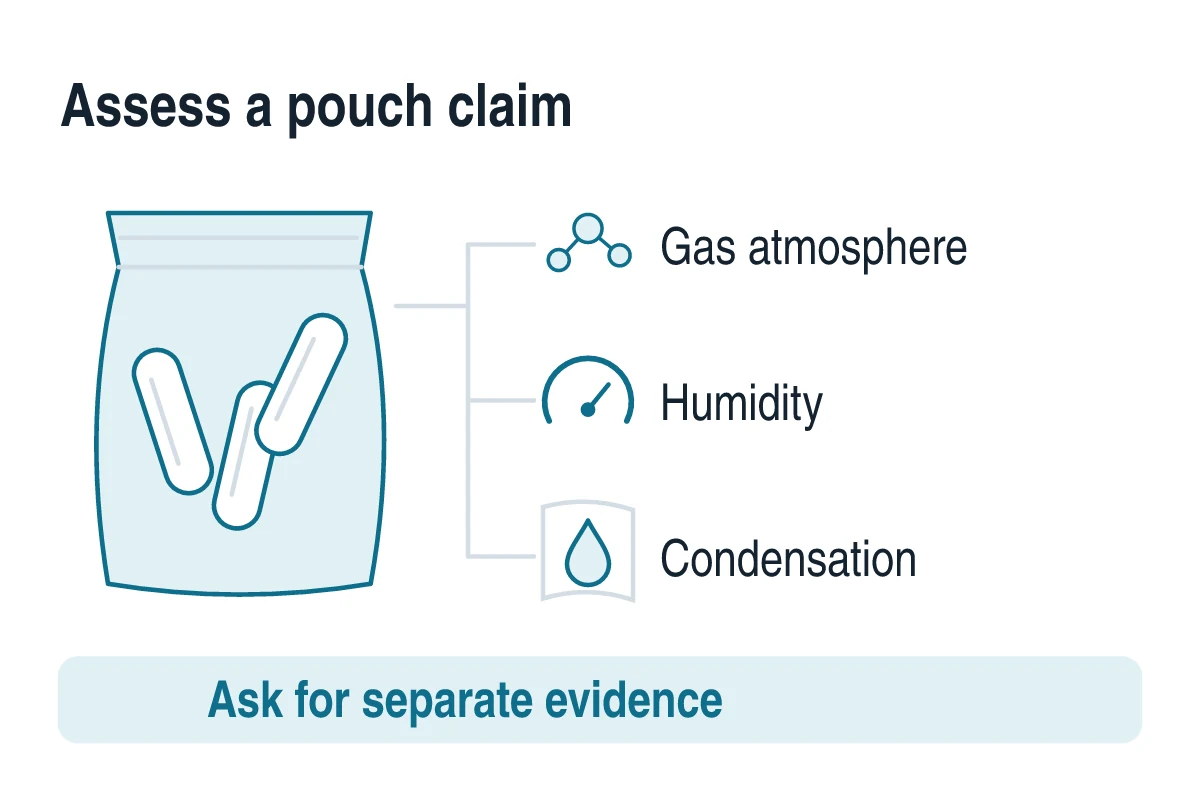
Treating a shelf-life headline as a shipping specification risks accepting produce on the wrong evidence. The useful next step is to request separate atmosphere, moisture and quality records for your actual product and route before deciding on a pouch trial.
This analysis serves US produce packaging managers reviewing the September 29, 2026 announcement. We have not tested the product. The applications section covers related shipping workflows.
- The announcement is a reason to ask for evidence, not an adoption deadline.
- Visible condensation, humidity and gas atmosphere need distinct records.
- A reported quality advantage needs a scoring definition and matching comparator.
- Film selection, line fit and supply terms remain questions for the supplier.
What was announced, and what it establishes
StePacPPC announced a patent-pending, resealable Xgo PAZ Pouch combining modified atmosphere packaging (MAP), moisture management and condensation control. Its original release is the source of these product claims; it is not independent proof of their effectiveness.
Label announcements, test evidence and proposed investigations separately, following the editorial policy.
MAP concerns the package’s gas atmosphere; humidity describes water vapor; condensation is liquid water on surfaces. A clear-looking pouch supplies neither a gas measurement nor a food-safety determination.
The company’s technology page separates gas permeability, water vapor transmission rate (WVTR) and antifog properties. Request film-specific measurements and test conditions alongside condensation images.
In the release’s explanation, a laminated pouch with low WVTR can retain excess moisture; macro-perforating it lets moisture escape but compromises the modified atmosphere and increases dehydration risk. This is the supplier’s stated trade-off, not a measured ranking here. The macro-perforated format in that explanation is distinct from the microperforated comparator named in its trial result.
Takeaway: Treat the announcement as an evidence request, not a verified shipping specification.
Who is affected: turn each concern into a record
Managers considering a change to cucumber retail packaging have the clearest reason to review this announcement. Assign each team a question and document owner.
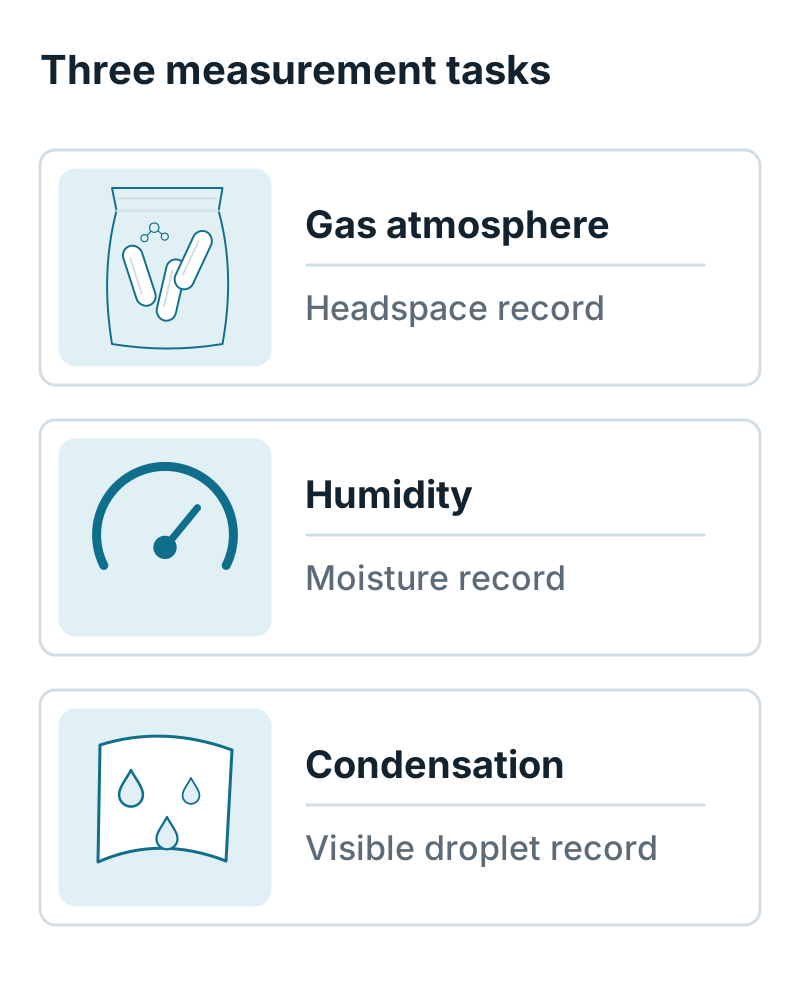
Table: scroll horizontally if needed to see every column.
| Team or reader | Assessment question | Record to request or produce |
|---|---|---|
| Produce packer | Does the proposed pack suit our product and starting condition? | Product description, pack version and supplier application notes |
| Cold-chain manager | What conditions did the comparison actually reproduce? | Time, temperature and handling sequence for each trial arm |
| Retail packaging team | What does the visible quality endpoint include? | Scoring definitions, images and rejection criteria |
| Line engineer | Can the actual pouch be handled and closed on our line? | Material specification, closure instructions and observed line trial |
| Procurement manager | What would be supplied for our market and application? | Written supply scope and identified packaging version |
The food packing versus thermal shipping guide keeps the retail pack distinct from the transport system. A retail-format change also needs a review of the dispatch and receiving handoffs, because the trial record should describe the journey the product actually takes.
Review other produce or pack sizes separately.
Takeaway: Give each affected team one question, one evidence record and one owner.
Read the test as a comparison, not a duration guarantee
The release reports simulated supply-chain comparisons assessed at day 16, summarized below. Different produce labels and comparators do not establish whether the samples came from the same trial cohort; request the protocol.
The figures do not mean shelf life increased by 16 days or spoilage fell by 29 percent. A percentage-point difference compares percentages on a defined scale; request that scale, baselines and score sheets.
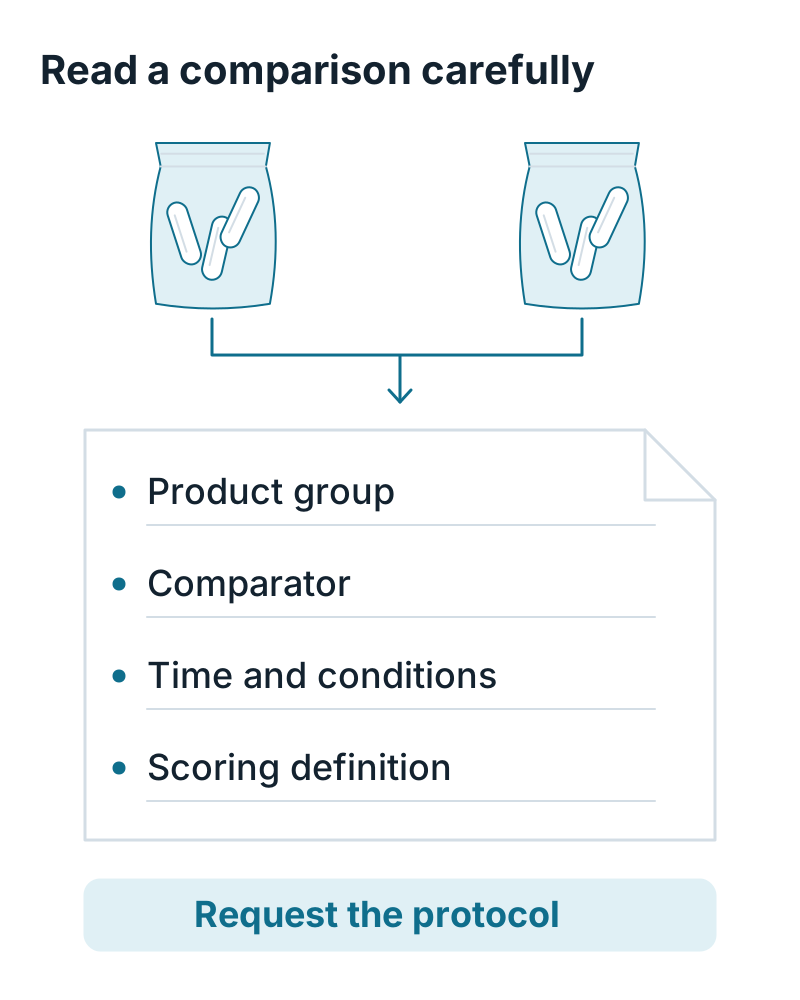
Keep the two reported comparisons in separate rows:
Table: scroll horizontally if needed to see every column.
| Product label in the release | Comparator | Reported result at day 16 | Evidence status |
|---|---|---|---|
| Organic baby cucumbers | Top-seal alternative | 29 percentage-point overall-quality advantage | Manufacturer claim; protocol requested |
| Organic mini cucumbers | Traditional microperforated packaging | 10 percentage-point overall-quality advantage | Manufacturer claim; protocol requested |
Both rows come from the September 29 release. Scoring scale, baseline scores, detailed conditions and whether samples were shared remain unprovided in that release; request them with the following fields:
Table: scroll horizontally if needed to see every column.
| Field | What the record should identify | Why your team needs it |
|---|---|---|
| Product group | Cultivar, maturity, source and initial condition | Establishes which produce was compared |
| Pack configuration | Pouch version, fill and comparator construction | Prevents comparison of unlike packouts |
| Trial sequence | Conditions, durations and handling stages | Lets the logistics team compare the tested journey with its lane |
| Quality endpoint | Definition, scale and assessment method | Makes the reported advantage interpretable |
| Replication and assessor | Samples, repeat runs and who scored them | Lets a technical reviewer assess the strength of the comparison |
Use report review to match evidence to configuration, and logger specifications to define a future route record. This produce trial is not a thermal qualification.
Common mistake: Combining separate reported comparisons into a single performance ranking. Ask for the data separately and retain the original comparator description.
Takeaway: Review the protocol and scoring basis before translating a reported difference into a decision.
When to act: prepare before the show, decide after evidence review
Use the approaching show to organize questions and contacts, rather than scheduling adoption around a media headline. The IFPA organizer confirms the Global Produce & Floral Show in Orlando on October 14–16, 2026. Confirm any supplier meeting directly; this page does not treat a reported display as a supply date.
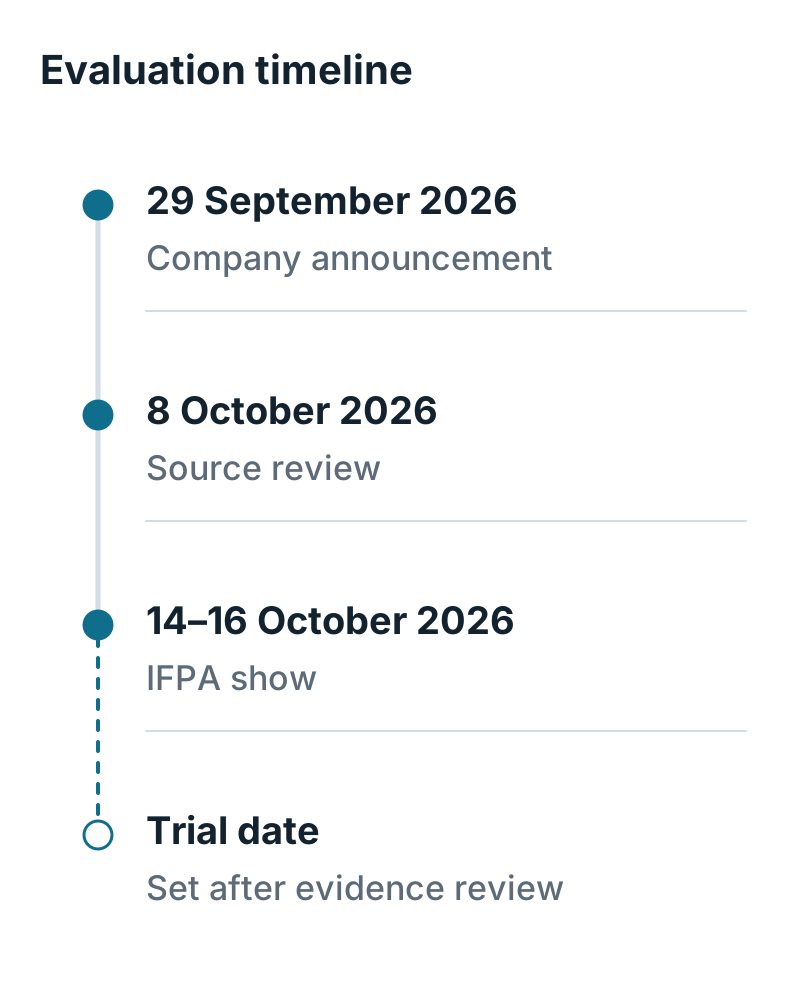
Table: scroll horizontally if needed to see every column.
| Date or decision point | Event or action | Source and status |
|---|---|---|
| September 29, 2026 | Manufacturer published the pouch announcement | StePacPPC original release |
| October 8, 2026 | This article’s source review | Editorial review; no new experiment |
| October 14–16, 2026 | IFPA show in Orlando | Organizer’s event page |
| Before a supplier discussion | Assemble your product and route description | Editorial preparation advice |
| After reviewing the documents | Decide whether to design a matched trial | Conditional action; date to be set by your team |
Define trial prerequisites: comparison record, material specification, filling and closure plan, and written supply proposal. Record reasons to proceed or defer.
Takeaway: Put dates on confirmed events and conditions on adoption decisions.
What is still uncertain: ask the person who owns the evidence
The public announcement does not supply the complete records needed to approve your application. Make the missing fields visible and assign each request to someone who can answer it.
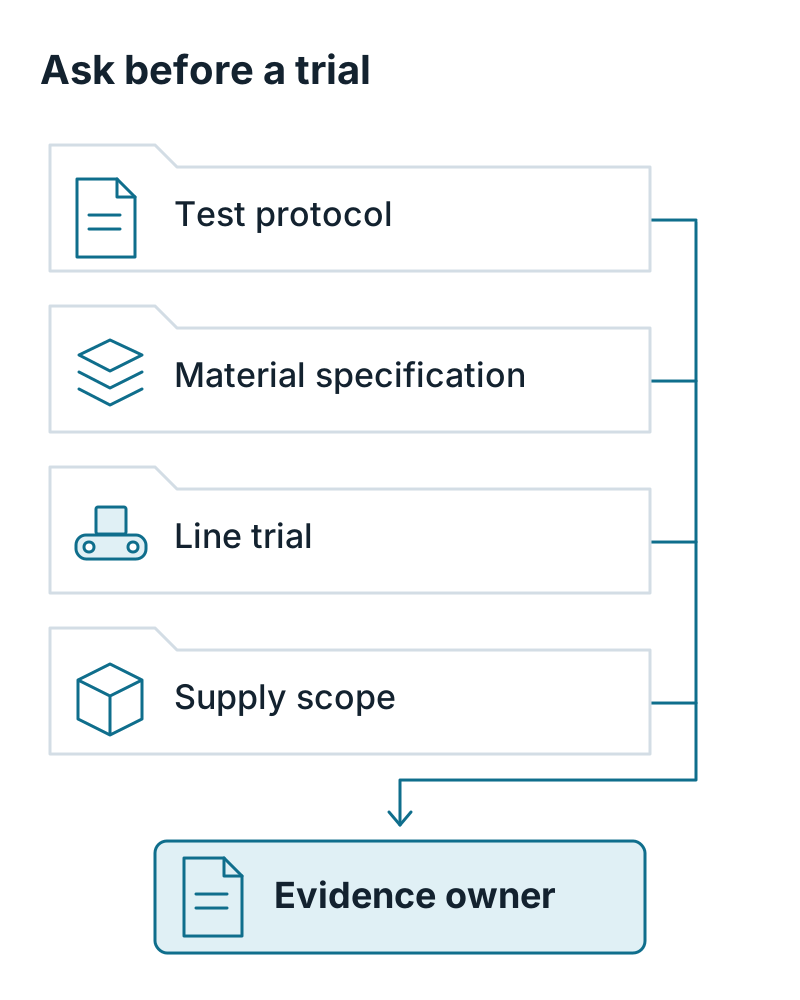
Table: scroll horizontally if needed to see every column.
| Unresolved item | Who to ask | Document or observation to request |
|---|---|---|
| Test execution and scoring | Supplier and identified trial organization | Named protocol, original data and assessor details |
| Atmosphere and moisture behavior | Supplier’s technical team | Product-specific gas and moisture measurement records |
| Material and disposal claims | Supplier and appropriate technical reviewer | Layer structure and evidence for any proposed disposal claim |
| Filling and closure compatibility | Line team and equipment provider | Trial on the actual pouch and intended operating sequence |
| Supply scope | Supplier’s commercial team | Written offer for the exact version and destination |
For line fit, use the end-of-line interface guide to describe downstream handling. Do not interpret a resealable format as proof that a particular machine can fill or seal it. Use packout station planning to identify tasks that a sample demonstration omits.
Compare your own costs only after defining the version and workflow. The packout cost guide provides categories; this news analysis supplies no prices or savings forecast.
Takeaway: Close each missing field with the responsible person’s record before approving a trial scope.
IFPA assessment checklist: capture the answer and its limits
Copy this question log for the meeting. Record documents beside verbal answers; dashes mark empty fields, not negative answers or promised dates.
Table: scroll horizontally if needed to see every column.
| Question | Reply / open item | Document | Owner | Follow-up date |
|---|---|---|---|---|
| Exact product and pack configuration? | — | — | — | — |
| Who ran and scored each comparison? | — | — | — | — |
| Quality scale and rejection endpoint? | — | — | — | — |
| Separate gas, humidity and droplet records? | — | — | — | — |
| Material and closure instructions? | — | — | — | — |
| What should our filling and closing trial demonstrate? | — | — | — | — |
| Written version, supply region and terms? | — | — | — | — |
The supplier evaluation guide helps organize the document requests.
Common mistake: Treating a presentation sample as proof of supply-chain or line performance. Write down which observations a subsequent trial would need to add.
Takeaway: Leave the meeting with document requests and owners, not just an impression of the sample.
When this does not apply
This analysis does not replace product-specific cooling, food-safety evaluation or release decisions. It does not validate a film, a patent, a recycling claim or a machine configuration.
The UC Davis cucumber fact sheet identifies quality factors and chilling sensitivity. That older commodity background supports considering product condition alongside packaging; it neither tests this pouch nor supplies a current procedure for your operation. Ask your produce and quality specialists to define the conditions a trial should investigate.
A claim about a retail pouch also does not select a shipping system. Keep the insulated shipper requirements and retail pack evaluation separate where an outer thermal packout is part of your lane.
Takeaway: Assess packaging alongside product handling, with your own specialists owning the acceptance decision.
FAQ: adjacent produce-packaging questions
These broader questions help define the limits of the pouch announcement; they are not additional product claims.
What foods use modified atmosphere packaging?
For this produce assessment, StePacPPC’s technical page discusses berries, leafy greens and cucumbers; its release also names lychee, pitaya, rambutan and longan. Those are supplier-described applications, not a list of foods qualified for this pouch. Request the film and trial record for your commodity.
What are the disadvantages of modified atmosphere packaging?
Moisture retention and dehydration are opposing concerns in the supplier’s cucumber explanation: low-WVTR laminated film can retain moisture, while macro-perforation compromises atmosphere control. The practical limitation is that gas and moisture behavior need separate assessment; the release does not quantify either trade-off on your route.
What does modified atmosphere packaging mean?
It means the package’s gas composition differs from ordinary air. FDA’s Food Code 2022 definition explains that it may change over time through film permeability or food respiration. For a resealable pouch, request measurements after opening and closing; the release gives no gas-recovery curve.
Is modified atmosphere packaging safe?
A MAP label alone does not establish safety. FDA’s Food Code 2022 Annex 6 explains that reduced-oxygen methods require appropriate safety controls. Your food-safety specialists need to assess the actual food, material and handling process; this release’s quality results do not establish approval for it.
Why are English cucumbers wrapped in plastic?
To limit moisture loss after harvest. UC Davis WIFSS’s production summary describes thin-skinned greenhouse English cucumbers as prone to water loss and softening, with individual shrink wrap used to limit that loss. This older background explains the purpose, not a PAZ-pouch result or equivalence between wraps and pouches.
Can cucumbers be vacuum packed?
The pouch announcement does not establish suitability for vacuum packing cucumbers. FDA’s definition distinguishes vacuum packaging, which removes air and retains a vacuum, from MAP, whose gas composition can change. A resealable MAP pouch should therefore not be treated as a validated vacuum process; seek product-specific process evidence.
Takeaway: Use commodity and process evidence to answer adjacent questions without extending the pouch claim.
Method and review
We read the manufacturer’s original September 29 release, compared it with the Packaging Europe account and checked the organizer’s event page on October 8, 2026. The news accounts share an announcement lineage and do not constitute independent performance validation. Where comparator wording differs, this article follows the original release. We have not reviewed the raw trial data, conducted a pouch trial or confirmed line compatibility.
The tables and proposed decision sequence are editorial analysis. Recheck event details before travel and request current technical and supply documents before setting a trial date. Review after the October 2026 show if new public evidence changes the assessment.
Further reading: food packing versus shipping clarifies the system boundary; report review helps match evidence to conditions; supplier evaluation organizes the document requests.
Takeaway: Revisit the assessment when new trial or supply records become available.
Prepared by Cold Chain Practice Editorial Desk.
Related guides
Chilled and Frozen Food Packaging: Product Packing vs Thermal Shipping
Separate primary food packaging from thermal shipping packaging, and see where the equipment boundary sits between product packing and cold chain packout.
Read guide
Temperature-Sensitive Dispatch: A Warehouse Handover Checklist
A cold chain dispatch checklist covering pick checks, logger start, documents, carrier handover, data responsibility and exception escalation fields.
Read guide
Thermal Packaging Qualification Reports: Reading Conditions and Limitations
How to read a thermal packaging qualification report: check the test object, payload, temperature profile, duration, acceptance criteria and stated limits.
Read guide
Pharmaceutical Shipping Packout: What Buyers Must Define Before Equipment Selection
Build packout requirements from product documentation, lane assessment and quality input before you shortlist equipment. Owners, interfaces and records.
Read guide