
Cold Chain 3PL: Integrated Warehousing and Transportation
A cold chain 3PL typically specializes in integrated warehousing and transportation. A freight forwarder typically does not physically transport the goods.
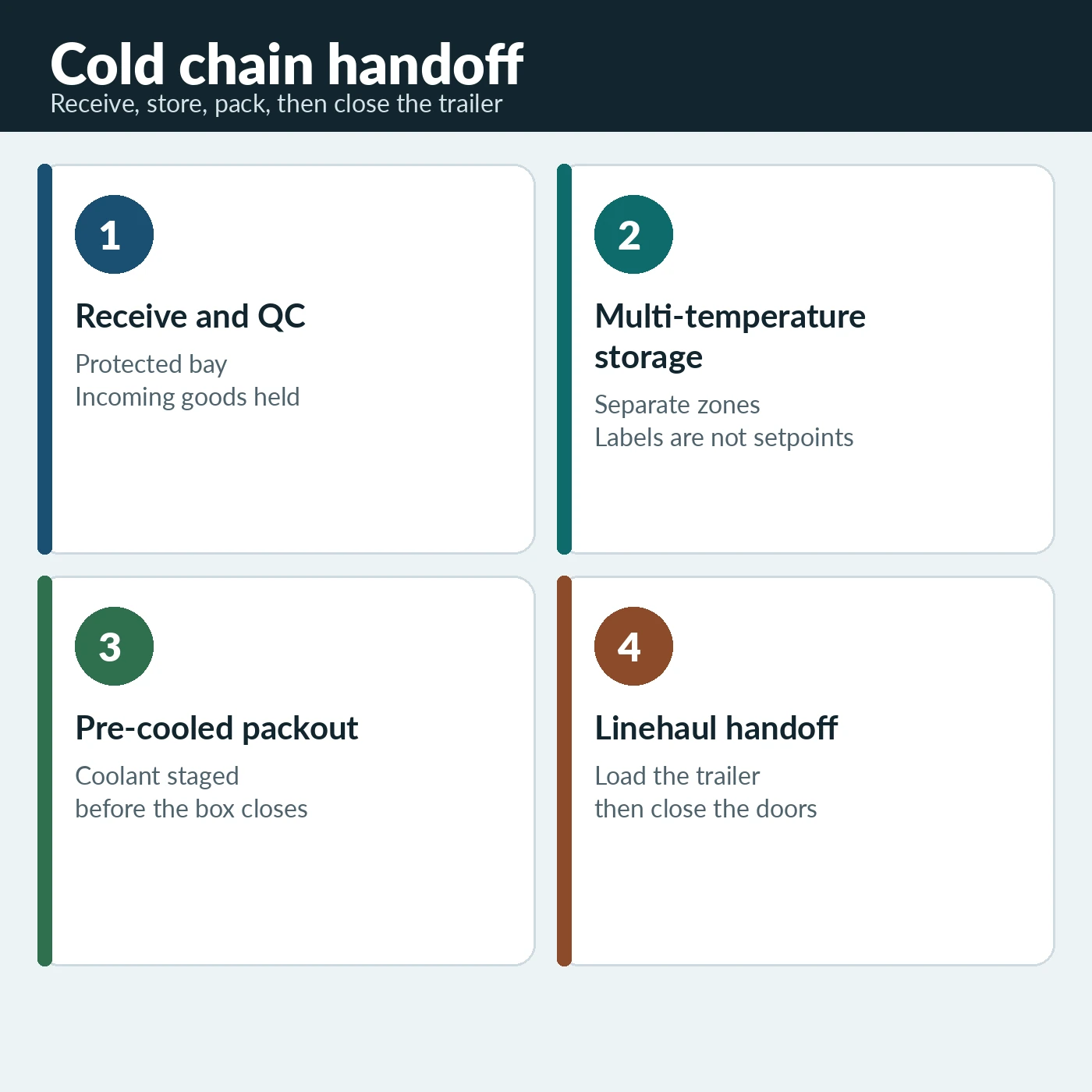
A cold chain 3PL supplies or coordinates logistics functions across multiple links and acts as an intermediary between the seller and the buyer. Third-party logistics providers typically specialize in integrated operations of warehousing and transportation services that can be scaled and customized. Services often extend to value-added work. Integrated warehousing and transportation is a different role from a freight forwarder, who typically does not physically transport the goods but acts as an agent.
A temperature excursion is an event in which a time- and temperature-sensitive pharmaceutical product is exposed to temperatures outside the range prescribed for storage and/or transport. A service level agreement may specify the target and minimum level of performance. The contract giver should assess the contract acceptor before entering into the contract. The contract acceptor should have adequate premises, equipment, personnel, knowledge, experience, and vehicles as appropriate to carry out the work.
The procurement hub sends an undecided system to packaging supplier evaluation to establish who supplies components, who defines the complete packout, and who owns its evidence.
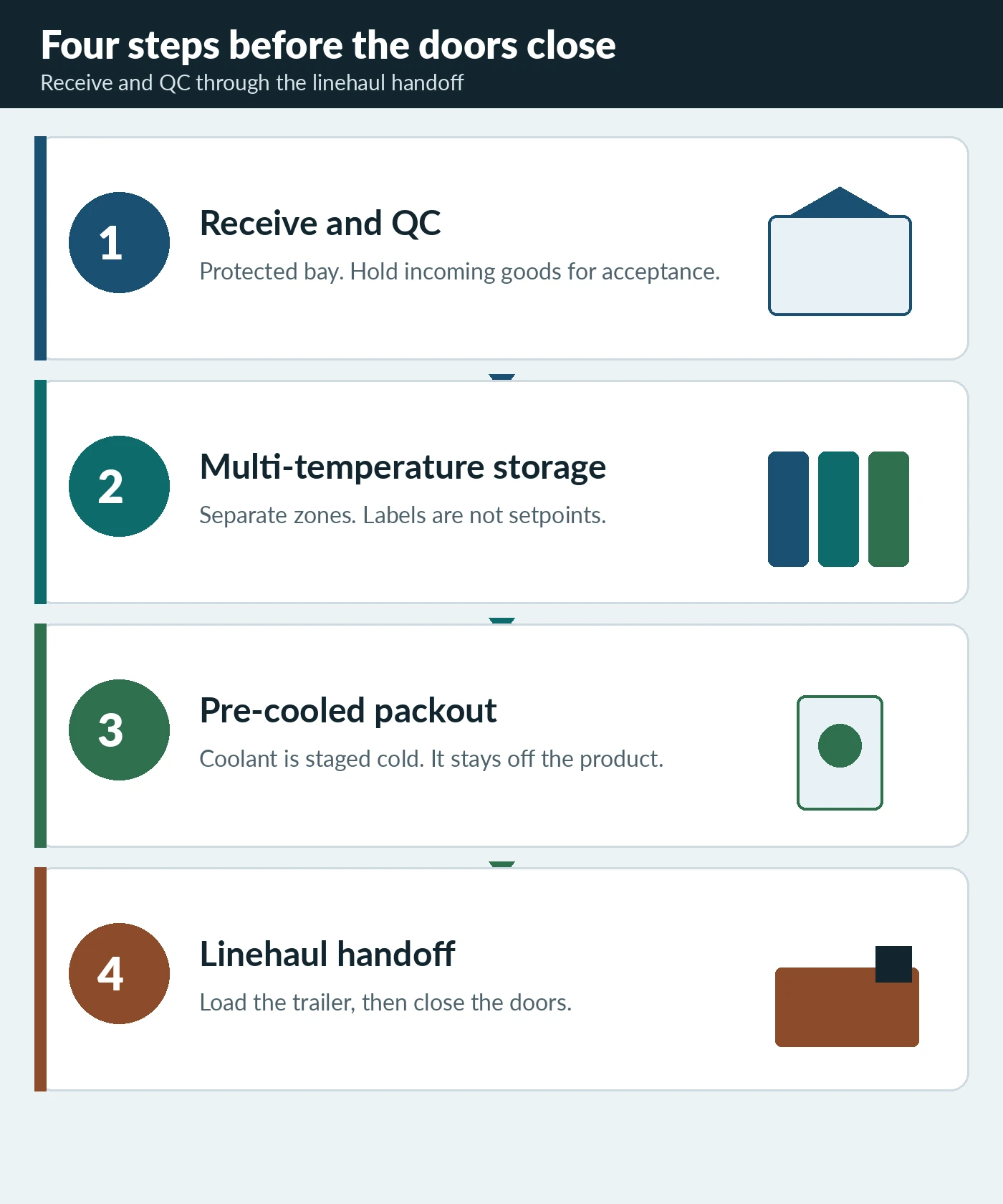
Storage buildings should contain receiving and dispatch bays as well as the storage areas needed to operate the store. Standard operating procedures cover product arrival and receiving records, stock storage and warehousing including put away, replenishment, order fulfilment and packing, and management of temperature excursions.
What does cold chain logistics cover beyond pallet storage?
A cold chain is a supply chain that uses refrigeration to maintain perishable goods, such as pharmaceuticals, produce, or other temperature-sensitive goods. Its objective is to preserve integrity and quality from production to consumption. A well functioning, or unbroken, cold chain requires an uninterrupted sequence of refrigerated production, storage and distribution activities, along with associated equipment and fleet management logistics, which maintain a desired low-temperature interval for perishable or sensitive products.
Unlike other goods, cold chain goods are perishable and always en-route towards end use or destination. Adequate cold storage can be crucial to prevent food loss and waste. The cold chain refers to the precise temperature management of perishable products to maintain quality and safety, from the point of origin through the distribution chain to the final consumer.
Passive systems maintain a temperature-controlled environment inside an insulated enclosure, using a finite amount of pre-conditioned coolant in the form of chilled or frozen gel packs, phase change materials, dry ice, or others.
How does integrated warehousing differ from a freight forwarder?
Third-party logistics providers include freight forwarders, courier companies, and other companies integrating and offering subcontracted logistics and transportation services. A freight forwarder coordinates and organizes movement by liaising with carriers, and carries out freight consolidation, rate negotiations, shipment tracking, and customs-related documentation. FIATA describes a freight forwarder as the architect of transport. A forwarding agent clears and forwards operations, including as a consignment agent.
Modern freight forwarders may offer an end-to-end process and additional services such as warehouse planning, cargo insurance, and customs brokerage. Some specialize in a niche such as rail freight or collection and deliveries around a port.
GCCA Warehouse members represent and serve the temperature-controlled warehouse and storage industry, and GCCA Transportation members represent and serve the refrigerated transportation and logistics industry. GCCA represents industries engaged in temperature-controlled warehousing, logistics, and transportation. GCCA represents 1,500 companies operating in 92 countries, and nearly 50% of these members are based outside of North America.
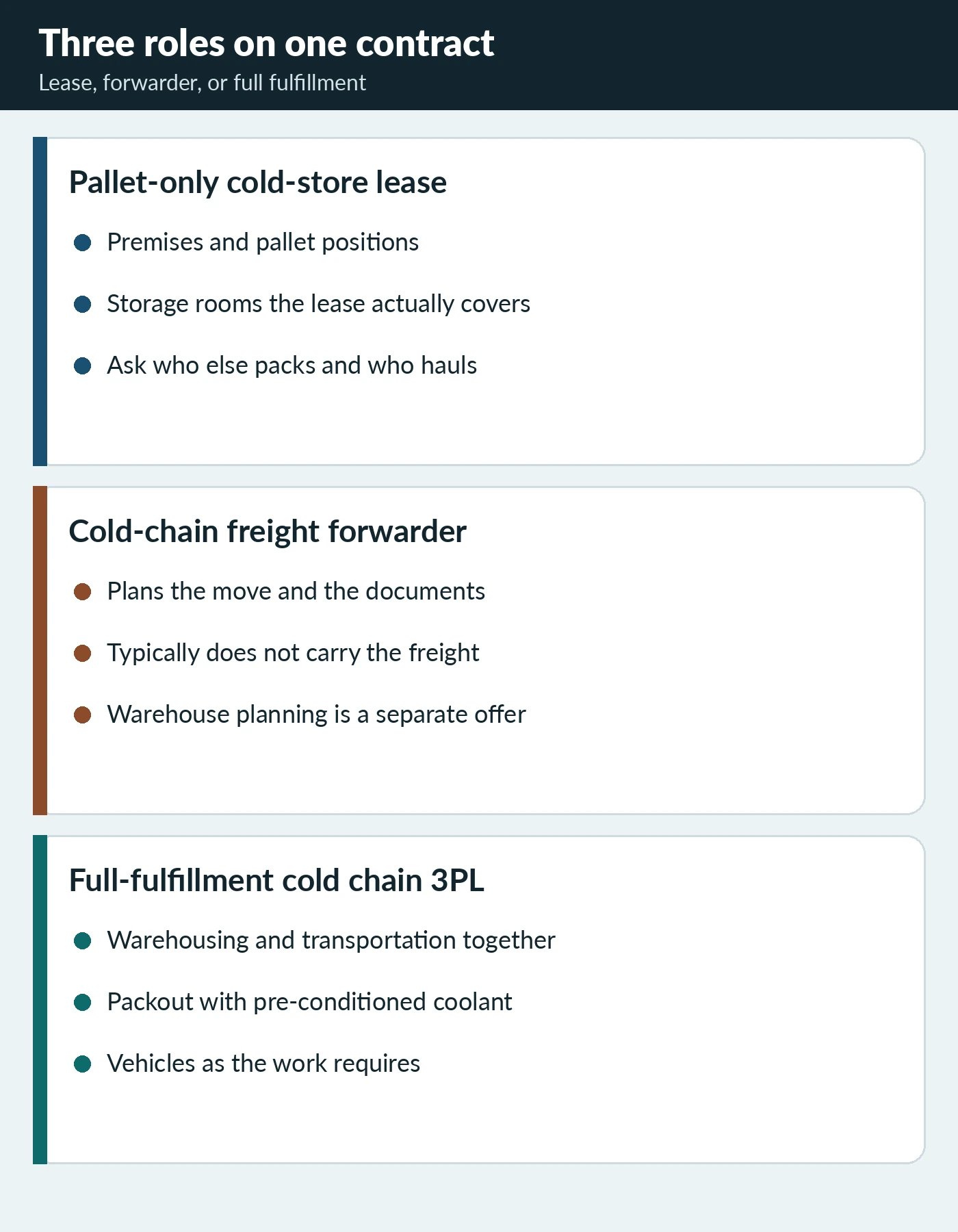
A pallet-only cold-store lease stops at storage premises. A full-fulfillment offer is integrated warehousing and transportation that can be scaled, services often extend to value-added work, and the contract acceptor should have vehicles as appropriate to the work. If most or all operative functions are outsourced to a 3PL provider, there is usually no need for the client to own its own warehouse or transport facilities, lowering the amount of capital required for the client’s business.
On cold storage rates, the procurement guides supply checklists and field tables and imply no supplier ranking, price, or test result.
Reliance on third-party logistics for e-commerce warehousing and pick-and-pack also means those companies are relied on for reverse logistics. Returns events can slow warehouse operations.
Where does a provider sit from first party to fifth party?
First party logistics providers (1PL) are single service providers in a specific geographic area that specialize in certain goods or shipping methods. The logistics department of a producing firm can also be a 1PL if it has its own transport assets and warehouses.
Second-party logistics providers (2PL) provide specialized logistics services in a larger geographical area than a 1PL. They provide their own and external resources such as trucks, forklifts, and warehouses. Examples include freight forwarders.
The most significant difference between a second party logistics provider and a third-party logistics provider is that a 3PL provider is always integrated into the customer’s system. The 2PL is not integrated.
Non-asset based providers do not employ truck drivers or warehouse personnel, and they do not own trucks, storage trailers, pallets, or warehousing. These providers are 4PL and 5PL services. A fourth party logistics provider has no owned transport assets or warehouse capacity and selects the 3PL for operative activities. Fifth party logistics providers (5PL) provide supply chain management and offer system-oriented consulting.
Which label limits and dock protections apply?
Storage areas should be maintained within acceptable and specified temperature limits. Where the labels show special storage conditions, these should be provided, controlled, monitored, and recorded. Mapping studies for temperature, and relative humidity where appropriate, should be done, for example in storage areas, refrigerators, and freezers.
The rows below are recommended label limits, kept as separate rows.
Table: scroll horizontally if needed to see every column.
| Label description | Recommended limit |
|---|---|
| Store at controlled room temperature | 15 to 25 °C |
| Store in a cold or cool place | 8 to 15 °C |
| Store in a refrigerator | 5 ± 3 °C |
| Store in a freezer | –20 ± 5 °C |
| Store in deep freezer | –70 ± 10 °C |
| Chilled | 5 ± 3 °C |
The table note says these limits are recommended values and are based on pharmacopoeia limits and guidelines. Statements such as store at ambient conditions should be avoided. Where possible, actual limits should be specified by the manufacturers, such as store below 25 °C.
One common temperature range for a cold chain in pharmaceutical industries is 2 to 8 °C (36 to 46 °F), but the specific temperature and time at temperature depend on the actual product being shipped. The encyclopedia describes an ultralow vaccine cold chain at -70 degrees C, a frozen vaccine chain at -20 degrees C, and a refrigerated vaccine chain between two and eight degrees C. Those encyclopedia examples stay separate from the label-limit rows.
Set point temperature of a node is the temperature set by the operator of the facility. Set points are targets, not actual measurements recorded by a sensor. Facility air temperature is the temperature in proximity to the product, and it depends on the sensor location, including a warehouse, transport, or a loading dock.
Thermostatic control for temperature-controlled rooms, cold rooms, freezer rooms, refrigerators, and freezers must continuously maintain air temperatures within the set point limits throughout the validated storage volume. Control sensors are accurate to ± 0.5 °C or better.
Receiving and dispatch bays should be protected from direct sunlight, dust, dirt, rain, snow, wind, and from extremes of heat, cold, and solar radiation that could damage the products. Where possible, ancillary areas where products are temporarily held during arrival, order assembly, or dispatch are maintained within the temperature range specified for the goods being handled, and are monitored during the times when those products are handled. Active environmental control of ancillary areas may not be needed if all of the products are kept in temperature-controlled packaging and/or humidity-protective packaging when passing through these areas.
Provide sufficient space to receive, assemble, and pack products for dispatch under temperature-modified conditions. Preferably these areas should be physically close to the temperature-controlled storage area. Provide a temperature-controlled holding area for incoming products pending acceptance into the main storage area. The holding area may be a physically separated zone, or it may be defined using a suitable stock control information system. Where goods are held in bond awaiting customs clearance, they must be physically separated and secured.
What coolant and expiry rotation should storage prove?
Net storage capacity of the temperature-controlled stores must accommodate peak stock and the associated transit temperature protection components, including freezer blocks, flexible ice blankets, refrigerated gel packs, phase change materials, and insulated packaging if retained, under correct temperature conditions.
Good warehousing practices can be adopted: first in-first out (FIFO) or earliest expiry-first out (EEFO). Overstocking makes FIFO or EEFO handling difficult or impossible and hinders accurate physical stock counts. First expiry/first out (FEFO) is a distribution procedure that ensures that the stock with the earliest expiry date is distributed and/or used before an identical stock item with a later expiry date. Materials and medical products should be stored so that stock is appropriately rotated, and the FEFO principle should be followed.
If cool-packs are used in insulated boxes, they need to be located such that the product does not come in direct contact with the cool-pack. There should be a system in place to control the re-use of cool-packs to ensure that incompletely cooled packs are not used in error. There should be adequate physical segregation between frozen and chilled ice packs.
Condition phase change material packs to the starting phase and packout temperature specified for the shipper configuration. A freezer setpoint or a hard exterior alone cannot establish that a brick is ready. Those checks sit on the phase change material conditioning page. Evaluate cold chain packaging suppliers against a written use case, a defined supply scope, and evidence for the exact configuration offered, using packaging supplier evaluation.
How do handoffs assign excursion responsibility?
Storage and transport ranges may be the same or different. They are determined by the product manufacturer, based on stability data. Product stability data must demonstrate the acceptable temperature excursion time during transport. Storage temperature is the temperature range listed on the product label, and within the regulatory documentation, for long-term storage.
Any carrier contracted to transport these products by air or by sea operates under a formal service level agreement. The carrier is to be made responsible for maintaining load temperatures within the transport temperature profile defined for each product. Temperature control in vehicles operated by a common carrier must be qualified, and the details and responsibilities for this process should be set out in a formal service level agreement. Temperature-controlled vehicles need thermostatic control able to maintain air temperatures within the set point limits throughout the validated storage volume. Control sensors are accurate to ± 0.5 °C.
Every contractor with whom there is an SLA provides periodic evidence of compliance with the GSP and/or GDP standards incorporated into the SLA. There must be a written contract between the contract giver and the contract acceptor which clearly establishes the duties of each party. There should be a written contract covering compliance with the guideline and the principles of GSP and GDP, conditions of subcontracting subject to the written approval of the contract giver, and periodic audits.
Vehicles and containers should be loaded carefully and systematically on a last-in/first-out (LIFO) basis, to save time when unloading, to prevent physical damage, and to reduce security risks. That load order is not the warehouse expiry rotation above.
As soon as possible after arrival, remove shipments from the wharf or airport apron to a suitable temperature-controlled storage location. Provision should be made to minimise the duration of temporary storage while awaiting the next stage of the transportation route. It is the responsibility of the supplying wholesale distributor to ensure that temperature conditions are maintained within acceptable limits during transport. Where transportation is performed by a third party, the contract in place should encompass the requirements of Chapter 7. If a deviation such as a temperature excursion or product damage has occurred during transportation, this should be reported to the distributor and recipient of the affected medicinal products. A procedure should also be in place for investigating and handling temperature excursions.
Written procedures should be in place for investigating and dealing with any failure to comply with storage requirements, for example temperature deviations. If a deviation has been noticed during transportation by the person or entity responsible for transportation, this should be reported to the supplier, distributor, and recipient. An audit of the contract acceptor should be performed before commencement of, and whenever there has been a change to, the outsourced activities.
Before picking up a load, always run the refrigeration unit in high speed cool for at least 20 minutes and perform an automatic Pre-Trip test. The unit must pass the Pre-Trip test. That run is the refrigeration unit before pickup. It is not a dock dwell limit.
It is imperative that every trailer is pre-cooled before the loading process begins to remove residual heat. If specified by the shipper, in writing, the trailer should be pre-cooled prior to loading. Generally, pre-cooling a trailer can be accomplished in less than two hours. Pre-cooling trailers may take up to two hours or possibly more to maintain stable temperatures. Pre-cool the entire trailer as a single compartment to the coldest temperature required by the cargo being hauled. A multi-temperature load of fresh and frozen is pre-cooled to the designated frozen requirement.
Refrigeration unit display readings should not be used to determine the pre-cooling status because they do not accurately portray the compartmental temperatures. Turn the refrigeration unit off after the trailer reaches the desired pre-cooled temperature and during the loading process. Most products, with a few exceptions like bananas, which are loaded at ambient temperatures, should be at the specified shipping temperature at the time of loading. With a few exceptions, refrigeration units are designed to maintain product temperature, not change it.
The product pallets should be staged in a loading zone near the loading dock and ideally pre-positioned in a Cool Dock. The quicker the loading process, the quicker the trailer doors can close, which helps reduce thermal loss. Generally, in multi-temperature zone loads, frozen products are loaded first in the nose of the trailer, followed by the fresh products. Bulkhead walls separate the compartments. Product should always be palletized and centerline-loaded in order to maintain a cold air envelope around all six sides of the load.
Industry best practice includes a detailed written procedure, created by the shipper, for temperature management of multi-temperature trailers. It is generally acceptable to transport chilled and frozen products in the same multi-temperature trailer when those conditions are met. It is not advisable to transport ambient and refrigerated products in the same multi-temperature trailer. Hazardous cargo such as chemicals and cleaning supplies should never ship with edible animal and human food in the same trailer.
Most international transportation companies have policies against pre-cooling refrigerated containers in a hot humid and open environment. Refrigerated loading docks with cold tunnels are recommended. The cold tunnels prevent outside ambient air from entering the refrigerated dock and the interior of pre-cooled containers. When refrigerated cargo moves from the cold room to a hot, humid dock, cargo sweat on the cartons can persist even if the refrigerated container is not pre-cooled.
The goal of the sanitary transportation rule is to prevent practices during transportation that create food safety risks, such as failure to properly refrigerate food. The requirements cover shippers, loaders, carriers by motor or rail vehicle, and receivers. The requirements do not apply to transportation by ship or air. Carrier means a person who physically moves food by rail or motor vehicle in commerce within the United States. The term carrier does not include any person who transports food while operating as a parcel delivery service. Shipper means a person, for example the manufacturer or a freight broker, who arranges for the transportation of food in the United States by a carrier or multiple carriers sequentially.
Operating temperature means a temperature sufficient to ensure that under foreseeable circumstances of temperature variation during transport, for example seasonal conditions, refrigeration unit defrosting, and multiple vehicle loading and unloading stops, the operation will meet the requirements of the section. A shipper of food that requires temperature control for safety must specify in writing to the carrier, except a carrier who transports the food in a thermally insulated tank, and when necessary the loader, an operating temperature for the transportation operation including, if necessary, the pre-cooling phase. Before loading food that requires temperature control for safety, the loader must verify that each mechanically refrigerated cold storage compartment or container has been properly pre-cooled, if necessary, and meets other sanitary conditions for food transportation. Before offering a vehicle or transportation equipment with an auxiliary refrigeration unit for food that requires temperature control for safety, a carrier must pre-cool each mechanically refrigerated cold storage compartment as specified by the shipper. Upon receipt of food that requires temperature control for safety under the conditions of shipment, the receiver must take steps to adequately assess that the food was not subjected to significant temperature abuse. Shippers keep records of written agreements and the written procedures required by the shipper paragraphs for a period of 12 months beyond when the agreements and procedures are in use in their transportation operations.
The baseline protocol says adherence to this guidance does not ensure compliance with applicable statutory and regulatory requirements, and the document is neither intended as nor does it constitute legal advice.
Tarmac and customs cold rooms, active ULD charging, and the quality technical agreement stay on the pharmaceutical courier GDP audit. That guide establishes a GDP audit framework and a quality technical agreement clause matrix. The warehouse dispatch guide gives a dispatch checklist and the fields a handover record should carry. It does not state temperature limits, hold times, or acceptance criteria.
Supplier audit checklist
Use this supplier audit checklist on the contract before signature. Walk temperature zones, the dock handoff, coolant pre-conditioning, FEFO, and excursion liability. Leave the commercial quote, including any cold storage rate, off the signed evidence pack.
- Storage areas for each temperature zone are maintained within the specified limits, and those conditions are provided, controlled, monitored, and recorded.
- Receiving and dispatch bays are protected from weather and from extremes of heat and cold, and incoming product has a temperature-controlled holding area pending acceptance.
- Ancillary space skips active control only when every product stays in temperature-controlled packaging, humidity-protective packaging, or both, while it passes through. Open packout stays in the temperature-modified area, preferably close to storage.
- Net storage capacity accommodates peak stock and freezer blocks, flexible ice blankets, refrigerated gel packs, phase change materials, and insulated packaging under the correct temperature, with frozen and chilled ice packs physically segregated and incompletely cooled packs blocked from reuse.
- Cool-packs do not touch the product. Phase-change bricks are released only at the starting phase and packout temperature specified for the shipper configuration.
- FEFO sends the earliest expiry out before a later expiry of the same item. FIFO or EEFO is the warehouse rotation. Vehicle LIFO is only the load order that unloads the last item loaded first.
- The service level agreement may specify the target and minimum level of performance and defines responsibilities and communication mechanisms; an air or sea carrier maintains load temperature under that agreement; and a transport deviation is reported to the supplier, distributor, and recipient.
- The acceptor is audited before the work starts and again when the activities change. The acceptor still needs vehicles as appropriate when the work includes transport.
- Trailer pre-cool follows the shipper’s written instruction. High-speed cool runs at least 20 minutes and the automatic Pre-Trip passes before pickup. The pre-trip high-speed cool is not a dock dwell limit.
- Shippers keep written agreements and procedures for 12 months beyond when they are in use in transportation operations.
Prepared by Cold Chain Practice Editorial Desk.
Related guides
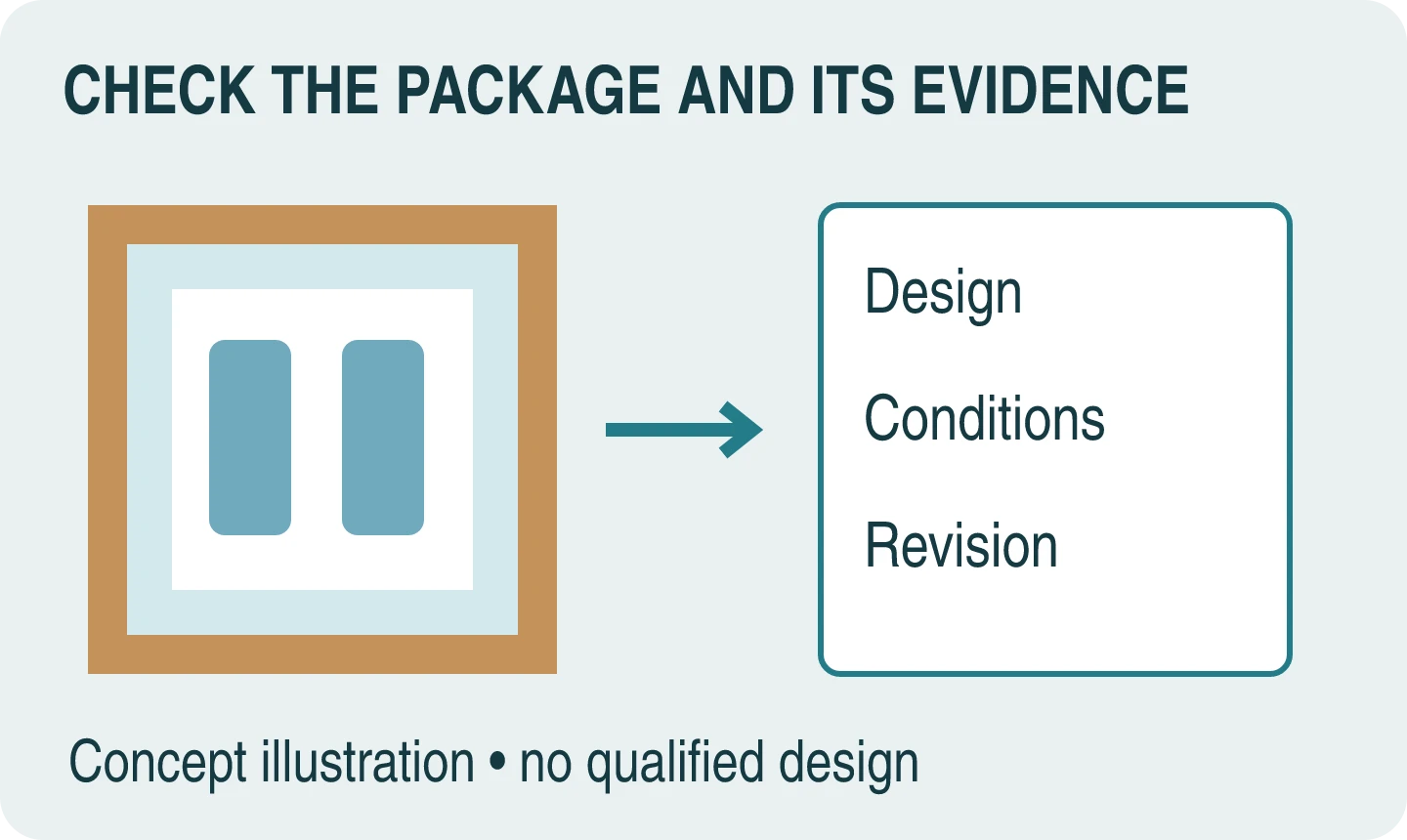
How to Evaluate Cold Chain Packaging Suppliers
Compare supplier scope, qualification evidence and regional support before selecting a cold chain packaging manufacturer or provider.
Read guide
Pharmaceutical Cold Chain Couriers GDP Audit Checklist: Specialty vs Integrator QTA, Customs Cold Rooms, and Excursion SLAs
Audit pharmaceutical couriers and temperature-controlled shipping companies across EU GDP QTA clauses, customs cold rooms, ULD charging, and excursion SLAs.
Read guide
Temperature-Sensitive Dispatch: A Warehouse Handover Checklist
A cold chain dispatch checklist covering pick checks, logger start, documents, carrier handover, data responsibility and exception escalation fields.
Read guide
Cold Chain Equipment Procurement: A Practical RFQ Checklist
Turn capacity, environment, interfaces, evidence, service and acceptance needs into a clear RFQ, with a copy-ready field table for packout equipment buyers.
Read guide