
Dry Shipper: Vapor-Phase LN2 Hold Time and Transit Rules
A vapor-phase LN2 dry shipper holds cargo below -160 °C without free-liquid spill risk. Review IATA A152 rules, 24-hour evaporation checks, and tilt loss.
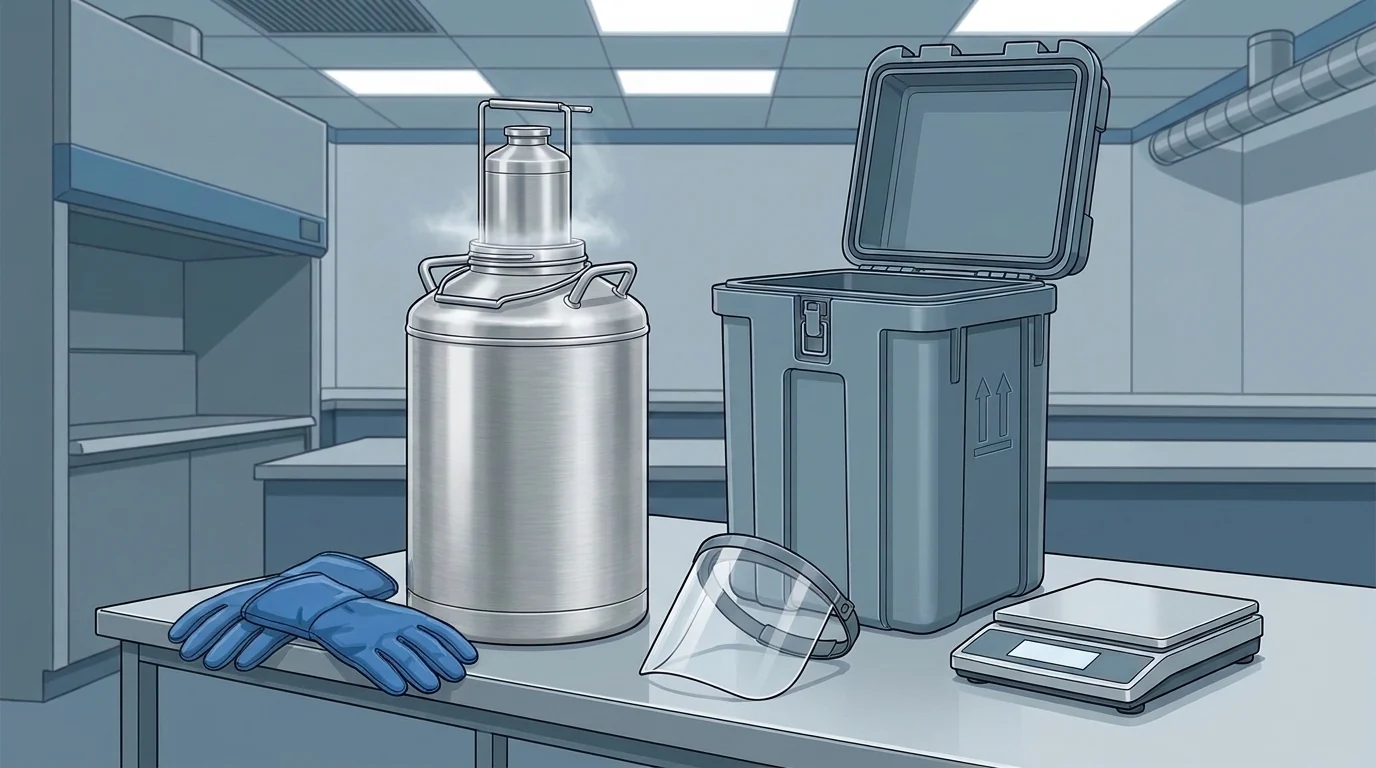
A vapor-phase liquid nitrogen dry shipper is a high-vacuum double-wall dewar lined with a porous absorbent matrix that traps liquid nitrogen after operators pour out all free liquid, keeping specimens such as vitrified cryoEM grids below −160 °C for 14+ days without spill risk unless tipping, probe heat wicks, or vacuum loss cut hold time.
For system-level container boundaries across passive cold-chain lanes, start in the cold chain packaging hub. Standard chilled or frozen gel packs and phase-change bricks sit in refrigerant selection, while solid carbon dioxide package limits and markings belong in dry ice shipping regulations.
How does an absorbent core hold liquid nitrogen inside a dry shipper?
Inside the double-wall outer vessel, a high-vacuum jacket and internal insulating layer surround a porous liquid-nitrogen-absorbing core that retains absorbed nitrogen after excess liquid is poured out, bathing the central sample chamber in cold nitrogen vapor below −160 °C across capacities from a dozen vials up to 25,000 vials without free-liquid spillage.
According to NIH PubMed Central guidance on preparing cryogenic research samples, macromolecular crystals and vitrified cryoEM grids travel in these dewars because cryoEM grids must stay below −160 °C after freezing to remain usable for data collection. Unlike nitrogen-vapor dewars, shipping on dry ice can shift sample buffer pH through carbon dioxide absorption unless samples and buffers rest at −80 °C off dry ice prior to thawing. Fisher BioServices notes that commercial dry shippers scale from a dozen vials or canes up to 25,000 vials, with static hold times spanning from a few days to more than two weeks.
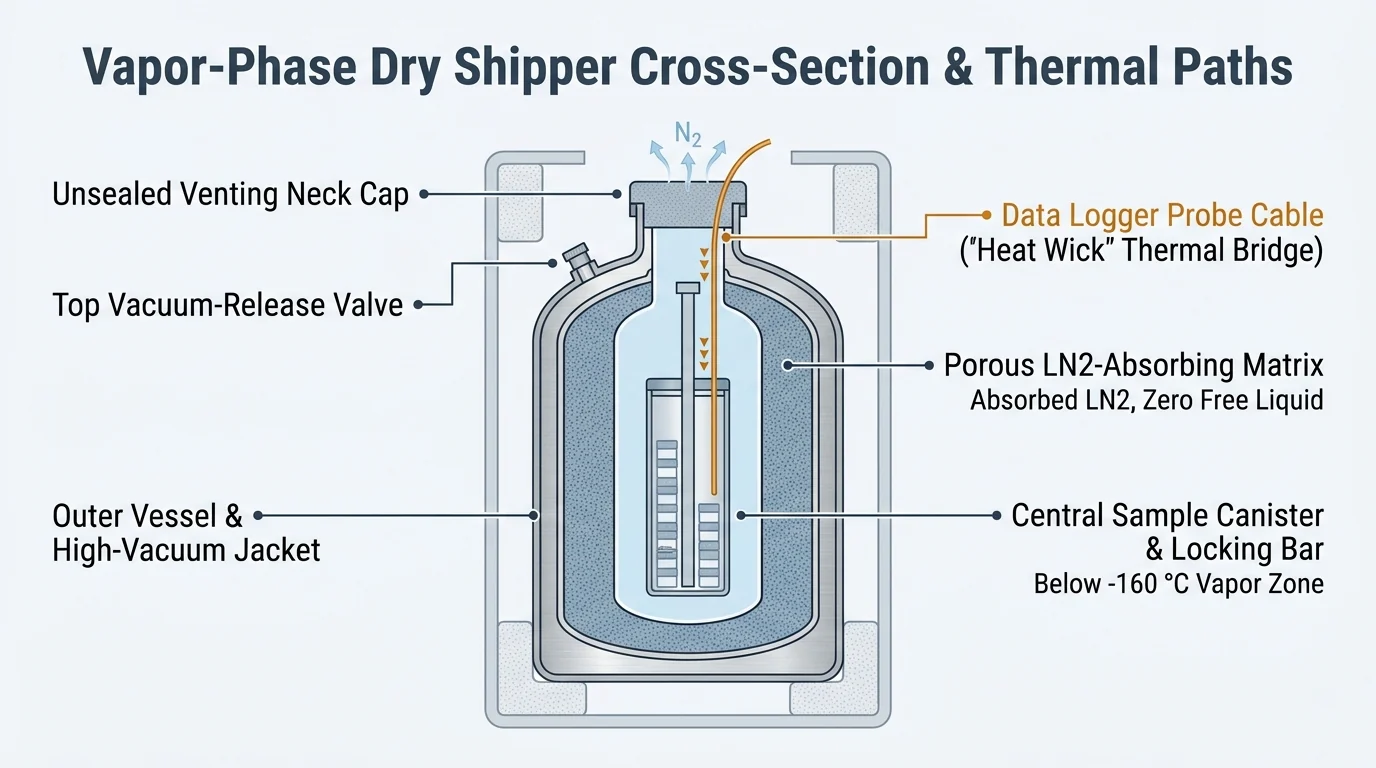
Sample tubes, puck locking bars, and 700-fold gas expansion
Inner containment inside the cryogenic cavity must handle extreme thermal contraction and trapped liquid expansion. Each dry-shipping dewar rides inside a hard-shell insulated outer box with a lockable lid and holds either high-capacity puck canisters or 50 ml conical tubes directly in the storage cavity. Because liquid nitrogen expands roughly 700 times in volume when boiling into gas, 50 ml conical tubes transferred out of liquid-nitrogen storage dewars need punched holes in both the lid and tube walls so residual liquid cannot rupture the tube.
Small sample tubes holding 2 ml or less belong inside larger secondary containers, marked with permanent pens rather than adhesive labels that peel off at cryogenic temperatures, with any paper forms sealed inside plastic bags. When loading pucks or Uni-Pucks, operators must install the canister locking bar so pucks cannot come loose and jam irretrievably inside the cryogenic dewar, and must never drop canisters or force the lid over oversized items because mechanical impact damages the dewar neck.
When does a charged dry shipper qualify for transport without free-liquid nitrogen hazard restrictions?
Unlike regulated bulk liquid nitrogen, a properly conditioned dry shipper qualifies for non-restricted air transport when its unsealed design prevents internal pressure build-up, its drained absorbent matrix releases zero free liquid nitrogen in any orientation, and the Air Waybill declares “Not restricted, as per Special Provision A152” alongside non-hazardous specimen cargo.
The UNMC Environmental Health and Safety liquid nitrogen dry shipper fact sheet specifies five Air Waybill entries for a qualifying non-restricted dry shipper:
- Complete shipper and consignee address fields.
- Enter “Not restricted, as per Special Provision A152” on the Air Waybill.
- Mark “Other” as the packaging type.
- Mark “No” for whether the shipment contains dangerous goods.
- Record total package count and shipment weight.
In the United States, interstate biological sample shipments fall under US Department of Transportation (DOT) and International Air Transport Association (IATA) oversight, and enclosing a plain-language manifest listing all contents helps prevent customs or carrier confusion, delays, and fines. Under eCFR section 173.320 cryogenic liquid exceptions, atmospheric gases such as nitrogen carried in qualifying non-pressurized Dewar flasks receive specific regulatory exceptions from full hazardous-materials subchapter requirements. That refrigerant exception covers only the nitrogen vapor vessel: while dry shippers typically carry non-regulated or exempt specimens, additional dangerous-goods rules apply whenever the cargo includes Category A or Category B infectious substances.
What drives total dry shipper cost across dewar purchase, return freight, and requalification?
Total cryogenic shipping cost extends well beyond the dewar vessel itself, combining replaceable hard-shell outer shipping cases, liquid nitrogen saturation supplies, round-trip dimensional freight with mandatory prepaid return labels, multi-day drying turnaround, quarterly-to-semiannual evaporation requalification labor, and fleet replacement for unreturned dewars or units rejected after vacuum failure.
Evaluating reusable cryogenic shipping hardware on unit purchase price alone hides the operational loop that sustains hold time across repeated trips. Reusable thermal shipping systems pair an insulated inner vessel with a replaceable multi-use external shipping box that absorbs parcel handling abuse and shields cargo during transit delays. As outlined in reusable shipper operations and modeled in the packout cost worksheet, program budgets must account for shipper hardware, liquid nitrogen conditioning, size-driven outbound and return freight charges, receiving and cleaning labor, and unreturned or lost containers.
Cycle time also governs fleet size. Because dewars require several days of complete drying between trips—and routine vacuum, absorbent, and evaporation testing every 3–6 months—teams cannot turn a returned dry shipper around on the same afternoon without degrading its porous core. Receiving facilities such as MIT.nano also require shippers to supply a prepaid return FedEx or USPS label on every delivery, making round-trip courier freight and clear inspection-rejection disposition rules permanent parts of per-shipment cost.
How do you charge, pour off, and evaporation-test a dry shipper?
Operators charge a dry shipper in a ventilated space by adding liquid nitrogen slowly to the neck through repeated soak cycles until standing liquid stops dropping, inverting the vessel into a storage dewar until all free liquid drains, checking for exterior frost, and weighing 24-hour evaporation loss against a 150–200 g per day new-unit baseline.
High nitrogen gas concentrations displace oxygen and can cause oxygen deprivation and asphyxiation without warning, so both charging and emptying must take place in well-ventilated areas. Operators wear insulated LN2 gloves and a face shield during filling—adding a thermal apron during pour-off—and pour LN2 slowly because contact with warm interior surfaces generates heavy nitrogen boil-off. Once liquid reaches the base of the neck, operators replace the cap, let the absorbent core soak for the manufacturer-specified interval, and repeat top-offs until the standing liquid level no longer drops.
Before loading cargo, all free LN2 must be poured back into a storage dewar or approved cryogenic receptacle—never down a sink where extreme cold can crack pipes or onto a floor where splash causes severe cryogenic burns. Hold the dewar upside down until liquid stops flowing, stand it upright for the manufacturer-specified interval, and repeat inverted draining until zero free LN2 remains, taking care to minimize LN2 splash onto the vacuum-release valve near the top shoulder of the dewar.
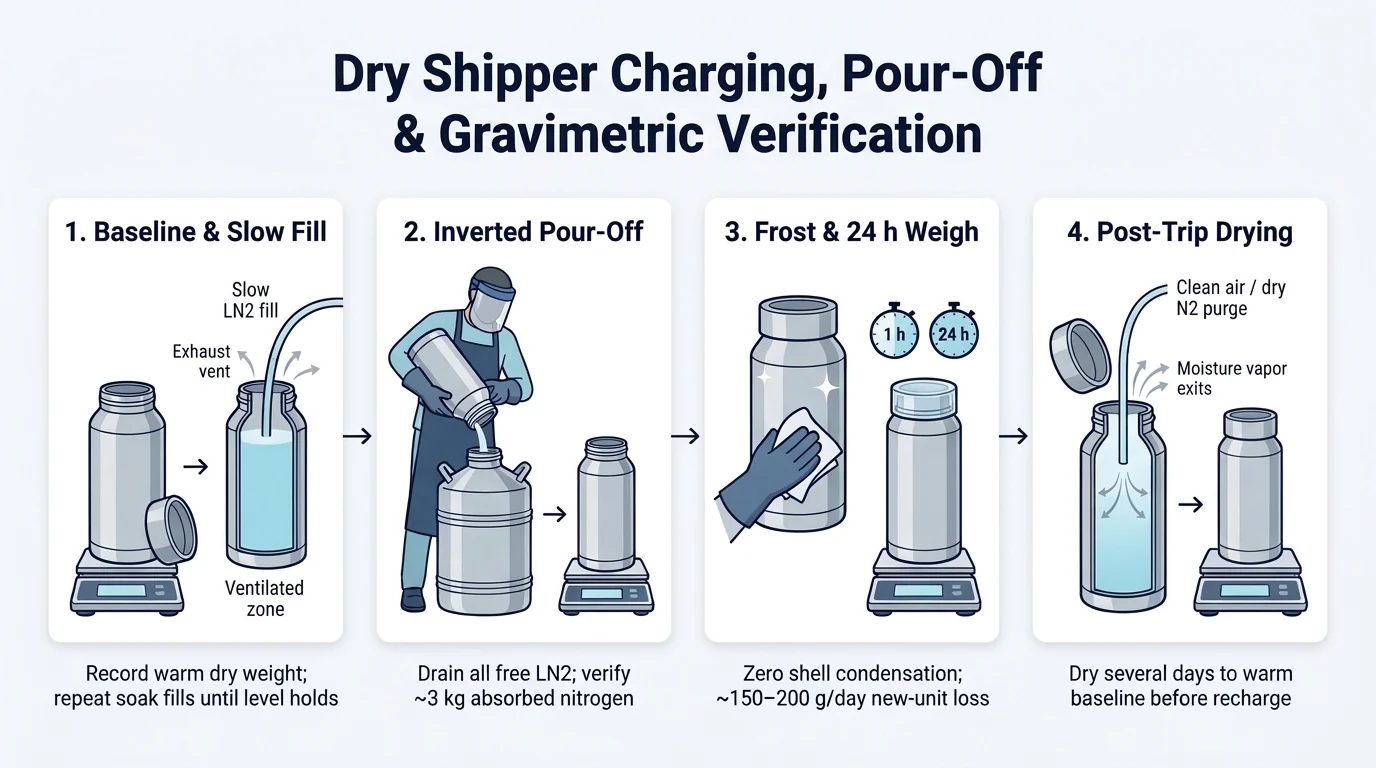
Pre-trip and 3–6 month gravimetric verification table
Although a dry shipper has no moving parts, both the inter-vessel vacuum and the nitrogen-trapping absorbent core degrade over time from mechanical shock, moisture accumulation, or core wear. Dewars should be inspected at least every 3–6 months and ideally before each shipment using the verification checks below.
Table: scroll horizontally if needed to see every column.
| Verification test | Weighing or inspection protocol | Reference benchmark or unit | Action on failure |
|---|---|---|---|
| Vacuum frost and condensation test | Charge dewar, wipe outer shell dry with a cloth, and inspect exterior wall | Zero exterior frost or condensation | Remove dewar from service immediately due to vacuum failure |
| Absorbent stored LN2 mass test | Weigh warm dry empty dewar without lid, saturate with LN2, pour off free liquid, and reweigh without lid | ~3 kg stored nitrogen mass | Retire or requalify unit for moisture saturation or absorbent loss |
| Insulation 24-hour evaporation test | Weigh charged, poured-off, capped shipper at 1 h and again at 24 h | ~150–200 g per day mass loss on a new dewar | Quarantine unit if daily boil-off rises above model baseline |
| Quick transit simulation check | Charge exactly as intended for transport and hold upright across expected lane duration | 2–3 days cryogenic retention (14+ days on a healthy unit) | Block dispatch for lanes approaching reduced hold margin |
| Post-trip warm dry-weight check | Dry open dewar over several days, optionally purging with air or dry nitrogen, and weigh against initial dry baseline | Matches initial warm dry empty weight (kg) | Continue drying before recharge so trapped moisture cannot degrade core |
Why does tipping a dry shipping dewar on its side cut hold time?
Tipping a dry shipping dewar onto its side disrupts internal vapor stratification and accelerates heat entry across the unsealed neck, erasing up to 60% of static hold time within a few hours, while inverted transport collapses days of protection into hours and data-logger probe cables conduct continuous ambient heat inward.
Catalog static hold ratings reflect upright bench conditions rather than parcel sortation hubs. Fisher BioServices reports that even among dry shippers of the same make, unit-to-unit hold-time variations of up to 40% occur in service. Adding a temperature data logger and internal probe—selected using temperature data logger selection—invariably trims static hold time further because the probe lead forms a thermal “heat wick” that draws ambient heat through the neck into the cryogenic chamber. In air cargo lanes, because venting nitrogen gas requires the dry shipper to remain an unsealed vessel, aircraft cabin pressurization and depressurization cycles can also induce in-gassing that warms upper neck zones or triggers false excursion alarms unless properly baffled and positioned.
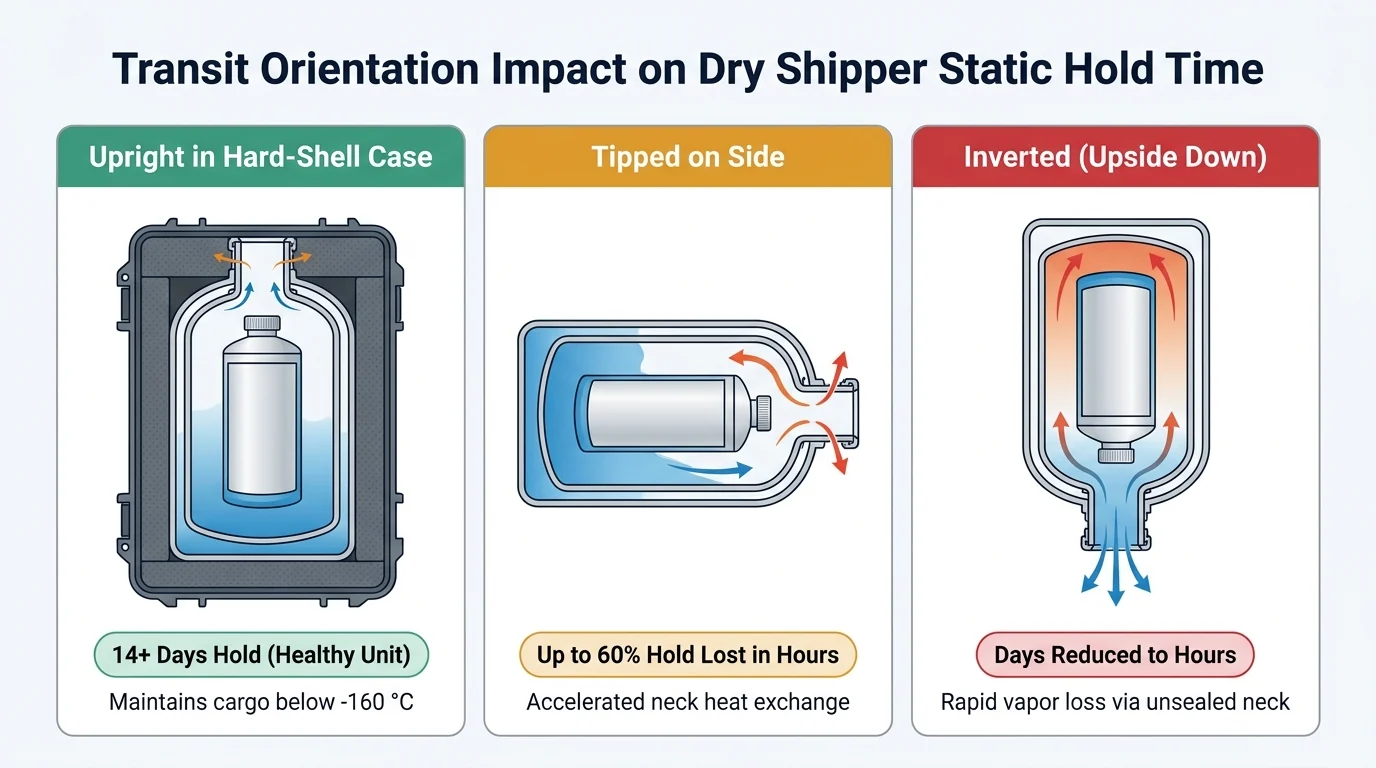
Upright vs side-tipped vs inverted orientation and probe heat-wick comparison
Table: scroll horizontally if needed to see every column.
| Transit condition or thermal factor | Physical mechanism inside dewar | Quantified impact on static hold time | Operational control |
|---|---|---|---|
| Upright inside lockable hard-shell case | Dense cold nitrogen vapor stays stratified around central sample canister | 14+ days functional hold below −160 °C on a healthy unit | Ship inside upright-enforcing hard-shell outer box |
| Same-make fleet variance | Differences in vacuum retention and absorbent condition across units | Up to 40% hold-time variation across identical models | Run individual 24-hour evaporation weigh-checks (150–200 g per day new baseline) |
| Tipped onto side in transit | Cold vapor shifts laterally toward neck path and accelerates thermal exchange | Loses up to 60% of static hold time within a few hours | Use flat-base outer cases, orientation markings, and overnight air lanes |
| Transported upside down (inverted) | Heavy cryogenic vapor drains rapidly downward out of unsealed neck | Collapses days of hold time down to hours | Verify upright enclosure geometry and build hold buffer for handling |
| Attached data-logger probe assembly | Probe cable acts as a conductive heat wick across neck insulation | Invariably reduces static hold time below bare-dewar rating | Factor logger thermal load into lane qualification duration |
| Aircraft cabin pressure cycling | Unsealed venting neck experiences ambient air in-gassing during pressure shifts | Risks localized warming or logger excursion spikes | Secure neck baffling, canister locking bar, and deep canister placement |
What return-label, orientation, and receiving-dock handoffs apply when sending a dry shipper via FedEx?
Sending a dry shipper by overnight courier requires weekday dispatch ahead of weekend dock closures, upright lockable hard-shell outer cases, advance arrival notice to receiving staff, attended loading-dock handoffs within posted receiving hours such as 8 am to 3 pm, and a prepaid return FedEx or USPS label enclosed or emailed before delivery.
Overnight weekday shipping prevents cryogenic packages from stalling behind closed receiving docks over a weekend while still leaving hold-time margin for weather events, customs clearance, or rough parcel handling. Institutional cryoEM centers enforce strict dock and return-label rules so dewars are never abandoned outside secure areas. Under MIT.nano Cryo-EM Facility dry shipper shipping instructions, senders must notify staff before dispatch and have the dry shipper arrive at least 2 business days ahead of a scheduled session when staff grid clipping is required. Couriers must deliver to the loading dock between 8 am and 3 pm rather than the main building entrance and wait for technical staff handoff rather than leaving dewars unattended on the dock, while every inbound dry shipper must carry a prepaid return FedEx or USPS shipping label (or have one emailed to facility staff) before the facility stores and returns the unit via its FedEx pickup point.
Dry shipper charging, pour-off, 24-hour evaporation, and return turnaround checklist
Use this release and return checklist before every dispatch and upon receiving returned dewars back into fleet stock:
- Warm dry baseline verified: Confirm the empty dewar was dried over several days (with optional air or dry nitrogen purge) back to its room-temperature lid-off dry weight before introducing LN2.
- Ventilated saturation completed: Wearing insulated LN2 gloves and a face shield in a ventilated room, fill LN2 slowly to the neck and repeat capped soak intervals until the standing liquid level stops dropping.
- Inverted free LN2 pour-off confirmed: Wearing insulated gloves, a thermal apron, and a face shield, invert the dewar into a storage dewar (avoiding sink or floor disposal and minimizing splash on the top vacuum-release valve) across repeated upright/inverted cycles until zero free liquid flows and lid-off stored nitrogen mass checks near ~3 kg.
- Vacuum frost and 24-hour evaporation passed: Wipe the outer shell dry with a cloth to verify zero exterior frost or condensation, and check capped mass loss between 1 h and 24 h against the ~150–200 g per day new-dewar benchmark at least every 3–6 months.
- Inner containment and outer case secured: Place vented 50 ml tubes or permanent-pen-labeled secondary containers (for 2 ml or smaller tubes) into the canister, engage the puck locking bar without forcing the neck, pack plastic-bagged manifests, and lock the upright hard-shell outer shipping case.
- Non-restricted paperwork and dock handoff aligned: Mark the Air Waybill “Not restricted, as per Special Provision A152” (“Other” packaging, “No” dangerous goods) for non-infectious cargo, enclose or email the prepaid return FedEx or USPS label, pre-alert receiving staff at least 2 business days before handling sessions, and schedule weekday overnight arrival inside attended 8 am to 3 pm loading-dock hours.
- Return inspection and disposition logged: Assign staff to receive, inspect, clean, and dry returned dewars, and quarantine or retire any unit that fails frost or evaporation limits.
Frequently asked questions
How does a dry shipper work without spilling liquid nitrogen?
A dry shipper lines its high-vacuum double-wall vessel with a porous liquid-nitrogen-absorbing material around the central sample canister. Operators saturate that core with LN2 and pour out all free liquid upside down before loading samples, leaving absorbed nitrogen to evaporate slowly and hold cargo below −160 °C without free-liquid spill risk.
Is a charged liquid nitrogen dry shipper regulated as dangerous goods by air?
No, provided it contains no Category A or Category B infectious substances and meets IATA Special Provision A152: the unsealed container prevents internal pressure build-up, releases zero free LN2 regardless of orientation, and carries an Air Waybill stating “Not restricted, as per Special Provision A152” with packaging marked “Other” and dangerous goods marked “No”.
How do you test whether a dry shipper has lost vacuum or absorbent capacity?
Perform three checks at least every 3–6 months: wipe the charged outer shell dry with a cloth to verify zero condensation or frost, compare warm lid-off dry weight against poured-off charged weight to confirm ~3 kg of stored nitrogen, and weigh the capped unit at 1 h and 24 h against a ~150–200 g per day new-unit evaporation rate.
Does attaching a temperature data logger reduce dry shipper hold time?
Yes. Fisher BioServices reports that attaching a temperature data logger and internal probe invariably reduces static hold time because the probe cable acts as a conductive “heat wick” across the neck, so qualification plans should account for both logger heat leak and up to 40% unit-to-unit hold variation.
Why must a returned dry shipper dry for several days before recharging?
Moisture condenses inside the cold dewar cavity when samples are unloaded and during return transit, and recharging a damp porous core degrades the absorbent material. Letting the open dewar warm and dry over several days—or purging with clean air or dry nitrogen until it returns to its initial warm dry weight—protects core capacity.
Sources
- University of Nebraska Medical Center EHS — Hazardous Material Fact Sheet: Liquid Nitrogen Dry Shippers
- NIH PubMed Central (Acta Crystallographica Section F) — Preparing research samples for safe arrival at centers and facilities
- MIT.nano Cryo-EM Facility — Dry Shipper Shipping and Receiving Instructions
- eCFR — Section 173.320 Cryogenic Liquids Exceptions
- Fisher BioServices (Thermo Fisher Scientific) — Ten Things You Should Know About Dry Shippers Before Shipping High Value Biologics.
Prepared by Cold Chain Practice Editorial Desk.
Related guides
Comparing Water-Based Gel Packs and Other PCM Refrigerants
Compare cold chain refrigerants by formulation, phase-change range, conditioning and encapsulation instead of relying on a simple gel versus PCM label.
Read guide
Reusable Thermal Shippers: Return Logistics, Cleaning and Rotation
Compare return flows, cleaning responsibility, rotation, losses and total cost when you run reusable thermal shippers, with a checklist for operations teams.
Read guide
How to Specify a Cold Chain Temperature Data Logger
A specification checklist for a cold chain temperature data logger: range, accuracy, logging interval, export method and calibration documents to request.
Read guide
Cold Chain Packout Cost: A Transparent Comparison Worksheet
A transparent cost worksheet for cold chain packout: materials, labor, monitoring, return logistics and losses, with formulas and blank cells you fill in.
Read guide