
Controlled Room Temperature: USP Storage & Excursion Rules
USP controlled room temperature requires 20 °C to 25 °C control, not ambient freight. Review excursion rules, MKT shelf-life risk, and CRT cabinet specs.
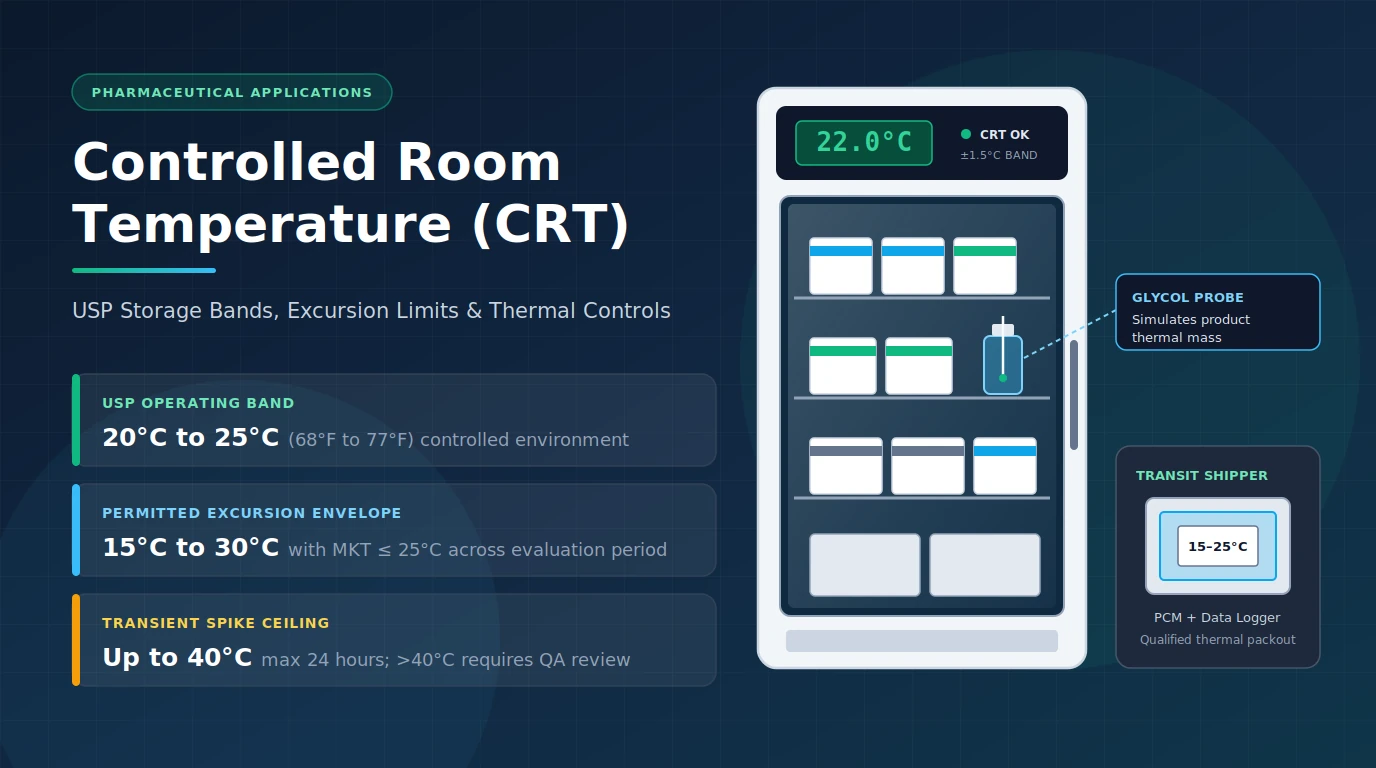
Controlled room temperature (CRT) under United States Pharmacopeia (USP) standards is a thermostatically controlled environment maintained between 20 °C and 25 °C (68 °F to 77 °F), permitting excursions between 15 °C and 30 °C when mean kinetic temperature stays at or below 25 °C and transient spikes up to 40 °C last no more than 24 hours.
Shipping teams frequently misread a controlled room temperature label as permission to tender pharmaceuticals as standard unconditioned ambient freight. That single assumption exposes solid oral dosage forms and medical products to summer cargo heat exceeding 40 °C and winter overnight drops below freezing. For broader shipment planning across product classes, see the Applications hub and our pharmaceutical packout guide.
What operating band defines controlled room temperature versus uncontrolled ambient?
USP controlled room temperature requires active thermal regulation within a 20 °C to 25 °C (68 °F to 77 °F) operating environment, whereas uncontrolled warehouse or trailer ambient simply tracks outside weather and solar heat gain. Under federal wholesale distribution rules in Section 205.50, prescription drugs without other labeled limits default to compendial controlled room temperature.
Prescription drugs must be stored at appropriate temperatures and conditions in accordance with product labeling or the current edition of an official compendium such as the United States Pharmacopeia/National Formulary (USP/NF). When no specific storage requirements are established for a prescription drug, holding the product at controlled room temperature as defined in an official compendium protects identity, strength, quality, and purity.
In contrast, field monitoring of unconditioned transport compartments shows how quickly ambient freight breaches every compendial boundary. Across 24 unrefrigerated vehicles logged over 124 summer days in a BMC Veterinary Research vehicle study, mean compartment temperatures reached 29.1 °C overall, averaging 26.9 °C in Nebraska and 31.4 °C in Texas while peaking at 47.7 °C and 54.4 °C.
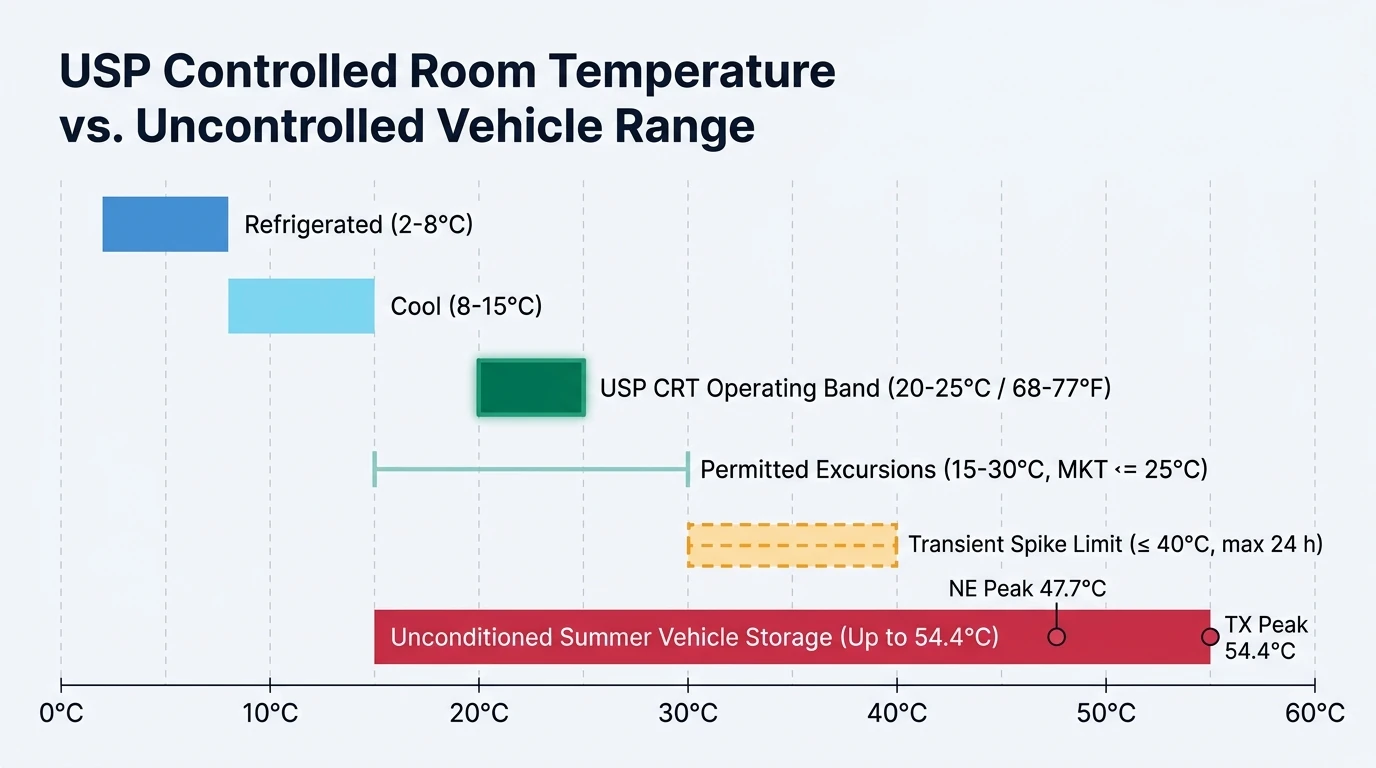
Key differences between USP controlled room temperature and uncontrolled summer vehicle ambient include:
- Target operating band: USP CRT maintains 20 °C to 25 °C (68 °F to 77 °F), whereas uncontrolled ambient has no setpoint and floats with outdoor weather and solar gain.
- Permitted excursion window: USP CRT permits 15 °C to 30 °C (59 °F to 86 °F) only when MKT remains at or below 25 °C, whereas unconditioned vehicles exceeded 25 °C on 63% of Nebraska readings and 95% of Texas readings.
- High-temperature ceiling: USP CRT limits transient spikes up to 40 °C to no more than 24 h, whereas unconditioned cargo compartments peaked at 47.7 °C in Nebraska and 54.4 °C in Texas.
- Mean seasonal exposure: USP CRT stays at or below 25 °C, compared with measured summer means of 26.9 °C in Nebraska and 31.4 °C in Texas.
- Regulatory standing: Compendial CRT serves as the default prescription drug baseline under Section 205.50 when no other label range exists, whereas uncontrolled ambient freight does not satisfy labeled storage or compendial CRT requirements.
How do USP medication storage guidelines separate controlled room temperature from cool, cold, and warm bands?
USP storage guidelines partition pharmaceutical environments into non-overlapping thermal bands—refrigerated (2 °C to 8 °C), cool (8 °C to 15 °C), controlled room temperature (20 °C to 25 °C), warm (30 °C to 40 °C), and excessive heat (above 40 °C)—so logistics teams cannot substitute one zone for another without manufacturer stability support.
Each band carries distinct handling rules across receiving, warehousing, and transport. As documented in the Prehospital Emergency Care storage band study and BMC Veterinary Research, USP explicitly distinguishes cool storage (8 °C to 15 °C) and general room temperature (15 °C to 30 °C) from the tighter 20 °C to 25 °C controlled room temperature operating window, while classifying 30 °C to 40 °C as warm and temperatures above 40 °C as excessive heat.
Table: scroll horizontally if needed to see every column.
| USP Storage Band | Temperature Range | Operational Meaning in Warehousing and Transit |
|---|---|---|
| Refrigerated | 2 °C to 8 °C | Dedicated cold-chain refrigeration; room-temperature holding requires product-specific stability data |
| Cool | 8 °C to 15 °C | Intermediate chilled zone below standard controlled room temperature |
| Controlled room temperature (CRT) | 20 °C to 25 °C (68 °F to 77 °F) | Active climate control; excursions allowed 15 °C to 30 °C only if MKT remains at or below 25 °C |
| Warm | 30 °C to 40 °C | Above normal CRT operating range; transient CRT spikes allowed only up to 24 h if label permits |
| Excessive heat | Above 40 °C | Extreme excursion zone requiring prioritized quality assurance and manufacturer review |
Why refrigerated medications cannot default to controlled room temperature
Refrigerated products stored at 2 °C to 8 °C exhibit highly variable tolerance once moved to 20 °C to 25 °C, making blanket substitution unsafe. In a Cureus formulary review of 150 refrigerated medications with published room-temperature stability data, only 22.8% remained stable at room temperature for at least 24 hours.
Individual Summary of Product Characteristics (SmPC) allowances diverge sharply even among vials stored at 2 °C to 8 °C. Anidulafungin solution vials permit up to 96 hours at 25 °C with return to 2 °C to 8 °C storage, anifrolumab-fnia allows no longer than 21 days at 8 °C to 25 °C and no longer than 4 hours at 25 °C to 40 °C, and belimumab autoinjectors permit up to 30 °C for only 12 hours. For side-by-side terminology across every shipping temperature class, review our temperature-controlled shipping terms guide.
How are transient USP controlled room temperature excursions evaluated during loading and transit?
Transient controlled room temperature excursions between 15 °C and 30 °C are evaluated against a 25 °C mean kinetic temperature ceiling, while brief spikes up to 40 °C are tolerated only if they last no more than 24 hours, keep MKT at or below 25 °C, and are permitted by the manufacturer. Any breach above 40 °C triggers prioritized quality review.
A temperature excursion occurs whenever environmental conditions during transport or long-term storage exceed the manufacturer’s label claim conditions for the product. Because dock transfers, unconditioned cross-docks, and parcel sorting hubs create short-duration spikes that do not always equilibrate through secondary packaging, quality teams separate documented time-temperature telemetry from disposition decisions.
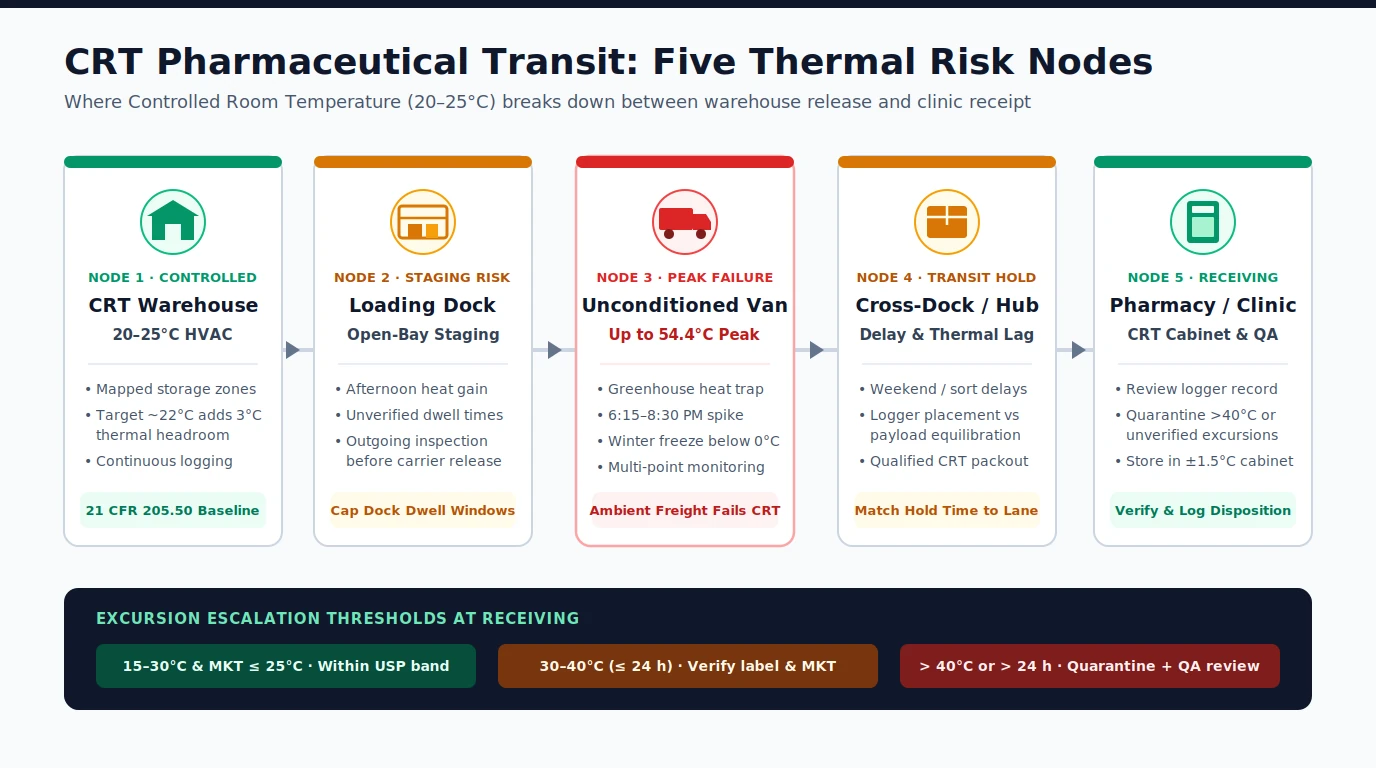
Regulatory documentation, quarantine, and return inspection triggers
Under federal prescription drug distribution rules in Section 205.50, distributors must maintain appropriate manual, electromechanical, or electronic temperature and humidity recording equipment, devices, or logs to document proper storage. Operations teams must also inspect each outgoing shipment for product identity and verify that no drugs damaged in storage or held under improper conditions leave the dock.
When an excursion casts doubt on product integrity, prescription drugs that are outdated, damaged, deteriorated, misbranded, or adulterated must be quarantined and physically separated until destroyed or returned to the supplier. For returned goods, distributors must assess the storage and shipping conditions before and during return along with container, carton, and labeling condition, and written disposition records for outdated prescription drugs must be retained for 2 years after disposition.
Thermal lag, logger placement, and quality attributes at risk
Evaluating a transient loading or transit spike requires looking beyond raw ambient air peaks. As noted in the BMC Public Health excursion modeling study, temperature excursions can degrade four core quality attributes: potency (loss of assay), dissolution (altered API release profile), increased impurities or degradation products, and microbial contamination.
Over brief excursions measured in hours, the true temperature experienced by the dosage unit is difficult to determine without documenting exact data logger placement, packaging type, and the product’s thermal equilibration rate relative to surrounding air. Selecting and placing calibrated cold chain monitoring solutions inside the payload zone—rather than taping a probe to an exposed trailer wall—gives quality reviewers accurate time-temperature records.
How does mean kinetic temperature factor into assessing brief controlled room temperature spikes?
Mean kinetic temperature (MKT) converts a fluctuating temperature record into a single isothermal temperature that produces the same cumulative chemical degradation over that period. Because degradation accelerates exponentially with temperature under the Arrhenius relationship, MKT weights brief high-temperature spikes far more heavily than a simple arithmetic average and confirms whether total thermal stress stayed at or below 25 °C.
When manufacturer stability data are unavailable, kinetic risk modeling uses a default activation energy of 83.144 kJ/mol and a common minimum assay threshold of 90% label claim through end of shelf-life. For the full Arrhenius equation, step-by-step spreadsheets, and edge-case pitfalls, see our dedicated guide on mean kinetic temperature calculation.
Shelf-life erosion and the value of 3 °C warehouse headroom
Simulated excursion data from BMC Public Health show why holding routine CRT storage near the 25 °C ceiling leaves virtually no tolerance for summer transit spikes. Across solid oral dosage models labeled for 25 °C storage, each day of excursion erodes an average of 0.86 (±0.16) days of shelf-life at 30 °C, 3.48 (±0.86) days at 40 °C, 11.90 (±0.39) days at 50 °C, and 29.45 (±2.07) days at 60 °C.
Table: scroll horizontally if needed to see every column.
| Excursion Temperature | Average Shelf-Life Lost per Excursion Day (25 °C Label) | Consecutive Days to ~15-Day Loss (2 years, 25 °C Storage) | Consecutive Days to ~15-Day Loss (5 years, 25 °C Storage) | Consecutive Days to ~15-Day Loss (2 years, 22 °C Storage) | Consecutive Days to ~15-Day Loss (5 years, 22 °C Storage) |
|---|---|---|---|---|---|
| 30 °C | 0.86 (±0.16) days | 19 days | 16 days | 215 days | 510 days |
| 40 °C | 3.48 (±0.86) days | 3 days | 3 days | 49 days | 124 days |
| 50 °C | 11.90 (±0.39) days | 1 day | Less than 1 day | 17 days | 41 days |
| 60 °C | 29.45 (±2.07) days | Less than 1 day | Less than 1 day | 6 days | 16 days |
Holding long-term storage 3 °C below the maximum—at 22 °C instead of 25 °C—dramatically delays shelf-life loss when an unexpected transit excursion occurs. For a 2-year 25 °C-labeled product stored at 25 °C, reaching approximately 15 days of shelf-life loss takes only 3 consecutive days at 40 °C and 1 day at 50 °C; storing the same product long-term at 22 °C expands that threshold to 49 days at 40 °C and 17 days at 50 °C.
Field data also confirm why MKT must be paired with upper-peak rules rather than used to excuse broken HVAC control. In a 14-week multi-leg shipment record spanning approximately -2 °C to 41 °C, 12-hour interval calculations produced an MKT of 24.4 °C; even when overall MKT stays below 25 °C, excursions above 40 °C are still classified as extreme temperature excursions requiring prioritized quality assurance and manufacturer review.
Why does room temperature on a carrier tariff not equal controlled room temperature?
Carrier terms such as “room temperature,” “ambient,” or “general freight” describe unconditioned cargo spaces with no thermostat setpoint or thermal guarantee, whereas USP controlled room temperature demands verified 20 °C to 25 °C control. Enclosed vehicles exposed to direct sun act as heat traps in summer and drop below freezing in winter, breaking CRT limits in both magnitude and duration.
Greenhouse heat gain and evening peaks in unconditioned road vehicles
Field telemetry from 24 unrefrigerated vehicles monitored at 15-minute intervals with loggers calibrated to ±0.2 °C across 124 summer days (BMC Veterinary Research) demonstrates how severe cargo heat buildup becomes. While daily outdoor ambient highs peaked at 41.9 °C in Texas (mean daily ambient 29.0 °C, mean daily high 41.5 °C) and 40.1 °C in Nebraska (mean daily ambient 22.9 °C, mean daily high 37.8 °C), enclosed vehicle compartments averaged daily highs of 43.9 °C in Texas and 41.3 °C in Nebraska—an overall mean high of 42.6 °C—and reached maximums of 54.4 °C and 47.7 °C.
Excursions were not isolated afternoon events. Nebraska compartments crossed 25 °C on a mean of 111 of 124 days (63% of all logger readings) and exceeded 30 °C on 74 of 124 days; Texas compartments crossed 25 °C on 123 of 124 days (95% of readings) and exceeded 30 °C on 117 of 124 days. Peak violation frequency clustered in early evening—reaching 1481 of 1488 Texas readings above 25 °C between 6:45 PM and 8:30 PM and 1344 of 1488 readings above 30 °C between 6:30 PM and 6:45 PM—because insulated enclosures retain afternoon solar heat long after sunset.
USP Good Storage and Distribution Practices explicitly cover road vehicles used to transport drug products, specifying that temperature monitoring devices should be placed in different areas of the trunk or cabin during seasonal extremes rather than relying on a single cab thermostat.
Multi-climate cold drops, humidity swings, and drug-specific degradation
Unconditioned freight also fails at the low end and across humidity extremes. Non-refrigerated ocean and overland UNICEF pharmaceutical shipments tracked from Copenhagen to Lagos, Kampala, and Bangkok experienced temperatures ranging from -3.5 °C to 42.4 °C alongside 20% to 88% relative humidity (BMC Public Health).
Active ingredients do not respond uniformly to uncontrolled vehicle heat. In a 60-day Prehospital Emergency Care study across 14 U.S. cities (122 midazolam and 107 lorazepam samples exposed to mean monthly ambient temperatures of 9.2 °C to 35.9 °C), HPLC assay testing found that midazolam showed little degradation whereas lorazepam experienced temperature-dependent degradation. Because heat sensitivity varies by molecule, qualified CRT transport—either active climate-controlled trailers or passive 15 °C to 25 °C phase-change shippers matched to lane duration—must be selected from product stability documentation rather than assumptions.
Field monitoring datasets illustrate how quickly uncontrolled transit departs from USP CRT limits:
- Texas unconditioned vehicles (124 summer days): Mean 31.4 °C, mean high 43.9 °C, and peak 54.4 °C, exceeding 25 °C on 123/124 days (95% of readings) and exceeding 30 °C on 117/124 days—violating both the 30 °C excursion band and the 40 °C spike limit.
- Nebraska unconditioned vehicles (124 summer days): Mean 26.9 °C, mean high 41.3 °C, and peak 47.7 °C, exceeding 25 °C on 111/124 days (63% of readings) and exceeding 30 °C on 74/124 days—showing that even temperate northern corridors exceed 25 °C and 40 °C in summer.
- Ocean and overland non-refrigerated freight (UNICEF): Measured -3.5 °C to 42.4 °C with 20% to 88% RH, breaching both freezing and excessive-heat thresholds on long-haul ambient lanes.
- 14-city EMS vehicle deployment (60 days): Mean monthly ambient ranged from 9.2 °C to 35.9 °C with divergent HPLC assay outcomes (lorazepam degraded while midazolam stayed stable), proving product-specific stability governs risk.
When do pharmacies and depots deploy dedicated controlled room temperature cabinets?
Pharmacies, compounding cleanrooms, clinics, and regional depots deploy dedicated controlled room temperature cabinets whenever building HVAC systems cannot reliably hold 20 °C to 25 °C through night setbacks, weekend shutdowns, or seasonal swings. Under pharmacy compounding practice referenced alongside USP 797 and wholesale recording rules in Section 205.50, purpose-built cabinets isolate high-value CRT inventory in a continuously monitored, alarmed enclosure.
Unlike standard office air conditioning or household wine coolers, pharmaceutical CRT cabinets combine tight temperature uniformity with audit-ready alarm and probe interfaces. Specifying the right hardware eliminates nuisance false alarms triggered by brief door openings while still capturing genuine thermal excursions.
Key pharmaceutical engineering benchmarks to verify when specifying a dedicated CRT cabinet include:
- Operating control range: Adjustable 68 °F to 77 °F (20 °C to +25 °C) control directly matches the USP CRT band and supports a 22 °C target for thermal headroom.
- Chamber temperature uniformity: Designed for ±1.5 °C variation (measured via an NTC sensor in a 1 oz. vial) to prevent hot shelves near compressors or cold pockets near air ducts.
- Product-simulation sensing: A buffered probe inside a glycol-filled bottle filters transient air fluctuations during door openings to reflect actual stored product temperature.
- Display and min/max tracking: Digital min/max temperature displays updated in 15-minute increments support routine manual checks alongside automated logging.
- Open-door and excursion alarms: Audible and visual high/low temperature, power-failure, sensor-failure, remote alarm contacts, and an open-door alarm (default 4 minutes, selectable 1 to 99 minutes) alert staff before door-ajar events or utility outages escalate.
- Independent monitoring access: A half-inch probe port and password protection beyond setpoint allow independent calibrated cold chain monitoring solutions without compromising door gaskets or setpoint security.
CRT warehouse and linehaul verification checklist
Before releasing controlled room temperature pharmaceuticals into storage or distribution, verify each operational gate with quality and logistics owners:
- Confirm the exact labeled storage statement and permitted excursion language in product documentation, defaulting to USP/NF controlled room temperature only when no other storage requirement is established under Section 205.50.
- Set warehouse HVAC or dedicated CRT cabinet targets near 22 °C rather than 25 °C to preserve 3 °C of thermal headroom against unexpected transit spikes.
- Verify calibrated electronic temperature and humidity logging in storage areas, and confirm independent probe access via a dedicated port on pharmacy CRT cabinets.
- Eliminate unconditioned ambient parcel or dry-van bookings during summer heat and winter freeze seasons unless a qualified 15 °C to 25 °C passive shipper covers full transit and weekend hold durations.
- Place road-vehicle monitoring loggers across multiple trunk or cabin locations during seasonal extremes and cap open loading-dock dwell times—especially during late-afternoon and early-evening heat peaks.
- Inspect every outgoing shipment for storage integrity prior to dispatch, quarantine any lot exposed above 40 °C or beyond 24 hours of transient spikes, evaluate storage and shipping history on all returns, and retain written outdated disposition records for at least 2 years.
Frequently asked questions about controlled room temperature
What is the official USP temperature range for controlled room temperature?
USP defines controlled room temperature as an operating environment maintained between 20 °C and 25 °C (68 °F to 77 °F). Short-term excursions between 15 °C and 30 °C (59 °F to 86 °F) are permitted during storage, handling, and transit only when the calculated mean kinetic temperature remains at or below 25 °C.
How long can a controlled room temperature medication stay at 40 °C?
USP recommends that transient spikes up to 40 °C last no more than 24 hours without consulting the manufacturer, provided the mean kinetic temperature does not exceed 25 °C and the product label allows transient excursions. Any exposure above 40 °C is classified as an extreme excursion requiring prioritized quality assurance and manufacturer review.
Can controlled room temperature pharmaceuticals ship in standard ambient trucks?
No. Carrier “ambient” or “room temperature” freight uses unconditioned cargo compartments that track outdoor weather and trap solar radiation. Field measurements across 24 unrefrigerated summer vehicles recorded peak compartment temperatures of 47.7 °C in Nebraska and 54.4 °C in Texas, exceeding 25 °C on 63% to 95% of readings.
Does a compliant mean kinetic temperature allow a warehouse to run above 25 °C routinely?
No. Mean kinetic temperature is an excursion evaluation metric, not permission to run storage rooms above labeled limits. Modeling shows that storing 25 °C-labeled solid oral drugs right at 25 °C leaves almost no buffer—losing roughly 15 days of shelf-life in just 3 days at 40 °C—whereas maintaining 22 °C long-term dramatically delays shelf-life erosion.
Why do pharmacy CRT cabinets use a glycol-buffered probe instead of only an air sensor?
Air temperature inside a cabinet spikes within seconds whenever staff open the door to pick stock, whereas boxed cartons and liquid vials change temperature much more slowly. A buffered probe immersed in a glycol-filled bottle simulates stored product thermal mass to prevent nuisance alarms while forced-air recovery restores chamber uniformity within ±1.5 °C.
Related guides
Cold Chain Shipping: Ambient, Temperature-Controlled and CRT
Decode cold chain shipping, ambient and CRT terms with source-specific temperature definitions and a checklist for clarifying transport service boundaries.
Read guide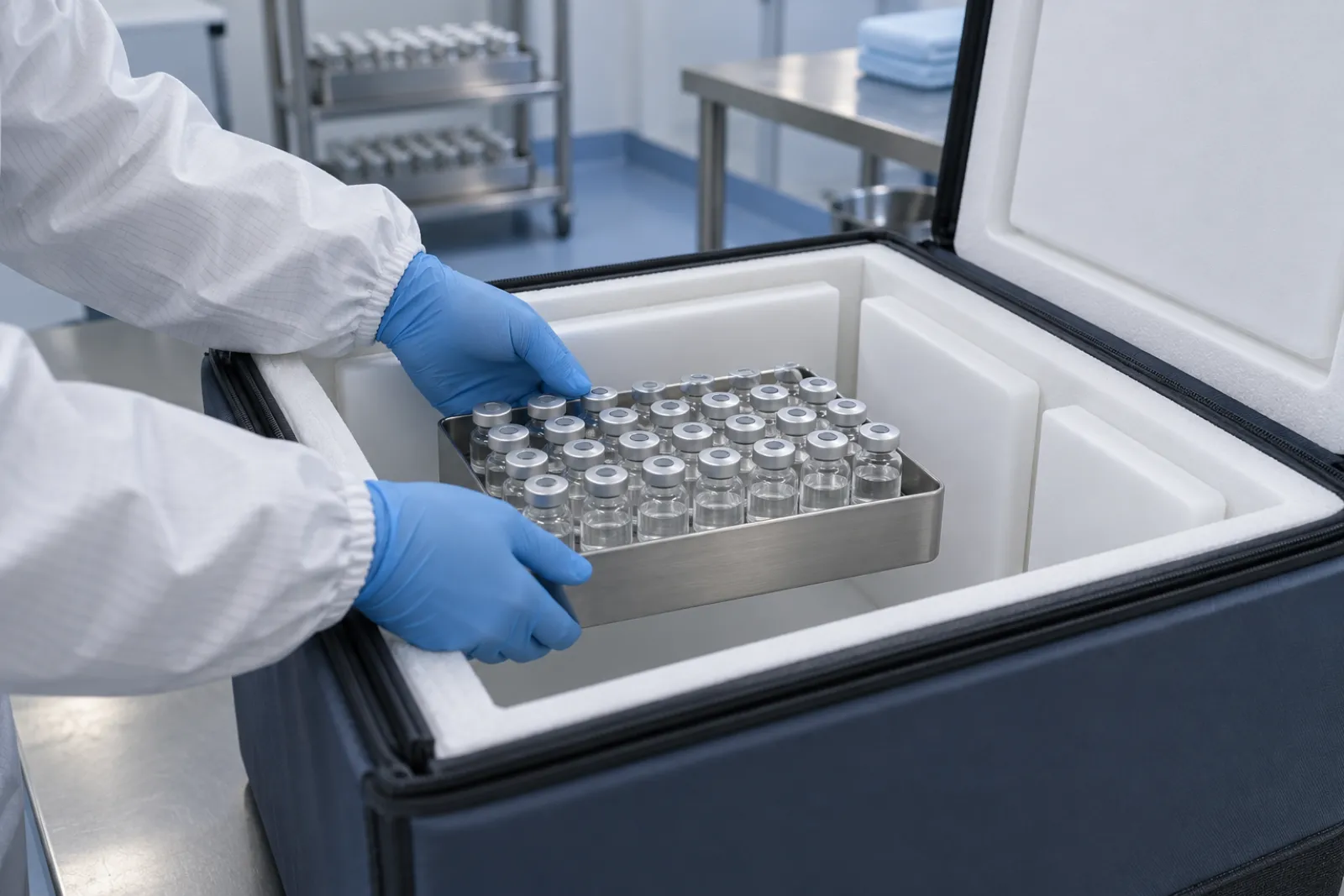
Pharmaceutical Shipping Packout: What Buyers Must Define Before Equipment Selection
Build packout requirements from product documentation, lane assessment and quality input before you shortlist equipment. Owners, interfaces and records.
Read guide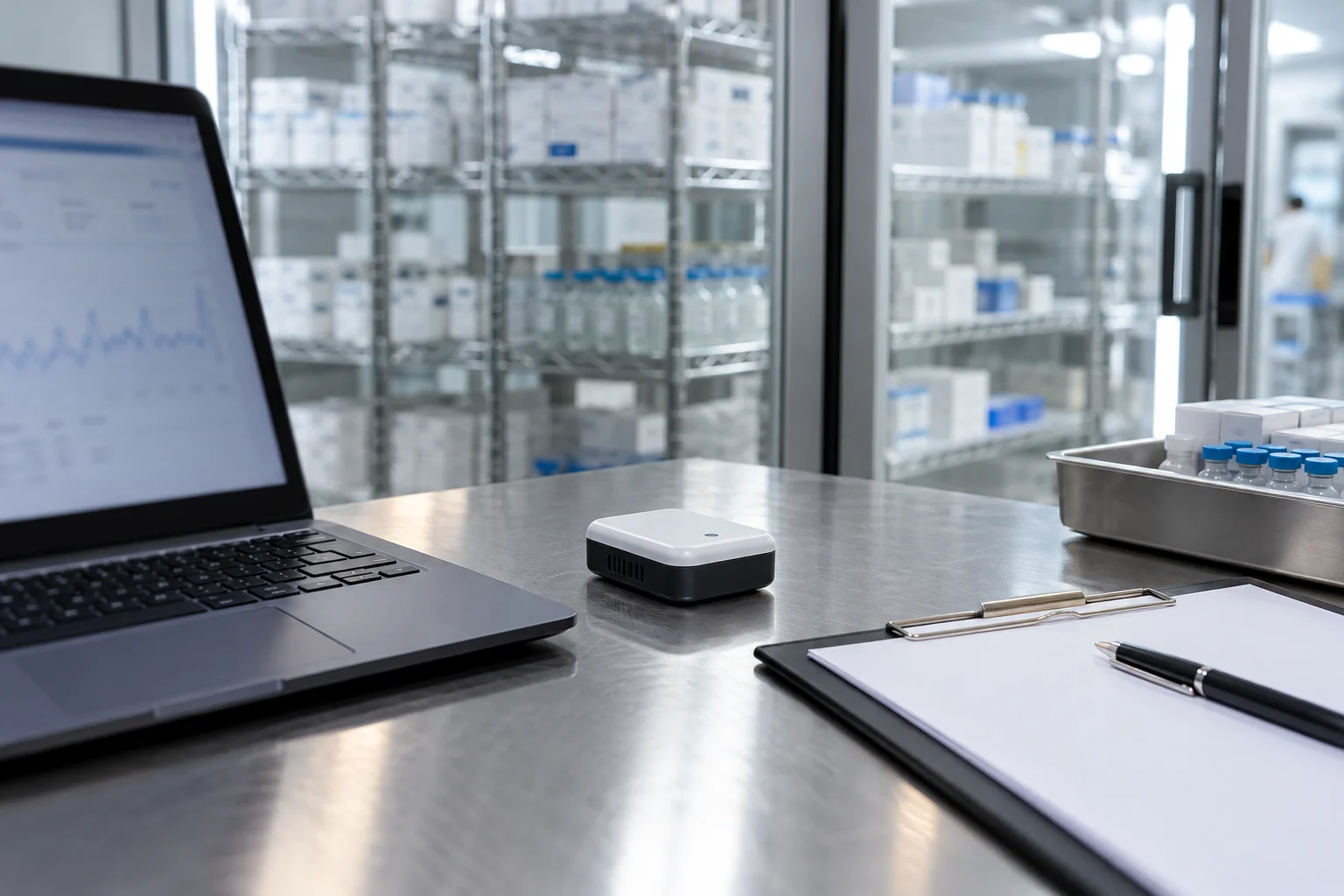
Mean Kinetic Temperature: What the Calculation Weights and What It Hides
Work through the mean kinetic temperature calculation, check its inputs and observation window, and use a temperature monitoring sheet for review.
Read guide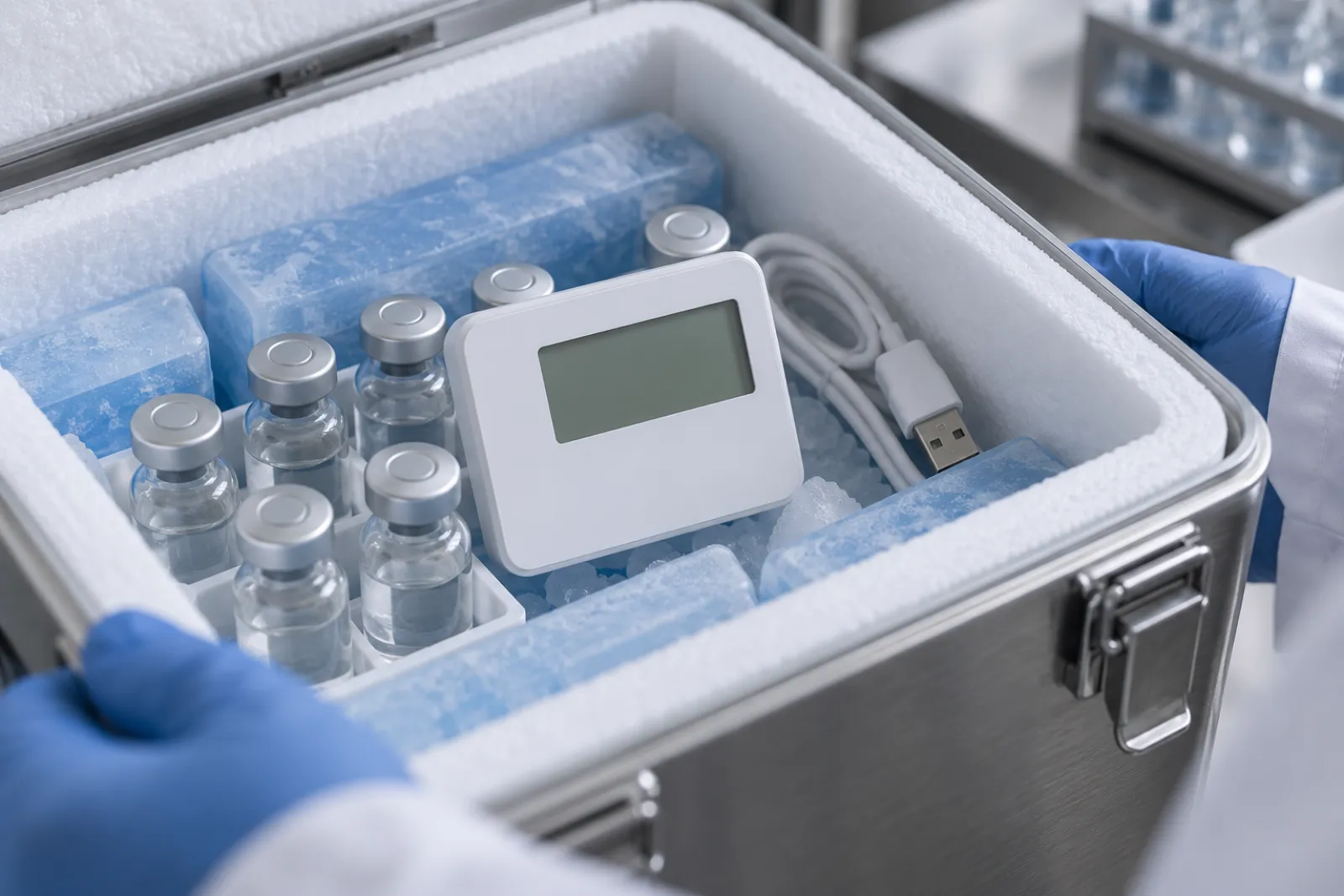
How to Specify a Cold Chain Temperature Data Logger
A specification checklist for a cold chain temperature data logger: range, accuracy, logging interval, export method and calibration documents to request.
Read guide