
How Many Pallets Fit in a 53 ft Trailer? Dry Van vs Reefer, Single vs Double Stacked
Pallet counts for a 53 ft dry van or reefer, worked from inside dimensions: 48 x 40 in orientation, reefer airflow gaps, and double-stack height and weight.
A 53 ft dry van takes 26 standard 48 × 40 in pallets on the floor when they are loaded straight, and up to 30 when they are turned, roughly twice that if the freight can be double stacked. A refrigerated trailer has less room: insulated walls bring the inside width down to about 97½ in, and the air gaps reefer loading guides ask for can take a full row off the straight count. This page gives the arithmetic, the inside dimensions it depends on, and what to confirm with the carrier before a load plan goes out.
Count floor positions from the trailer’s inside length and width, not its 53 ft outside length. On published dry van dimensions (about 52 ft 6 in by 100 to 101½ in inside), 48 × 40 in pallets fit 26 straight, 28 in a pinwheel and 30 turned. Published reefer dimensions (about 52 ft 2 in by 97½ in) give the same counts on paper, but a 4 in return-air gap at the rear doors, as UF/IFAS and USDA loading guides describe, leaves room for only 12 full straight rows (24 pallets), and turned pallets sit within about ¾ in of each wall. Height, the trailer’s own weight rating and the 80,000 lb federal gross limit decide whether a second tier is possible. Every count here is an estimate to check against the assigned trailer and with your carrier.
Key points:
- Work from inside dimensions measured at the wearband. The 53 ft trailers compiled here are 52 ft 2 in to 52 ft 6 in long inside.
- “26 straight, 28 pinwheel, 30 turned” is dry van arithmetic for 48 × 40 in pallets with no overhang.
- In a reefer, a turned row clears the walls by about 1½ in in total, which leaves almost no room for the off-the-wall loading that reefer guides ask for.
- A second tier needs height (tighter in a reefer, because of the ceiling air chute) and weight allowance; dense freight can reach the weight limits well before the floor is full twice.
- Floor positions are not payload. Pallet weight, axle loads and the gross limit are a separate check.
What is the formula for pallets per trailer?
Pallets per tier equal the number of rows times the pallets in each row. Rows come from the usable inside length divided by the length one row takes, rounded down. Pallets per row come from the usable inside width divided by the pallet dimension that runs across the trailer, also rounded down. Multiply by the number of tiers only after the height and weight checks pass.
Written out step by step:
- Usable length = inside length − front allowance − rear allowance.
- Usable width = inside width at the wearband − side allowances.
- Rows = usable length ÷ length of one row, rounded down.
- Pallets per row = usable width ÷ pallet dimension across the trailer, rounded down.
- Floor positions = rows × pallets per row.
- Total pallets = floor positions × tiers, if the height and weight checks allow a second tier.
| Input | Unit | Where it comes from | Why it changes the answer |
|---|---|---|---|
| Inside length | in | Trailer specification or build sheet; the carrier | Sets the number of rows |
| Inside width at wearband | in | Specification sheet, which may say “at wearband” or “lining to lining” | Decides whether two pallets fit side by side when turned |
| Usable height | in | Inside height, less the air chute or a marked maximum load line in a reefer | Decides whether a second tier fits |
| Pallet footprint and height | in | Measure the loaded pallet, including overhang and stretch wrap | 48 × 40 in is the nominal base, not the loaded footprint |
| Allowances | in | Loading guides and the carrier | Reefer return-air gaps at the doors, walls and front |
| Pallet weight | lb | Your shipping records | Gross and axle limits apply regardless of free floor space |
Convert feet to inches before dividing: 52 ft 6 in is 630 in, and 52 ft 2 in is 626 in. The same formula works for any trailer length: each 48 in of usable length removes or adds one straight row (two pallets), and each 40 in one turned row.
Which inside dimensions should you use for a dry van and a reefer?
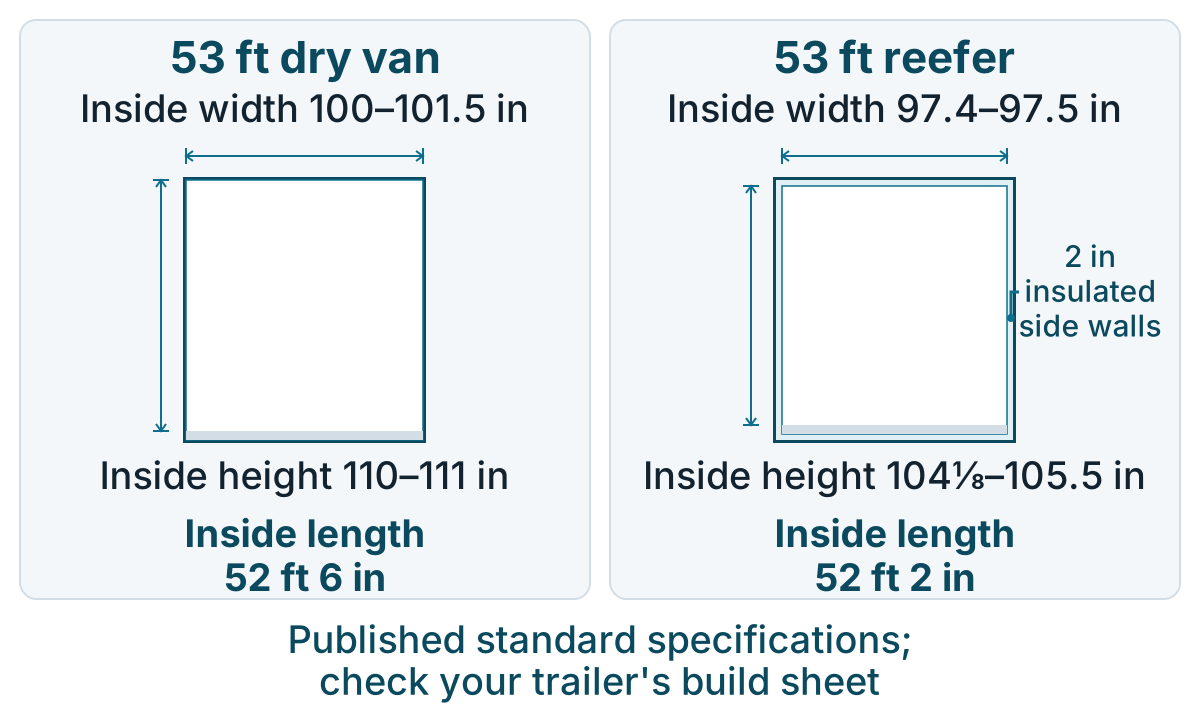
Use the inside dimensions of the trailer type and build you will actually get. On specification pages from two U.S. trailer builders, a 53 ft reefer is 2½ to 4 in narrower inside than a dry van (the builders measure width at slightly different points) and, on Hyundai Translead’s figures, about 4 in shorter. Utility lists 2 in insulated side walls and a 4 in insulated front wall on its standard 3000R reefer.
| 53 ft trailer, standard specification | Inside length | Inside width | Inside height | Interior volume |
|---|---|---|---|---|
| Utility 4000D-X dry van | Not listed on the specification page | 100 in or 101 in at wearband (two versions) | 110½ in front, 111 in rear | Not listed |
| Hyundai Translead Composite dry van | 52 ft 6 in | 101.5 in | 110 in | 4,070 cu ft |
| Utility 3000R reefer | 52 ft 2½ in (2014 brochure drawing) | 97½ in at wearband | 104⅛ in | Not listed |
| Hyundai Translead ThermoTech reefer | 52 ft 2 in | 97.4 in lining to lining | 105.5 in | 3,722 cu ft |
Compiled from the builders’ pages, accessed 2026-10-07. Utility’s reefer inside length comes from a 2014 brochure because its current specification page does not list one.
Before using these figures, note three things:
- Width is quoted in different places. Utility quotes width “at wearband”, the protective band along the lower walls (10 in high on its reefer). Hyundai Translead quotes “lining to lining”. For a pallet count, use the narrowest point at pallet height.
- Volume is not floor space. On Hyundai Translead’s figures, the reefer has about 8.6% less interior volume than the dry van (3,722 against 4,070 cu ft). Floor positions depend on length and width only, so the cube loss shows up in the pallet count only when it crosses a row or a column.
- Builds vary. Both builders offer options such as linings, scuff bands, floors and doors, and Utility’s brochure notes that dimensions may vary by model and are subject to change without notice. Treat the rows above as reference values for a standard build, not as the trailer that will back onto your dock.
The reefer floor is different too. Utility’s standard reefer floor is a 1½ in extruded aluminum duct floor, whose channels carry return air under the load. UF/IFAS advises putting cargo on pallets when floor channels or ducts are less than 2¼ in deep.
How does pallet orientation change the count?
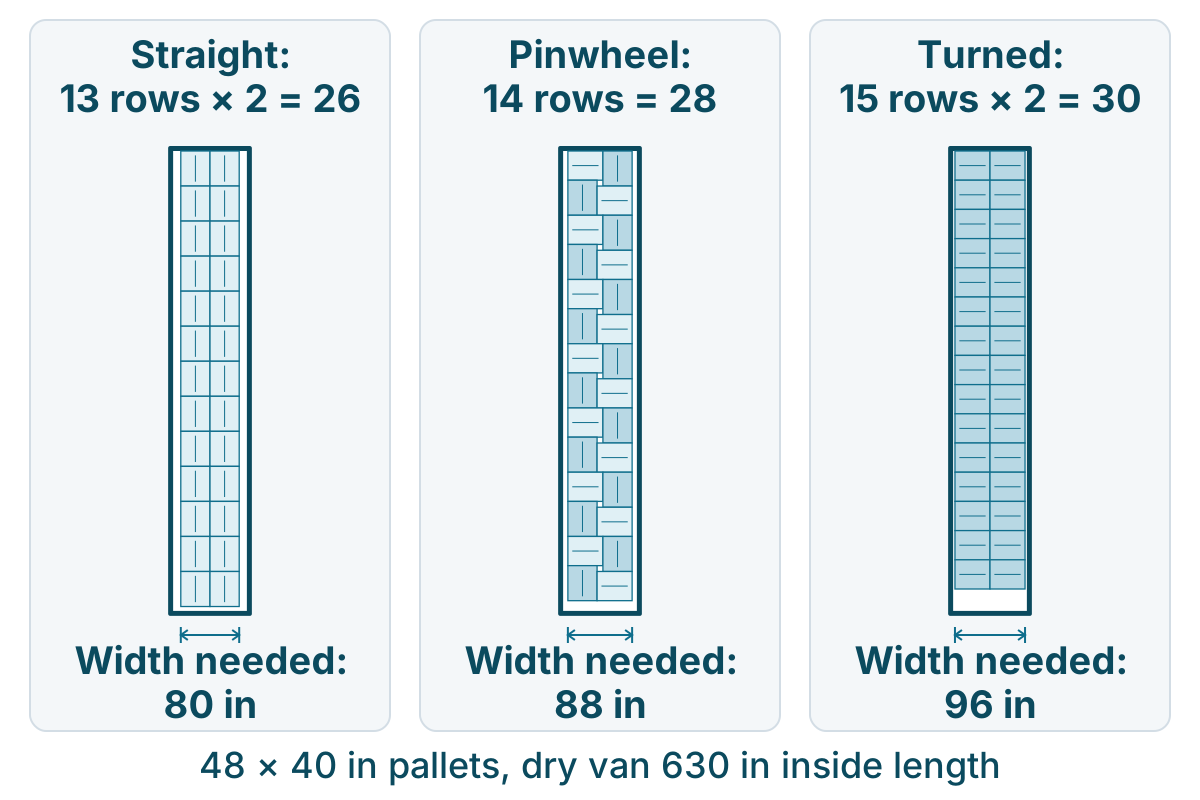
Straight loading gives 26 pallets, a pinwheel 28 and turned loading 30 in both trailer types on paper; the difference between them is width. Loaded straight, with the 48 in side along the trailer, two 48 × 40 in pallets need 80 in of width and each row takes 48 in of length. Turned, with the 40 in side along the trailer, they need 96 in of width and each row takes 40 in. A pinwheel alternates the two, so every pair of rows takes 88 in of length and each row 88 in of width.
| Pattern | Width needed | Length used | Dry van (630 × 100–101.5 in) | Reefer (626 × 97.4–97.5 in), no allowances | What limits it |
|---|---|---|---|---|---|
| Straight | 80 in | 48 in per row | 13 rows, 26 pallets, 6 in of length left | 13 rows, 26 pallets, 2 in left | Length |
| Pinwheel | 88 in | 88 in per two rows | 14 rows, 28 pallets, 14 in left | 14 rows, 28 pallets, 10 in left | Length; four-way pallets needed |
| Turned | 96 in | 40 in per row | 15 rows, 30 pallets, 30 in left; 4 to 5½ in of width to spare | 15 rows, 30 pallets, 26 in left; 1.4 to 1.5 in of width to spare in total | Width |
Arithmetic on the inside dimensions above, for pallets with a true 48 × 40 in footprint. Not a load plan.
The straight pattern is what “26 pallets” answers describe, and some of them divide 636 in, the outside length, by 48. With the inside lengths above, 13 rows still fit, but with 2 to 6 in to spare rather than about a foot, so a pallet with a little overhang can turn 13 rows into 12.
The turned pattern is where a figure of 30 comes from. It depends on the trailer being at least 96 in wide inside, plus whatever the loaded pallets overhang. It also changes how the pallets are handled. In top-air reefers, UF/IFAS advises loading pallets with their stringers (the base supporting rails) running the length of the trailer to help airflow, so check which way your pallets’ stringers run before turning them.
The pinwheel interlocks alternate rows. UF/IFAS does not recommend pinwheel loading in refrigerated vehicles, and says that if it is used the pallets must be the four-way type, or the airflow under the load will be blocked.
How much floor does a reefer’s airflow take?
On the published reefer dimensions, keeping the air path open costs about one straight row: a 4 in gap at the rear doors takes the straight count from 26 to 24 full-row positions, and turned rows leave almost no side clearance. Reefer trailers usually have top-air delivery. Conditioned air leaves the unit through a chute along the ceiling, flows over the load to the rear doors, and returns through and around the load and along the floor to an opening at the bottom of the front bulkhead. The loading guides below ask for space at points on that path. They are written for fresh produce and other perishable foods, so check with the shipper how far they apply to your product.
| Allowance | What the guidance says | Effect on the count | Source |
|---|---|---|---|
| Rear doors | Leave at least 4 in between the end of the load and the rear doors for return air | Usable length falls from 626 to 622 in, so 13 straight rows (624 in) no longer fit | UF/IFAS HS1328; USDA Handbook 669 |
| Side walls | Ribbed sidewalls or spacers at least 1 in thick so air can flow down the sides; palletized loads center-loaded and braced away from the walls | No gap figure is given for pallets, but a turned row leaves only 0.7 to 0.75 in per side in a 97.4 to 97.5 in reefer | UF/IFAS HS1328; USDA Handbook 669 |
| Front wall | A return-air bulkhead positioned at least 3 in from the front wall, a figure USDA cites as the NPLA/RTF recommendation | Subtract 3 in plus the depth of the bulkhead itself, which the specification pages do not give | USDA Handbook 669 |
| Floor | Keep the underfloor air path open; nothing that covers pallet fork openings | No length is lost, but nothing can be stowed on the floor between pallets | UF/IFAS HS1328; IRTA guide |
| Top | Cargo must not touch the air delivery chute; USDA describes a maximum load height line painted below the chute | Sets the usable height for a second tier | UF/IFAS HS1328; USDA Handbook 669; IRTA guide |
| Compartments | In multi-temperature loads, frozen product goes in the nose and bulkhead walls separate the compartments | Each compartment bulkhead takes floor length | IRTA guide |
The IRTA Refrigerated Transportation Best Practices Guide (version 2.0, April 2017) shows the size of the trade-off. It reproduces a University of California figure in which the same 24 standard pallets take different lengths of trailer in five patterns: 40 ft loaded against the side walls, 44 ft in a pinwheel, 48 ft staggered, 48 ft centerline-loaded with airbags between the pallets and the walls, and 52 ft as single pallets. The figure does not state the pallet size. Our reading is that 40 ft is 12 rows at 40 in each (pallets turned, wall to wall) and 48 ft is 12 rows at 48 in (straight rows held off the walls with airbags). On that reading, centerline loading, which the guide prefers for frozen product, uses about 8 ft more floor for 24 pallets than turned rows against the walls; part of that difference is orientation and part is wall clearance.
Worked examples: dry van, reefer and a second tier
Each example uses assumed inputs to show the method. None of them is a load plan, and none promises that a particular trailer will take these pallets.
Example 1: dry van, one tier (example, assumed inputs). Inside length 630 in, inside width 101 in, 48 × 40 in pallets with no overhang, no allowances.
- Straight: 630 ÷ 48 = 13.1, so 13 rows; 101 ÷ 40 = 2.5, so 2 per row; 26 pallets, with 6 in of length left.
- Turned: 630 ÷ 40 = 15.75, so 15 rows; 101 ÷ 48 = 2.1, so 2 per row; 30 pallets, with 30 in of length and 5 in of width left.
- Result: 26 or 30 floor positions, depending on whether the pallets can be loaded turned.
Example 2: reefer, one tier, with airflow allowances (example, assumed inputs). Inside length 626 in, inside width 97.5 in, 48 × 40 in pallets, a 4 in gap at the rear doors, no front bulkhead, and an assumed 1 in clearance between the pallets and each wall (the guides give 1 in as the thickness of wall ribs or spacers, not as a pallet gap).
- Usable length 626 − 4 = 622 in; usable width 97.5 − 2 = 95.5 in.
- Straight: 622 ÷ 48 = 12.96, so 12 rows of 2; 24 pallets, with 46 in left at the rear. One more pallet, turned and centered, fits in that 46 in, for 25.
- Turned: two pallets need 96 in, which is more than 95.5 in, so the pattern does not fit with a 1 in gap on each side.
- Pinwheel: 622 ÷ 88 = 7.07, so 7 pairs of rows; 28 pallets, with 6 in left and 7.5 in of width to spare. It needs four-way pallets, and UF/IFAS advises against the pattern in reefers.
- Mixed: 12 straight rows plus a full turned row at the doors use 616 in and give 26 pallets, but the turned row, centered, leaves only 0.75 in each side ((97.5 − 2 × 48) ÷ 2), less than the 1 in assumed here.
- Result: 24 positions in full straight rows, or 25 with a single turned pallet at the rear, loaded off the walls as the guides describe. The 26-pallet mix needs less side clearance than this example assumes. The 28-pallet pinwheel fits geometrically, but UF/IFAS does not recommend it in reefers and, if it is used, it needs four-way pallets so underfloor air is not blocked; check the airflow with the carrier. Both use 616 of the 622 usable inches, leaving 6 in at the front. A return-air bulkhead set 3 in from the front wall, the figure USDA cites, leaves room for them only if the bulkhead itself is no more than 3 in deep (3 in + bulkhead depth ≤ 6 in). Measure the bulkhead on the trailer you will get; a deeper one removes those counts. Whether that trade is acceptable for the product is a decision for the shipper and the carrier.
Example 3: a second tier (example, assumed inputs). Each loaded pallet is 48 in tall and weighs 1,500 lb, loaded straight.
- Height in the dry van: 2 × 48 = 96 in against 110½ in at the front, leaving 14½ in.
- Height in the reefer: 96 in against Utility’s listed 104⅛ in, leaving 8⅛ in before the air chute is taken into account. Whether that clears the chute depends on the trailer.
- Weight: 52 × 1,500 = 78,000 lb of cargo. That is above the 55,000 lb payload capacity Utility lists for its standard trailers, and close to the 80,000 lb federal gross limit before the tractor, the trailer and fuel are counted. The space is there; the weight allowance is not.
When does double stacking work?
A second tier needs three things: the bottom pallet load can carry the one above without crushing, both tiers fit under the usable height, and the total weight stays inside the gross and axle limits. A reefer is lower inside than a dry van and has the air chute to clear, and dense freight can run out of weight allowance long before it fills the floor twice.
Stack strength. Whether a pallet of insulated shippers can bear another on top is a packaging question, not a trailer one. The end-of-line packout guide lists stack stability of insulated cases among the palletizing checks.
Height. The dry vans compiled here are 110 to 111 in tall inside and the reefers 104⅛ to 105.5 in. In a top-air reefer the limit is lower than the inside height, because cargo must stay clear of the air delivery chute. Ask the carrier for the chute depth or the marked maximum load line of the trailer you are assigned.
Weight. On the Interstate System and reasonable access to it, 23 CFR 658.17 sets a maximum gross vehicle weight of 80,000 lb unless the bridge formula sets a lower figure, 20,000 lb on any one axle, and 34,000 lb on a tandem axle. The trailer has its own ratings as well: Utility lists a GVWR of 65,000 lb and a payload capacity of 55,000 lb for both its standard dry van and reefer. To work backward from the weight limit:
- Available cargo weight = gross limit − tractor − trailer − fuel and other equipment, using figures from the carrier.
- Average weight per pallet allowed = available cargo weight ÷ number of pallets.
Builders publish trailer weights in different ways. Hyundai Translead gives 13,350 lb for its standard Composite dry van and 11,950 lb for its ThermoTech reefer excluding the refrigeration unit, so check what any tare figure includes. This page does not judge whether a given load is legal on a given route. The carrier, the scale and the rules for that route decide.
Common misreadings of “26 pallets”
Most counting errors come from using a number that belongs to a different trailer, pallet or question:
- Dividing the outside length. 636 in is the outside length of a 53 ft trailer; the inside lengths compiled here are 626 to 630 in.
- Assuming any trailer takes 30. The turned pattern needs 96 in of clear width plus overhang. The dry van specifications compiled here, at 100 to 101½ in, have it; a reefer at 97½ in has it only with the pallets close to the walls.
- Using the nominal footprint. 48 × 40 in is the pallet base. Cartons that overhang the deck, and stretch wrap, add to it, and with 2 to 6 in of spare length that can remove a row.
- Treating floor positions as capacity. A trailer can have 52 positions free and still be at its weight limit.
- Copying dry van numbers into a reefer plan. Narrower walls, the return-air gaps and any compartment bulkheads all take space; whether they cost a pallet position depends on the remaining margin, where the bulkheads sit and the size of each compartment, so recount for the actual trailer.
What to confirm with the carrier before you plan a load
Before a pallet count goes on a load plan or a quotation, confirm these with the carrier and, where it applies, with the shipper’s quality or food safety function:
- Trailer type, and the inside length and inside width at the wearband of the trailer you will be assigned, from its build sheet if possible.
- Floor type (duct, T-rail or flat) and whether a return-air bulkhead or compartment bulkheads are fitted.
- Usable height: the air chute depth or the marked maximum load line.
- The loading pattern the carrier and shipper accept for the product, such as straight, centerline or pinwheel, and whether the pallets are four-way.
- The measured footprint and height of the loaded pallets, including overhang and wrap.
- The weight of each pallet and where the heaviest pallets will sit relative to the axles.
- Any allowances the carrier expects at the rear doors and the front wall.
Once the count is agreed, the warehouse dispatch handover checklist covers what to record when the trailer is loaded and handed over. For food, a powered refrigerated trailer is the pallet-scale option in the chilled and frozen food packaging comparison. How temperature is spread through a loaded trailer is a question for a study, not a count; see temperature mapping versus shipment monitoring. This guide sits in the Applications section, alongside the other shipment-level workflows.
FAQ
How many pallets fit in a 53 ft reefer trailer?
About 24 to 26 single-tier positions for 48 × 40 in pallets on published reefer dimensions, depending on the airflow allowances kept and before any front bulkhead. Example 2 above works through the options.
Can you fit 30 pallets in a 53 ft trailer?
On paper, yes, if the pallets are turned and the trailer is at least 96 in wide inside plus any overhang. The dry vans compiled here have that width; a 97½ in reefer has it only with the pallets close to the walls.
How these numbers were compiled
The inside dimensions come from Utility Trailer’s and Hyundai Translead’s public specification pages and one 2014 Utility brochure. The loading allowances come from the UF/IFAS extension publication HS1328 (originally published April 2019), USDA AMS Handbook 669 (1995, reprinted 2008) and the IRTA best practices guide (April 2017). The weight limits are from 23 CFR 658.17. All were read on 2026-10-07, and the arithmetic is ours. Cold Chain Practice did not measure or load any trailer for this page.
The counts assume pallets with a true 48 × 40 in footprint. They are estimates for planning conversations, not a load plan, a weight compliance check or a promise of what a carrier will accept. Specifications change by build and over time, so confirm them against the trailer you are assigned. Last reviewed 2026-10-07.
Related guides

Temperature-Sensitive Dispatch: A Warehouse Handover Checklist
A cold chain dispatch checklist covering pick checks, logger start, documents, carrier handover, data responsibility and exception escalation fields.
Read guide
Chilled and Frozen Food Packaging: Product Packing vs Thermal Shipping
Separate primary food packaging from thermal shipping packaging, and see where the equipment boundary sits between product packing and cold chain packout.
Read guide
Cartoning, Case Packing and Case Sealing in a Cold Chain Packout Line
How retail cartoning, shipping case packing, case sealing and insulated packaging steps differ in a cold chain line, and what to check at each interface.
Read guide
Temperature Mapping vs Shipment Monitoring: Different Questions, Different Evidence
Separate facility temperature mapping from shipment monitoring: the questions each answers, the evidence each produces and where buyers mix them up.
Read guide