
FAT and SAT: Evidence to Agree Before Equipment Purchase
A buyer's checklist of FAT and SAT items to agree with the seller before purchase: protocols, test cases, deviations, sign-off and documents for packaging equipment.

What buyer and seller must settle first
A factory acceptance test (FAT) is a set of checks run at the supplier’s site before the equipment ships. A site acceptance test (SAT) repeats or extends those checks after installation in your facility. Each is only as useful as the agreement behind it. If the test cases, samples and pass criteria are not fixed before the purchase order, FAT becomes a demonstration and SAT becomes a negotiation.
This guide lists the items to agree in advance for packaging and packout equipment such as sealers, fillers, labelers and end-of-line machines. It describes how to structure the agreement. It is not a record of any test, and this site has not performed or witnessed any. For the wider purchase specification, start with the equipment RFQ checklist, and see the procurement section for related guides.
Scope note: This guide covers what to agree and what evidence to request. It does not set pass criteria, speeds or tolerances for any machine. Those come from your product, your process and your quality system.
FAT versus SAT: who proves what
The two stages answer different questions, and confusing them is a common source of disputes.
| Aspect | FAT | SAT |
|---|---|---|
| Location | Supplier’s factory | Your site, in final position |
| Main question | Does the machine meet the specification as built? | Does it work in our environment, with our utilities, people and product? |
| Product used | Test materials, often substitute cartons or dummy product | Real or representative product and packaging |
| Typical scope | Mechanical function, safety devices, controls, alarms, speed on agreed test samples | Utilities, interfaces to upstream and downstream equipment, data connections, operator use, performance on production materials |
| Advantage | Faults are fixed before shipping and installation | Confirms real conditions that the factory cannot copy |
| Limitation | Cannot prove site conditions or your exact material variation | Late discovery is expensive, so it should not be the first time a function is seen |
| Who signs | Both parties at the supplier | Both parties at site, and the owning function after handover |
Risk-based approaches such as ASTM E2500 and the guidance in EU GMP Annex 15 describe how supplier testing can feed into your own verification. Whether you may rely on FAT results to reduce SAT effort is a decision for your quality function, and it should be written into the plan before the order. Check current versions of any standard you cite.
The evidence trail from contract to handover
The diagram shows the stages in order and the evidence each one should produce.
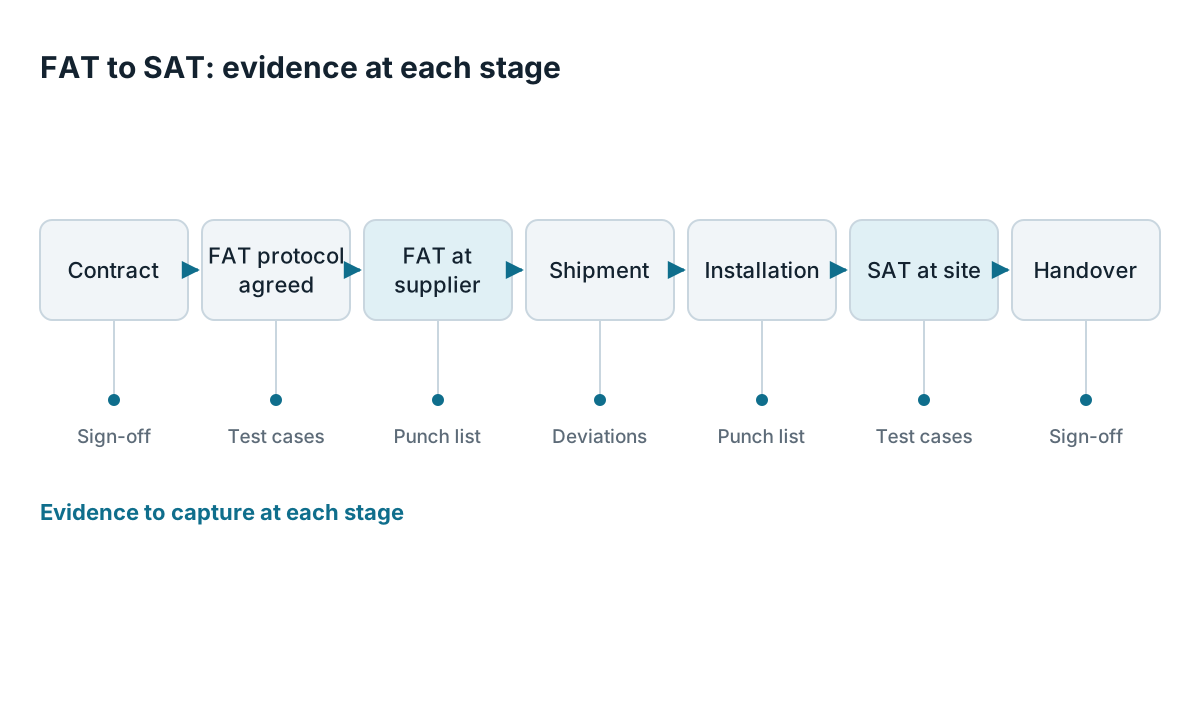
Read the timeline as a chain. If an early link is weak, such as a protocol that was never signed, every later record is harder to defend.
What to agree before the purchase order
The protocol. Attach a draft FAT protocol and SAT protocol to the contract, or at least a list of test cases with the agreed method to finalize them. Each test case should state its purpose, setup, steps, expected result and acceptance criterion in terms someone else could check.
Test materials. Decide who supplies cartons, shippers, liners, labels, refrigerant packs and any dummy product, and whether they must match production material. A machine that runs cleanly on supplier-chosen cartons proves little about your tolerance range. If the machine handles gel packs, see how gel pack filling and sealing differs from carton handling, since fill, seal integrity and leakage checks need their own test cases.
Sampling and run length. Agree how many units, how many cycles and what mix of formats make a run meaningful, and write the number in the protocol. If it says “sufficient quantity”, the two sides will interpret that at the test.
Witnesses and roles. Name who attends from each side and who has authority to accept a result, record a deviation or stop a test.
Instruments. List the measuring devices used in testing, such as scales, torque tools, thermometers and vision checks, and ask for their calibration records. The guide on calibration certificates explains how to read them. ISO/IEC 17025 describes the competence of calibration laboratories, so ask whether certificates come from a laboratory working to it, and check the current edition.
Documents due at FAT. Decide which documents must exist before FAT starts: drawings, manuals, electrical diagrams, parts lists, safety documentation and software description. Documents missing at FAT point to weak project control.
Test case categories to include
Not every machine needs every category, so choose by risk.
- Mechanical and safety: guards, interlocks, emergency stops, access points. ISO 12100 describes machinery risk assessment, and the supplier should be able to show the assessment they used.
- Controls and alarms: alarm triggering and reset, recovery after power loss, manual and automatic modes, access levels.
- Performance: speed and reject behavior on agreed samples, including worst-case formats from your RFQ.
- Format changeover: time taken and settings reproduced, by an operator from your team where possible.
- Data and software: label content, barcode readability, data export, audit trail and backup. For software functions, risk-based approaches such as GAMP 5 describe testing effort in proportion to risk.
- Line integration: for a machine at the end of a line, check handover, stacking and rejects with the real or simulated neighbors. The guide on end-of-line packout lists the interface points that tend to fail.
- Cleanliness and condition: cleaning access, lubricant choice and the state of the machine on arrival.
Deviations and punch lists
Some tests will fail, so write the rules for failure into the document. Agree these in advance.
- A deviation is recorded when a result does not meet the acceptance criterion, with a number, a description and a date.
- Each deviation gets an owner, a corrective action and a retest rule.
- Retests are on the buyer’s list of witnessed items when the failure affects a critical function.
- Items that do not block shipment go on a punch list with dates, and are closed at SAT or earlier.
- Changes to the machine after FAT, including software changes, require a written change record and a decision on which tests to repeat.
- The agreement states who pays for retests and for travel.
Typical disputes, and how an early agreement prevents them
| Dispute | Likely cause | Prevention |
|---|---|---|
| Machine passes FAT but fails SAT on speed | Different cartons or ambient conditions | Use production-representative materials and state environment assumptions |
| “Accepted” machine with open punch items | No rule on what blocks acceptance | Classify items as blocking or non-blocking in the protocol |
| Supplier claims the test was informal | No signed protocol | Sign the protocol before testing |
| Documents delivered after payment | Documents not tied to milestones | Link payment to document delivery |
| Argument over software changes after FAT | No change control | Write a change procedure into the contract |
| Warranty starts at shipping | Silent contract | State the start event |
Handover at SAT
Closing SAT is a handover, so agree what the package contains: signed protocols, final deviation list, as-built drawings, calibration records for installed instruments, training records, spares list and maintenance schedule. Keep copies of the originals. After handover, the owning function takes over change control.
Pre-purchase checklist
- FAT and SAT protocols, or a method to finalize them, are attached to the contract.
- Each test case has a purpose, steps, expected result and a measurable acceptance criterion.
- Test materials are specified, including worst-case formats.
- Sample sizes and run lengths are written as numbers.
- Witnesses and sign-off authority are named for both sides.
- Test instruments are listed, with calibration records requested.
- Documents due before FAT and at handover are listed.
- Deviation, punch list and retest rules are agreed, with cost responsibility.
- Change control after FAT is defined.
- Payment milestones and warranty start are tied to acceptance events.
Limitations of this guide
This guide offers a structure and is not a validated procedure. It does not state what tests a particular machine needs, what values count as passing or how much of your qualification FAT may replace. Regulated products, food contact and export markets can add requirements. Standards are mentioned by name and purpose only: read the current versions and agree the approach with your quality, safety and legal teams before you rely on any of this in a contract.
Related guides

What a Temperature Sensor Calibration Certificate Should Tell You
Check a temperature sensor calibration certificate for device identity, range, dates, reference traceability and results before you accept a logger.
Read guide
How to Specify a Gel-Pack Filling and Sealing Process
How to define refrigerant, film, fill quantity, sealing and cleaning requirements before you ask suppliers about gel-pack filling and sealing equipment.
Read guide
Cartoning, Case Packing and Case Sealing in a Cold Chain Packout Line
How retail cartoning, shipping case packing, case sealing and insulated packaging steps differ in a cold chain line, and what to check at each interface.
Read guide
Cold Chain Equipment Procurement: A Practical RFQ Checklist
Turn capacity, environment, interfaces, evidence, service and acceptance needs into a clear RFQ, with a copy-ready field table for packout equipment buyers.
Read guide