
Data Logger Calibration Frequency: Setting and Reviewing the Interval
Set and review temperature data logger calibration frequency using governing documents, risk inputs, intermediate checks and as-found drift records.
Why a calendar habit is not a calibration interval plan
Letting a reusable logger run on an unexamined calendar habit can leave months of shipment or storage records open to rejection when an out-of-tolerance sensor turns up at recalibration. Set temperature data logger calibration frequency by linking the governing requirement, initial deployment risk, intermediate check schedule, and as-found drift history on one reviewable record.
A temperature data logger calibration frequency is a risk- and document-controlled period between successive traceable calibrations for a reusable device, supported by intermediate checks and verified against historical as-found results. In the World Health Organization’s May 2015 transport monitoring supplement (Section 2.2), single-use loggers are supplied with a manufacturer’s calibration certificate across their designed operating range and cannot be recalibrated, whereas multiple-use devices are calibrated against a certified, traceable reference standard once a year unless otherwise justified. Under NIST’s calibration interval Q&A (updated 29 May 2026) and ILAC-G24:2022 / OIML D 10:2022 (Sections 4–6), neither organization sets a universal interval for all instruments; your initial period and any revision follow your governing documents, operating severity, intermediate checks, and recorded drift.
This guide sits in the temperature monitoring section and complements our sensor calibration certificate review checklist. While the certificate checklist inspects one document before accepting a sensor, the worksheets below help quality and monitoring leads justify, maintain, and review the recalibration schedule across a device’s service life.
Separate the three primary documents before setting a due date
Quality teams frequently encounter three public reference documents when defending a calibration schedule. Each document addresses a different audience and carries specific limits that belong on your procedure file before you assign a number of months.
Table: scroll horizontally if needed to see every column.
| Reference document and date | Target audience and scope | What it states on calibration intervals | Boundary to record in your procedure |
|---|---|---|---|
| WHO TRS 961 Annex 9, Supplement 15 (May 2015, Sections 1.1, 2.2, 2.2.1) | Shippers and logistics stakeholders handling time- and temperature-sensitive pharmaceutical products (TTSPPs) in transport | Single-use devices come with a manufacturer certificate covering their full design range and cannot be recalibrated. Multiple-use devices should be calibrated against a certified, traceable reference standard once a year, unless otherwise justified. | Model international guidance for pharmaceutical transport; does not automatically establish US statutory compliance or override a stricter service level agreement (SLA). |
| NIST Recommended Calibration Interval FAQ (Created 7 Jan 2010; Updated 29 May 2026) | General public and metrology users asking whether NIST mandates fixed intervals | In general, NIST does not require or recommend any set recalibration interval. Specific intervals depend on customer accuracy requirements, contract or regulation, inherent device stability, and environmental factors. | Internal measurement assurance (control charts, as-submitted and post-calibration data) is recommended in the absence of external requirements; it never cancels a contract, regulation, or manufacturer rule. |
| ILAC-G24:2022 / OIML D 10:2022 (Edition 2022, Sections 1.2, 2.1, 4–6) | Testing and calibration laboratories, conformity assessment bodies, and other parties (such as manufacturers) using measuring equipment | No single best practice fits all equipment. Initial intervals rely on a 14-factor risk assessment (Section 5.1); ongoing review uses historical calibration data and intermediate checks (Sections 4.9–4.10, 6.1–6.7). | Fixed intervals without ongoing review are not recommended unless specified in a normative document, specified method, or consensus standard (Section 6.1). |
Keep three boundaries explicit when writing an internal SOP:
- Single-use versus multiple-use hardware: WHO Supplement 15 Table 1 (Section 2.2.1, footnote 5) notes that regular calibration applies only to multiple-use devices such as reusable electronic data logging monitors (EDLMs), reusable electronic data integrators (EDIs), and fixed vehicle monitoring systems (TMELs). Disposable chemical indicators, single-use electronic temperature indicators (ETIs), and single-use USB loggers are retired after their trip and are never entered into a recalibration loop.
- External mandates take precedence: NIST’s statement that it does not set a universal recalibration interval cannot be cited to drop an annual calibration clause written into a customer SLA, a quality agreement, a national immunization program rule, or a manufacturer instruction required to maintain stated uncertainty.
- Certificate review is separate from interval review: Checking whether an individual certificate shows the right points, expanded uncertainty, and decision rule belongs on the calibration certificate checklist. This page governs when the next calibration falls due and what happens between calibrations.
Map the five-step decision chain: from governing document to review owner
Use the worksheet below to connect the governing rule, initial interval choice, intermediate check plan, as-found evaluation, and review responsibility on one sheet. Copy the table into your equipment register for each logger family or individual serial number, and leave the project column blank until the underlying document is in hand.
Table: scroll horizontally if needed to see every column.
| Lifecycle stage | Decision or record field | Primary basis to verify | Assigned role | Project entry (leave blank until verified) |
|---|---|---|---|---|
1. Governing document (适用文件) |
Contract, SLA, regulatory rule, normative standard, or internal SOP governing the device | WHO Supp. 15 Sec. 1.1 (SLA/SOP); NIST FAQ (contract/regulation); ILAC-G24 Sec. 5.1(n) & 6.1 | Quality / compliance lead | |
| 2. Device eligibility & configuration | Single-use (retire after trip; no recalibration) vs. multiple-use; integral sensor vs. detachable external probe | WHO Supp. 15 Sec. 2.2 & Table 1; ILAC-G24 Sec. 4.10 Note 1 & Sec. 5.1(b) | Monitoring engineer | |
3. Initial interval choice (初始周期) |
Starting calendar period or usage limit prior to accumulating multi-cycle history, plus documented risk factors | WHO Supp. 15 Sec. 2.2 (1 year unless justified); ILAC-G24 Sec. 5.1(a)–(n) & Sec. 5.2 | Technically competent owner / metrology lead | |
4. Intermediate check plan (中间核查) |
Check frequency between calibrations, reference check standard used, check temperature(s), and predetermined pass limit | ILAC-G24 Sec. 4.1 Note, Sec. 4.9, Sec. 4.10 & Sec. 5.1(k) | Site operations / metrology technician | |
5. As-found & pre-use release (as-found结果) |
Numerical as-found deviation and uncertainty at each point before adjustment; pass/fail check against predetermined limits prior to re-approving for service | NIST FAQ (“as submitted” & “post calibration” data); ILAC-G24 Sec. 3.2, 4.2(c) & 4.10 | Quality reviewer / equipment custodian | |
6. Interval review & trigger (复核责任) |
Chosen review method (ILAC-G24 Sec. 6.2–6.6), event triggers (drift, physical shock, repair, adjustment), and sign-off to keep, shorten, or adjust the interval | ILAC-G24 Sec. 6.1–6.7; NIST FAQ (control charts & historical refinement) | Quality manager & metrology reviewer |
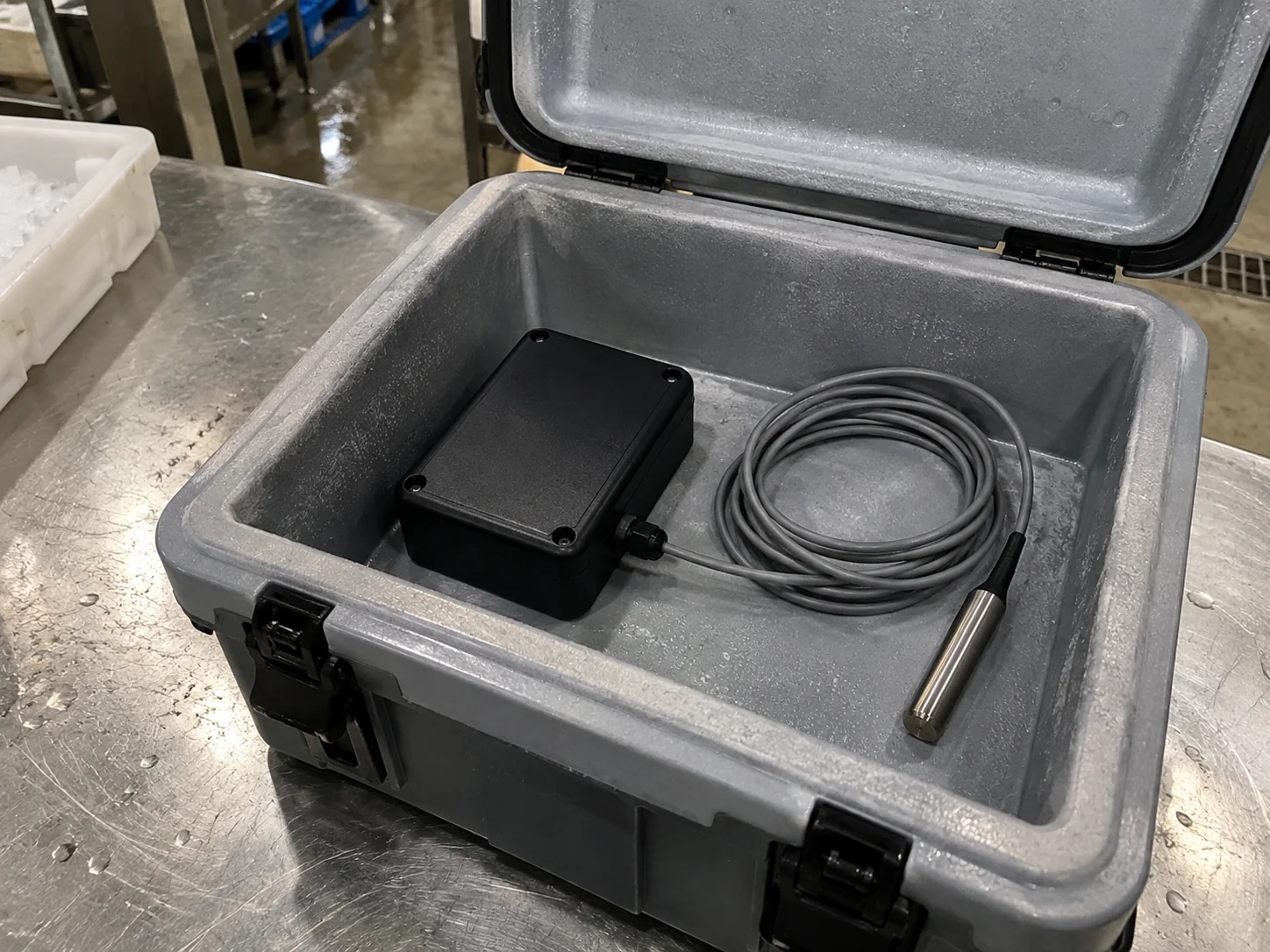
The photograph shows a reusable logger enclosure and probe in an open insulated container. It does not represent a tested model or a recommended interval.
Record the risk inputs that justify your initial calibration interval
When a reusable logger model enters service with no local calibration history, ILAC-G24:2022 / OIML D 10:2022 Section 5.1 states that the initial recalibration interval should be based on a risk assessment performed by personnel with relevant technical competence (Section 5.2). Rather than writing “12 months—industry standard” with no supporting detail, record the specific factors from Section 5.1(a)–(n) that apply to your cold-chain workflow:
- Required measurement uncertainty and maximum permissible error (Section 5.1(a), (c)): Tighter accuracy margins leave less room for instrumental drift before the sensor exceeds its predetermined limit. Define those bounds when specifying the device using the data logger selection guide.
- Equipment type, components, and manufacturer recommendations (Section 5.1(b), (d), (e)): Record whether the logger uses an internal sensor or a detachable external probe, and capture the manufacturer’s stated stability and recommended calibration interval. Under Section 4.10 Note 1, if a logger body and an external temperature probe are calibrated separately, the combined standard measurement uncertainty comes from both components, and the interval review applies to the whole system or its individual components.
- Extent, severity of use, and environmental conditions (Section 5.1(f), (g), (h), (l)): A fixed warehouse probe operating in a stable chilled room experiences different mechanical and thermal stress than a portable transit logger cycled repeatedly between ambient packout benches,
-20 °Cor dry-ice shippers, vibrating road freight, and air-cargo handling. - New equipment precaution (Section 6.1): ILAC-G24 Section 6.1 explicitly recommends calibrating new measuring equipment more frequently at first to identify performance trends before settling into a longer routine schedule.
- Staff training and procedure adherence (Section 5.1(m)): Record how operators handle probes at packout and receiving, and whether damaged cables or dropped loggers are quarantined immediately.
Use intermediate checks to bound exposure between formal calibrations
A 12-month recalibration interval means that if a logger returns from the calibration laboratory with an out-of-tolerance as-found (“as submitted”) reading and no check occurred during the year, every shipment record or freezer log collected since the previous calibration certificate is called into question.
ILAC-G24:2022 / OIML D 10:2022 addresses this exposure window in two linked clauses:
- Section 4.9 (Intermediate checks): The organization should maintain an appropriate system of intermediate checks to confirm the correct functioning and calibration status of measuring equipment between formal calibrations.
- Section 4.10 (Approval for further use): The organization should verify whether the results of external calibration and/or intermediate checks fall within predetermined limits prior to approving the measuring equipment for further use.
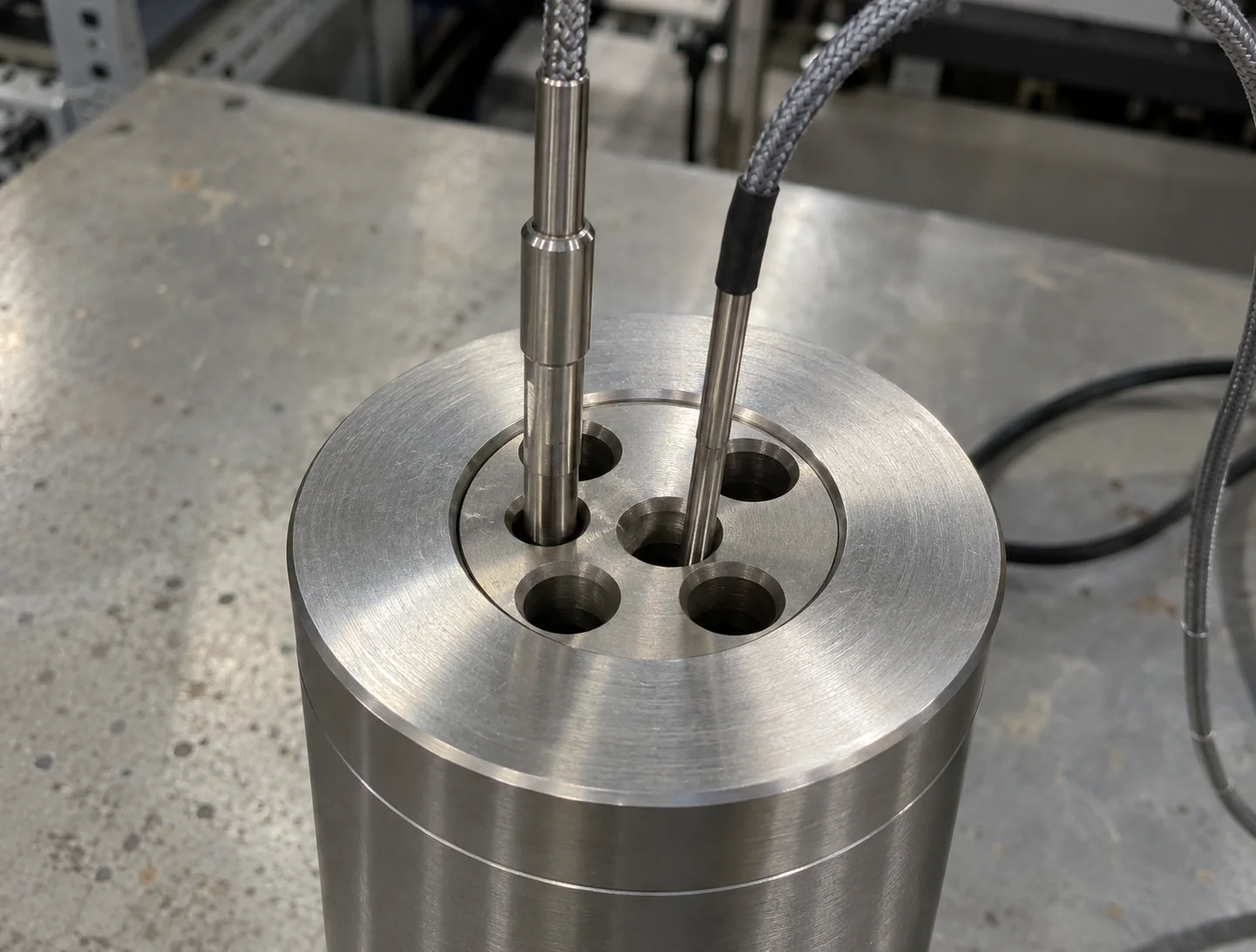
The photograph shows two probes seated in a metal block. It does not depict an accredited calibration procedure or a numerical test result.
When you add intermediate checks to your cold-chain monitoring program, keep three operational distinctions clear:
- An intermediate check does not replace traceable recalibration: Comparing a logger against a check standard or portable dry-well between trips (or before a temperature mapping study) verifies that the unit has not suffered gross drift or mechanical damage since its last certificate. It bounds the look-back window if a failure occurs later, but it does not issue a new metrological calibration certificate.
- The check equipment itself needs calibration control: As noted in ILAC-G24 Section 6.5 (Method 4), portable check gear or a reference probe used for in-service checking can also drift and requires its own periodic recalibration and review schedule.
- Quarantine before reuse: Under Section 4.10, a logger that exceeds predetermined limits during an intermediate check—or returns from a trip with a pinched probe cable, cracked casing, or unexplained monitoring data gap—must be held out of service until full calibration and impact review are completed.
Choose an interval review method that fits cold-chain loggers
Once a logger or group of identical loggers has accumulated consecutive calibration records, ILAC-G24:2022 / OIML D 10:2022 Section 6 describes five methods for reviewing and adjusting the recalibration interval. No single method fits every operation (Section 4.6, Section 6.7 Table 1). Compare their mechanics and documented limitations before writing a review rule into your SOP:
Table: scroll horizontally if needed to see every column.
| ILAC-G24 / OIML D 10 review method | How the review works (Sections 6.2–6.6) | Table 1 grading (Reliability / Effort) | Documented limitation for cold-chain loggers |
|---|---|---|---|
| Method 1: Automatic adjustment or “staircase” (calendar-time) (Sec. 6.2) | Extends or keeps the interval when as-found deviation stays within a defined percentage of maximum permissible error (MPE); shortens the interval when deviation exceeds that threshold. | Medium reliability / Low application effort | High look-back risk if stretched: Section 6.2 warns that setting an extremely long interval creates unacceptable risk of withdrawing large numbers of reported results or repeating work if a later calibration fails. |
| Method 2: Control chart (calendar-time) (Sec. 6.3; NIST FAQ) | Plots calibration results at chosen temperature points against time to calculate dispersion and mean instrumental drift over one or more intervals. | High reliability / High application effort | Requires historical data across multiple cycles and knowledge of device variability; unsuitable for instruments without continuous drift behavior. |
| Method 3: “In-use” time (service hours) (Sec. 6.4) | Tracks elapsed operating hours rather than calendar months and recalibrates when the timer reaches a set hour threshold. | Medium reliability / Medium application effort | Poor fit for transit loggers: Section 6.4(b) and (d) warn that in-use time is unsuitable for equipment that drifts on the shelf or undergoes handling and short on-off cycles, and makes due-date scheduling unpredictable. |
| Method 4: In-service checking or “black box” testing (Sec. 6.5) | Checks critical parameters frequently with portable gear or a check standard; sends the unit for full calibration/adjustment when outside limits. | High reliability / Low application effort | High availability for geographically distant devices, but the check gear might not test every failing parameter and requires its own recalibration interval. |
| Method 5: Other statistical approaches (group analysis) (Sec. 6.6) | Evaluates large groups of identical measuring instruments statistically (referencing NCSL RP-1) with appropriate software tools. | Medium reliability (higher with software) / High effort | Applicable only when managing homogeneous fleets of the exact same model and application conditions. |
Why “as-found” data and adjustments govern every review
Both the NIST FAQ and ILAC-G24 Section 6.1 emphasize that interval reviews depend on as-found (“as submitted”) data—the deviation measured across your operating points before any adjustment is performed:
- Calibration versus adjustment (ILAC-G24 Sections 3.2 and 3.3): Calibration establishes the relation between the reference standard and the logger’s indication. Adjustment alters the measuring system so its indications align closer to the reference. Under Section 3.2 Note 3, after an adjustment is made, the measuring system must usually be recalibrated.
- When a logger is adjusted at every annual calibration: If a lab adjusts a sensor back to zero error every year, comparing only post-adjustment (as-left) numbers hides how far the sensor drifted during the elapsed interval. Your interval review must compare the as-found reading at calibration $N$ against the as-left reading from calibration $N-1$.
- Triggers that force an immediate interval review: Regardless of calendar schedule, review the interval whenever (1) an as-found reading exceeds or approaches maximum permissible error, (2) an intermediate check fails, (3) the logger undergoes physical repair, sensor replacement, or adjustment (Section 6.1(d)–(e)), or (4) the deployment environment shifts (for example, moving a chilled-warehouse logger into ultra-low freezer service, covered in remote freezer monitoring).
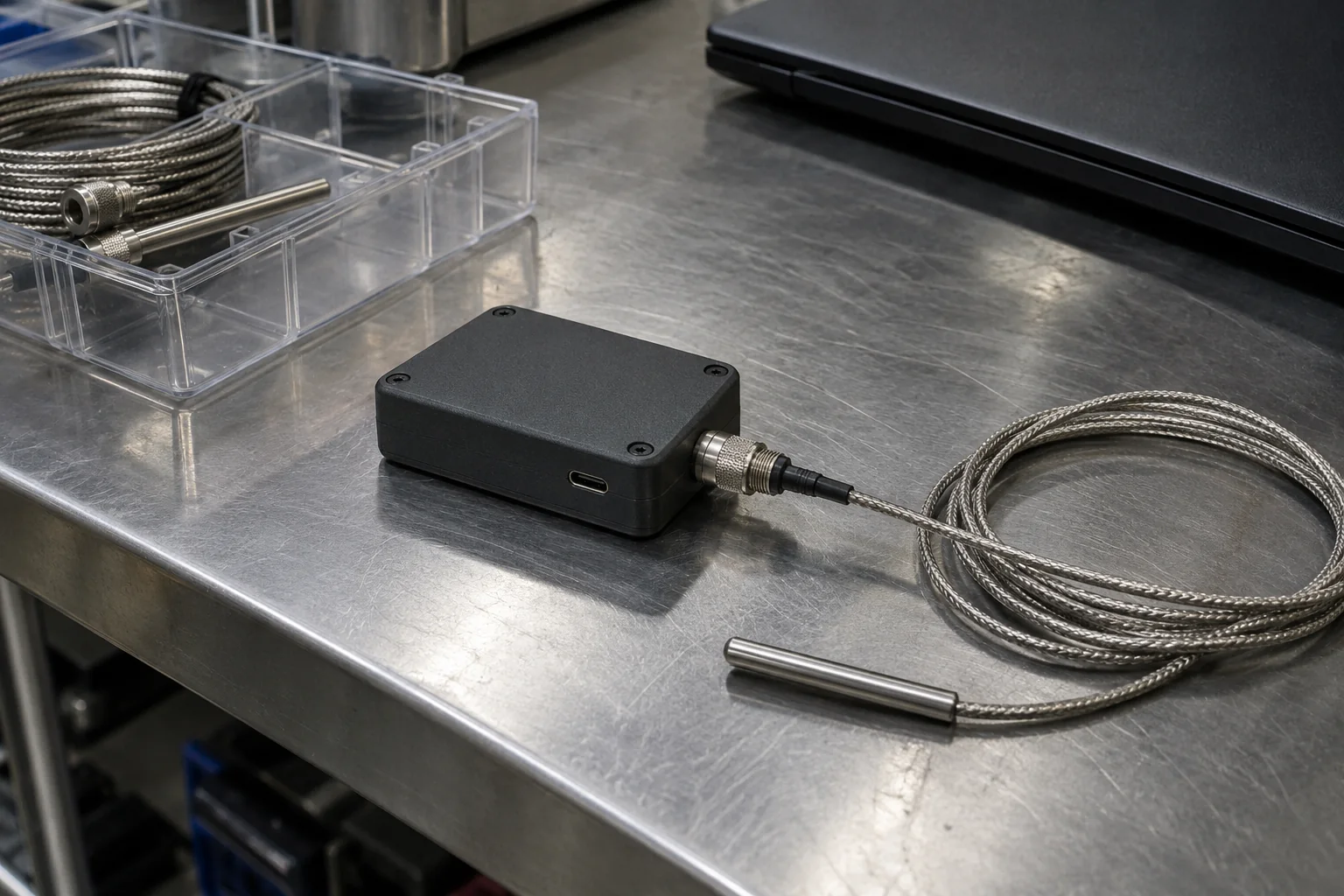
The photograph shows an unplugged logger and cable on a workbench. It shows no calibration certificate and no drift measurement.
Copyable blank calibration interval history and review log
Copy the blank log below into your quality system to track consecutive calibration cycles, intermediate checks, and as-found drift for each reusable logger.
- No universal months or automatic extension rules: This publication provides no default number of months and no automatic rule (such as “double the interval after two passes”). Every cell remains blank until populated from your governing documents, intermediate check logs, and laboratory certificates.
- Verify release before deployment: In accordance with ILAC-G24 Section 4.10, complete the pre-use approval column before returning a calibrated or checked logger to active stock.
Table: scroll horizontally if needed to see every column.
| Cycle / event ID | Device & probe serial ID | Governing doc & current interval | Intermediate check date, reference ID & result | Calibration date & certificate ref | Point (°C), as-found deviation & expanded uncertainty ($U$) | MPE / acceptance limit & decision rule | Adjusted or repaired? (Yes/No & as-left ref) | Pre-use release approved by & date | Interval review decision (Keep / Shorten / Extend), next due date & approver |
|---|---|---|---|---|---|---|---|---|---|
Verify the responsible owner and original documents
Before changing any due date in your equipment register, complete three checks with your quality and metrology staff using the tables on this page:
- Confirm the governing document first: Pull the customer SLA, regulatory requirement, or internal SOP (WHO Supplement 15 Section 1.1) and verify whether a fixed maximum interval (such as 12 months for multiple-use pharmaceutical transport loggers under WHO Supplement 15 Section 2.2) is mandated. Do not use a general metrology FAQ to override a binding specification.
- Audit the individual certificate before logging history: Use the temperature sensor calibration certificate checklist to confirm that the certificate matches the physical serial number, covers your operating temperature range, states measurement uncertainty, and reports numerical as-found values.
- Assign one named role to pre-use release and interval review: Record who reviews intermediate checks and external calibration results prior to approving the logger for further use (ILAC-G24 Section 4.10), and who holds authority to shorten or adjust the recalibration interval when drift or operating severity changes.
Prepared by Cold Chain Practice Editorial Desk.
Related guides
What a Temperature Sensor Calibration Certificate Should Tell You
Check a temperature sensor calibration certificate for device identity, range, dates, reference traceability and results before you accept a logger.
Read guide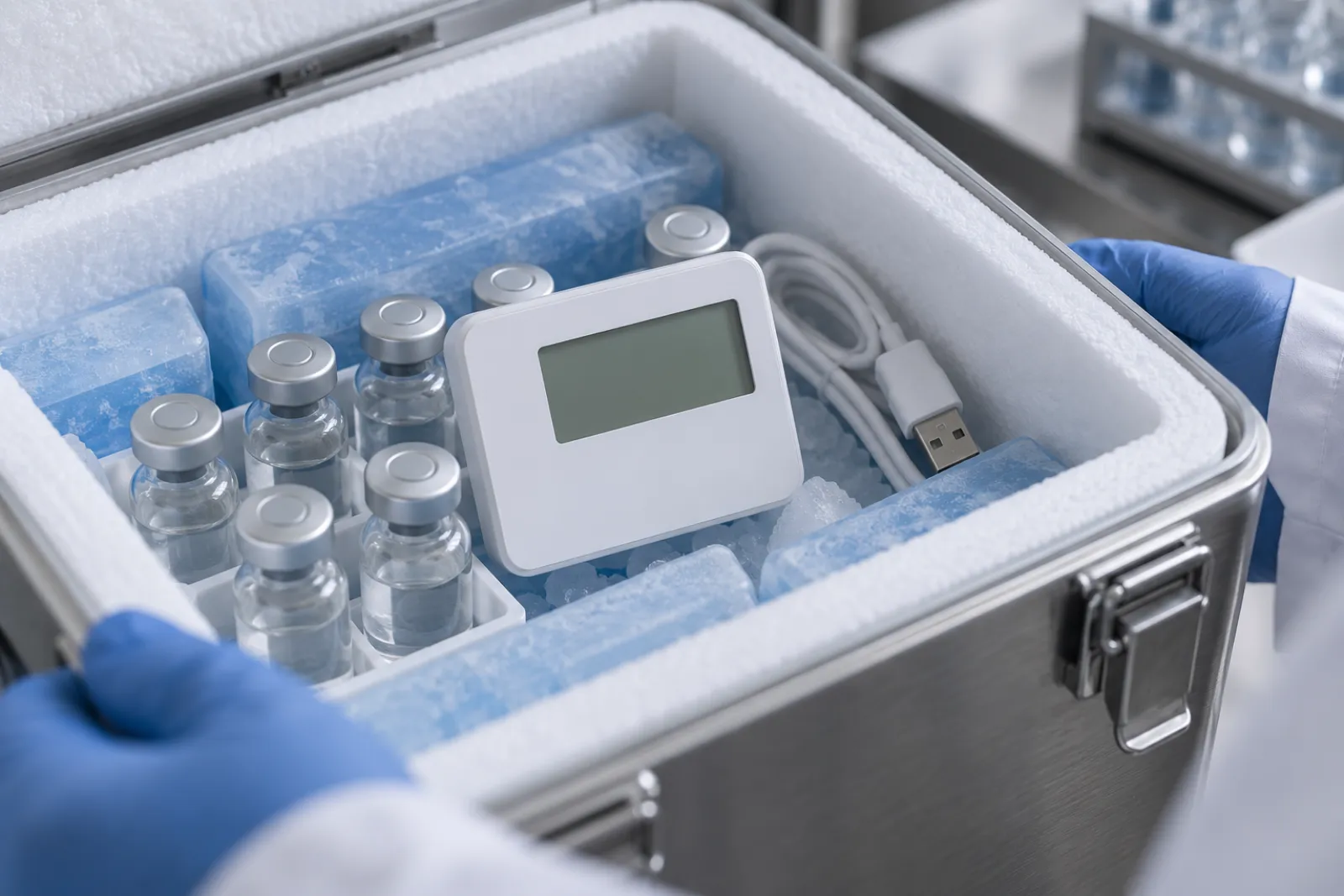
How to Specify a Cold Chain Temperature Data Logger
A specification checklist for a cold chain temperature data logger: range, accuracy, logging interval, export method and calibration documents to request.
Read guide
Remote Freezer Monitoring Systems: Architecture, Probes, and Compliance
How to select remote freezer monitoring for ULT freezers and cold rooms: probe types and rated ranges, wireless options, power-loss buffering, alarm escalation and where 21 CFR Part 11 applies.
Read guide
Temperature Mapping vs Shipment Monitoring: Different Questions, Different Evidence
Separate facility temperature mapping from shipment monitoring: the questions each answers, the evidence each produces and where buyers mix them up.
Read guide